Wet wipes causing sewer blockages statistics tell one story in every country that counts them. A wipe does not fall apart like toilet paper. It catches on a rough pipe wall or a pump, grease glues more waste to it, and a small clog becomes a call-out for a crew or a plumber.
The numbers below come from regulators, city sewer agencies, water companies, labs and legislatures. Most of the hard counts come from UK water companies, because they publish them. US cities publish fewer, and the US data leans on grease and heavy rain, so this page keeps the two apart and says which is which.
If you run a plumbing shop, you meet this problem at the private end of the pipe. The customer calls about a slow drain or a backup, and the first job is to learn whether the clog is in the house line or in the public sewer. These figures show how often each happens and what it costs.
Key Takeaways
- Blockages were the reported cause of 48% of US sanitary sewer overflow events with a known cause. (EPA, Report to Congress on CSOs and SSOs, Aug 2004)
- Of 35,178 sewer-abuse blockages Thames Water cleared in 2025 to date, 23,556 were wipe related. (Thames Water, Aug 2025)
- Sydney Water says non-flushable wet wipes contribute to 75% of its wastewater blockages. (Sydney Water, Oct 2026)
- Between 2.1 and 2.9 billion wet wipes are flushed down UK toilets each year. (Defra, May 2023)
- In a test of 101 consumer products, every product except bathroom tissue failed the disintegration test, including 23 labelled flushable. (Water Science and Technology, Jan 2020)
- Wipes made up 12% of the solids in a sewer but almost 50% of the solids causing pump blockages in a Berlin study. (Defra Impact Assessment, Sep 2025)
- New York City spends about $18.8 million a year to degrease sewers, handle backups and repair plant equipment damaged by non-flushable items. (NYC DEP, Oct 2026)
- The 2017 Whitechapel fatberg was 250 metres long and weighed an estimated 130 tonnes. (London Museum, Oct 2026)
- A 120-tonne fatberg more than one kilometre long was cleared from an Oxford trunk sewer in two weeks. (Thames Water, Aug 2025)
- A flushable wipe’s dispersibility fell below 10% after two weeks of wet storage. (Scientific Reports, Apr 2021)
- UK wet wipe sales grew 2.1% a year between 2012 and 2021. (Defra Impact Assessment, Sep 2025)
- The US House passed the WIPPES Act on June 23, 2025, which would require a “Do Not Flush” label on covered wipes. (US Congress, H.R. 2269, Jun 2025)
- England bans the sale of single-use wipes that contain plastic from 19 May 2027. (Defra, Dec 2025)
Sewer Blockage Statistics: How Much Do Wipes Contribute?
In the UK the answer is most of it. Water companies, a national industry study and the government all land between 60% and 94%, depending on who counts and where.
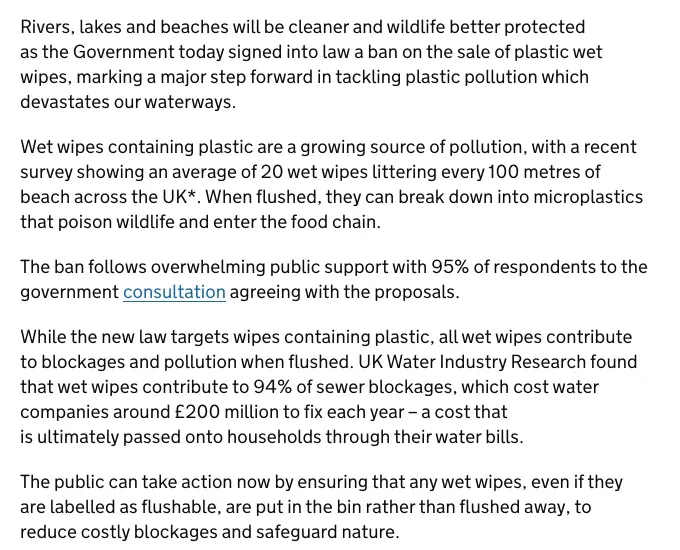 Figure 1: The UK government attributes 94% of sewer blockages to wet wipes and puts the yearly clearing bill near £200 million. Source: Defra, New law bans plastic wet wipes to protect rivers and seas, Nov 2025. Screenshot of the source page, captured 21 Oct 2026.
What share of UK sewer blockages involve wipes?
UK Water Industry Research found that wet wipes contribute to 94% of sewer blockages, which cost water companies around £200 million a year to fix (Defra, Nov 2025).
- A 2017 study of UK blockages found non-flushable wipes could make up around 93% of the material causing some blockages (Severn Trent, Jan 2018).
- EDANA cites a study of sewer blockages that found less than 1% of the blockage material was identified as products designed to be flushed (EDANA, Feb 2019).
- In over 50 blockages examined, no wipe that met the industry GD4 flushability guideline was identified (EDANA, Feb 2019).
- Water UK research cited by the government reports wipes’ prevalence at wastewater treatment works at 89% by weight and 65% by number (Defra, May 2023).
- The UK has about 300,000 sewer blockages a year, with around 45,000 in the Severn Trent region (Severn Trent, Jan 2018).
What do individual water companies report?
Company counts run lower than the national figure, because they count blockages from all causes and some count only the ones they can trace. Even so, wipes sit at or near the top of every list.
- Northumbrian Water says flushed wipes contribute to more than 60% of sewer blockages in the North East of England (Northumbrian Water, Oct 2026).
- Wessex Water deals with around 13,000 blockages a year, and around 75% of them involve disposable items (Wessex Water, Oct 2026).
- South West Water says about three-quarters of the 7,000 avoidable blockages it cleared in 2024/25 were caused by wipes and fats (South West Water, Nov 2025).
- Welsh Water says 40% of its wastewater pollution incidents are caused by sewer blockages, most directly caused or worsened by wet wipes (Welsh Water, Mar 2024).
- Thames Water says 60% of its sewer flooding incidents are caused by sewer abuse (Thames Water, Aug 2025).
- Fats, oils and grease account for 28% of all blockages on the Thames Water network, more than 20,000 a year (Thames Water, Dec 2025).
Do other countries see the same pattern?
Yes. In Melbourne, 1.87 million people flush or drain 2.4 billion litres of wastewater a day, and South East Water lists all types of wipes, even those marked flushable, among the items that cause blockages (South East Water, Oct 2026).
What Causes Sewer Blockages in the United States?
US data points first at grease, then at grit and roots. The country has no national count of wipe-related blockages, which is a gap, not proof that wipes are harmless.
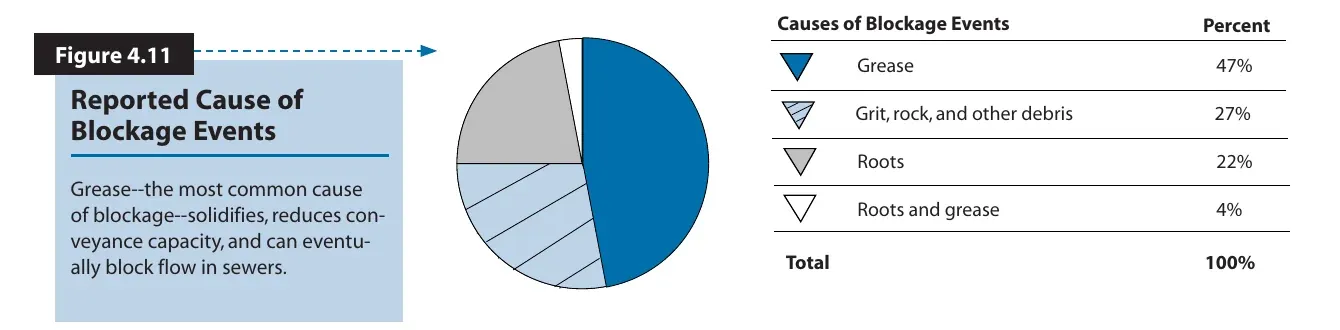 Figure 2: Grease caused 47% of reported blockage events in the EPA’s 2004 national review, ahead of grit and debris (27%) and roots (22%). Source: EPA, Report to Congress on Impacts and Control of CSOs and SSOs, chapter 4, Aug 2004. Chart published by the source, captured 21 Oct 2026.
What does EPA say causes sewer blockages?
Grease from restaurants, homes and industry is the most common reported cause of blockages, at 47% of events (EPA, Aug 2004).
- Grit, rock and other debris account for 27% of reported blockages (EPA, Aug 2004).
- Roots account for 22% of reported blockages, and roots with grease for another 4% (EPA, Aug 2004).
- EPA lists some household products, including some marked flushable such as baby wipes, facial wipes, sanitary pads and tampons, among inappropriate materials that may create blockages (EPA, Apr 2026).
How many sewer overflows happen in the US each year?
EPA estimates at least 23,000 to 75,000 sanitary sewer overflows a year, not counting sewage backups into buildings (EPA, Apr 2026).
- Those overflows release between 3 billion and 10 billion gallons of untreated wastewater a year (EPA, Aug 2004).
- In communities reporting more than 100 overflow events in a year, blockages caused 74% of them (EPA, Aug 2004).
- Nearly three-quarters of overflow events in the arid Southwest were caused by blockages (EPA, Aug 2004).
- Blockage events are small. EPA put their average volume at 5,900 gallons, against 360,000 gallons for wet weather events (EPA, Aug 2004).
- Blockages accounted for only 3% of total overflow volume, while wet weather accounted for 74% (EPA, Aug 2004).
- EPA found that backups into buildings are not widely tracked by permitting authorities (EPA, Aug 2004).
How Many Wipes Are Sold and Flushed?
Sales keep growing, and a share of every pack goes down the toilet. The people who flush are not careless in their own eyes. Many think the label allows it, or they have no bin within reach.
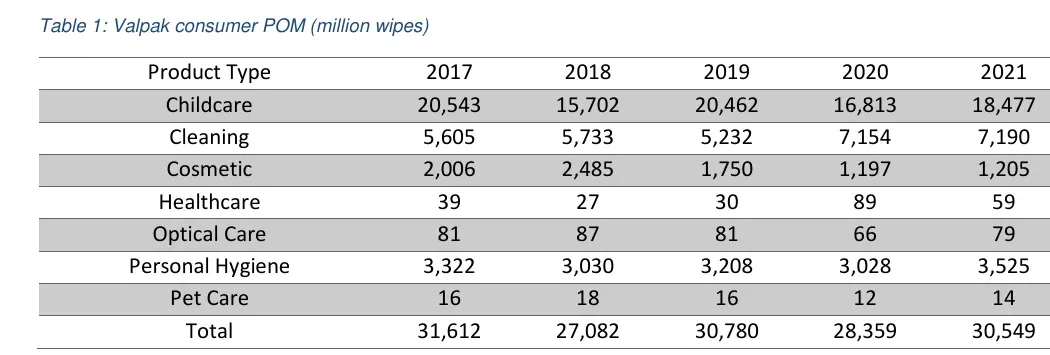 Figure 3: Childcare wipes are the largest product type on the UK consumer market, and the 2021 total is about 30.5 billion wipes. Source: Defra, Impact assessment for the ban on the supply and sale of wet wipes containing plastic in England, Sep 2025. Table of Valpak data, captured 21 Oct 2026 as a crop of the source PDF.
How many wipes are placed on the UK market?
Valpak estimated that 31 billion wet wipes were placed on the UK market in 2021 (Defra Impact Assessment, Sep 2025).
- The government forecasts 49 billion wipes in 2033, of which 39 billion would be sold to consumers (Defra Impact Assessment, Sep 2025).
- Baby wipes make up 60% of consumer wet wipes in the UK (Defra Impact Assessment, Sep 2025).
- The government assumes 38% of wet wipes sold contain plastic (Defra Impact Assessment, Sep 2025).
How many wipes do people flush, and why?
Thames Water says it removes an estimated 3.8 billion wipes from its network each year (Thames Water, Aug 2025).
- 22% of people surveyed by Water UK admitted to flushing wet wipes (Defra Impact Assessment, Sep 2025).
- Men and 18 to 24 year olds were the worst offenders in that Water UK research (Wessex Water, Oct 2026).
- In a 2024 survey, 36% of people who admitted flushing wipes cited convenience, and 14% cited not having a bin in the bathroom (Defra Impact Assessment, Sep 2025).
- A quarter of 2,501 adults surveyed by Thames Water believed disposable wipes were safe to flush (Thames Water, Nov 2025).
- In the same survey, 83% knew that pouring or throwing the wrong items down a sink or toilet can block pipes (Thames Water, Nov 2025).
- Over 30% of people surveyed by the Marine Conservation Society tended not to read disposal information, and 20% had flushed wipes even when they were not labelled flushable (Thames21, Apr 2017).
How fast is wipe litter growing?
The Marine Conservation Society saw a near 7-fold increase in the average litter level of wet wipes on UK beaches over a decade (Thames21, Apr 2017).
- Thames21 reported that wet wipes had increased by 700% over the past decade (Thames21, Apr 2018).
- A recent survey found an average of 20 wet wipes per 100 metres of beach surveyed across the UK (Defra, Apr 2024).
Do Flushable Wipes Break Down?
Mostly they do not, at least not fast enough. A label that says flushable usually means the wipe leaves the bowl, not that it clears the pipe.
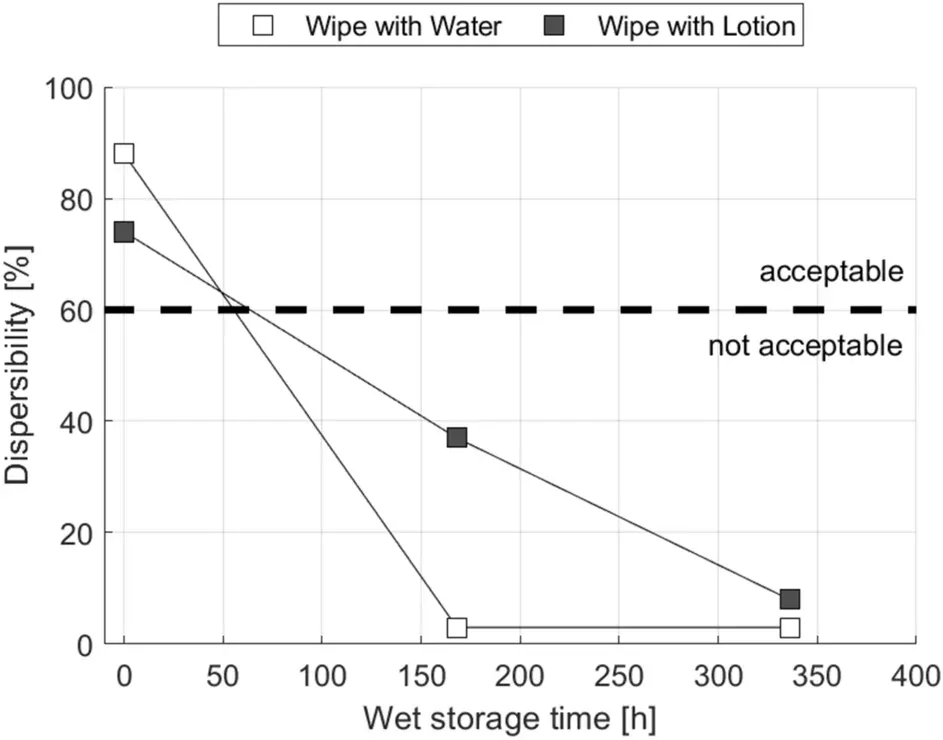 Figure 4: A wipe that starts above the 60% dispersibility line drops far below it within two weeks of wet storage. Source: Scientific Reports, Reduced dispersibility of flushable wet wipes after wet storage, Apr 2021. Chart published by the source under an open license, captured 21 Oct 2026.
What do lab studies find in wipes labelled flushable?
Half of the tested brands labelled flushable were a mixture of PET plastic and cellulose, and the rest were cellulose alone (Water Research, Jun 2020).
- None of the products in a multi-product review met the labelling Code of Practice (Water Science and Technology, Jan 2020).
- Dry flushable wipes needed 7 newtons to break, against 3 newtons for toilet paper (Science of the Total Environment, Aug 2019).
- Wet toilet paper lost 91% of its strength on average, while wet flushable wipes lost 29% (Science of the Total Environment, Aug 2019).
- The dry fabrics in the Scientific Reports test started with dispersibility well above 70%, and the INDA/EDANA guideline asks for at least 60% (Scientific Reports, Apr 2021).
- In a lab test of fat, oil and grease deposits, wet wipes raised deposits to 5.59 mg per mL of cooking oil, against 4.10 for facial tissues (Water Research, Feb 2025).
What do flushability standards require?
The UK water industry specification asks a wipe to pass on 40 occasions before it can carry its approval mark (Water UK, Nov 2019).
- It requires more than 80% of the product mass to pass a 5.6 mm sieve, with no piece larger than 40 mm (Water UK, Nov 2019).
- Any wipe that snags in the test pipe must clear in no more than 7 toilet flushes (Water UK, Nov 2019).
- The industry’s own GD4 guideline has a history of over 15 years of testing, according to EDANA (EDANA, Jun 2019).
- EDANA states that no GD4-compliant flushable wipe contains plastic fibres (EDANA, Jun 2019).
- INDA and EDANA have worked on flushability since 2004, and the deadline to adopt the fourth edition of the guidelines was November 1, 2018 (INDA, Oct 2026).
What do utilities say about flushable claims?
New York City’s sewer agency says a product labelled flushable generally means it will clear the toilet bowl, not that it will break down in the sewer or at a treatment plant (NYC DEP, Oct 2026).
- An independent consumer report in 2014 found a flushable wipe would not break down in water after 10 minutes in a kitchen mixer (EBMUD, Nov 2016).
- WSSC Water in Maryland gives a simple test: if the item does not dissolve like toilet paper or organic waste, it is not flushable (WSSC Water, Nov 2025).
- Welsh Water says its blockage autopsies confirm that so-called flushable wipes still block sewers (Welsh Water, Mar 2024).
Fatberg Statistics: How Big Do They Get?
Fatbergs are what a clog becomes when nobody clears it. Wipes give the mass its frame, and cooking fat sets it like concrete.
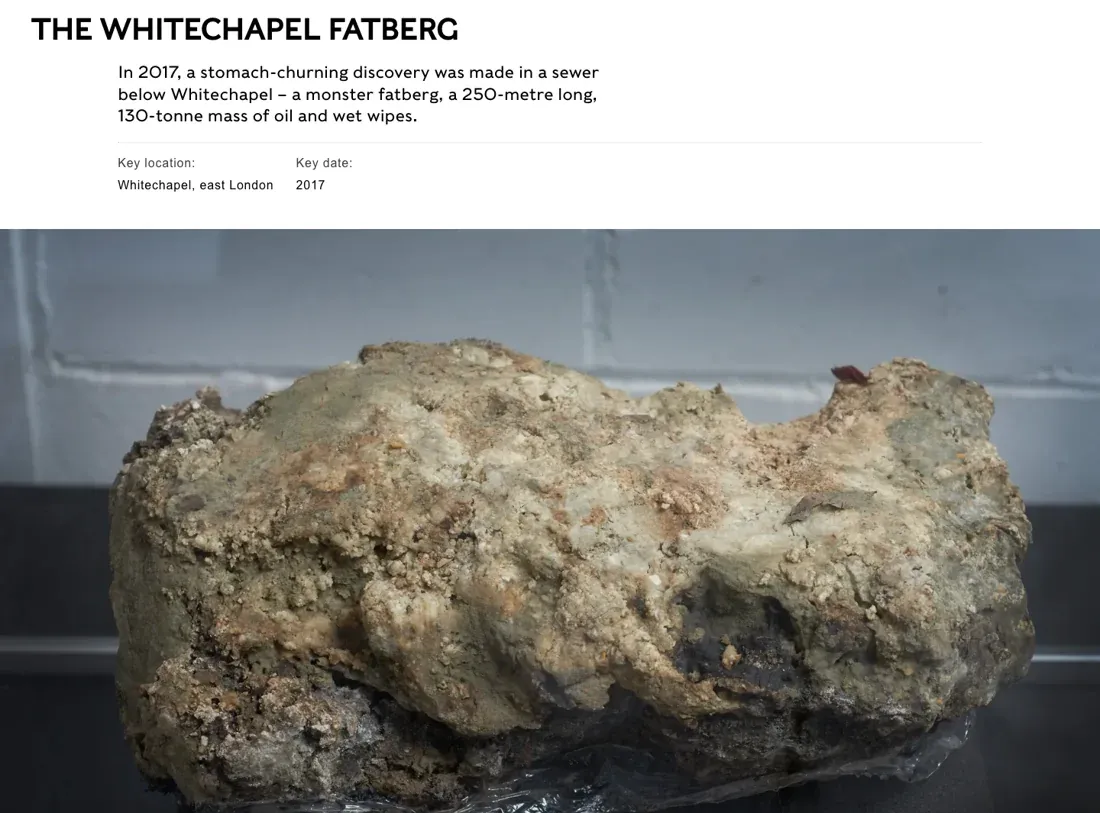 Figure 5: A sample of the 2017 Whitechapel fatberg, which the London Museum describes as a 250-metre, 130-tonne mass of oil and wet wipes. Source: London Museum, The Whitechapel Fatberg, Sep 2017 (discovery date; page read Oct 2026). Screenshot of the source page, captured 21 Oct 2026.
How big was the biggest fatberg?
Wet wipes created the main structure of the 2017 Whitechapel fatberg, which weighed about the same as 11 double-decker buses (London Museum, Oct 2026).
- The mass was found in a routine inspection in September 2017 (London Museum, Oct 2026).
- A sample went to the museum for a world-first display in 2018 (London Museum, Oct 2026).
- United Utilities describes a Liverpool fatberg 250 metres long and 400 tonnes in weight (United Utilities, Oct 2026).
- The Oxford fatberg sat in a trunk sewer 20 metres underground (Thames Water, Aug 2025).
- That job took two weeks (Thames Water, Aug 2025).
- A new Whitechapel fatberg found in 2025 is estimated at around 100 metres and 100 tonnes (Thames Water, Dec 2025).
- In Plymouth, South West Water removed a 50-metre fatberg, over 88 tonnes of debris, in 34 days (South West Water, Apr 2021).
- Wessex Water used jetting equipment to clear wipes from a 400-metre stretch of sewer at Highbridge (Wessex Water, Oct 2026).
How many wipes pile up on riverbanks?
Where sewers overflow, wipes reach rivers and build up on the foreshore. Thames21 counted 5,453 wipes on 116 square metres of foreshore near Hammersmith Bridge, the highest number in a single place in the UK at the time (Thames21, Apr 2018).
- A year earlier, the charity counted and removed 4,500 wipes from 154 square metres at the same site (Thames21, Apr 2018).
- 160 volunteers counted and removed 23,000 wipes from one stretch of foreshore in two hours, filling 473 bin bags (Thames21, Apr 2019).
- The average density on the mounds was 201 wipes per square metre (Thames21, Apr 2019).
- One mound in front of St Paul’s school in Barnes had grown by 0.7 metres and stood more than 1 metre high (Thames21, Apr 2019).
- By 2025 an estimated 180 tonnes of congealed wipes formed an island along a 250-metre stretch of the tidal Thames (Thames Water, Aug 2025).
- Thames Water later said 114 tonnes had been removed from that site (Thames Water, Nov 2025).
- Volunteers had already collected more than 140,000 wipes along the Thames (Thames Water, Aug 2025).
How Do Wipes Affect Pumps, Plants and Sewer Pipes?
Pumps and screens are where wipes do the most damage per item. A wipe twists into a rope, wraps an impeller and stops it. Old pipes make the rest worse.
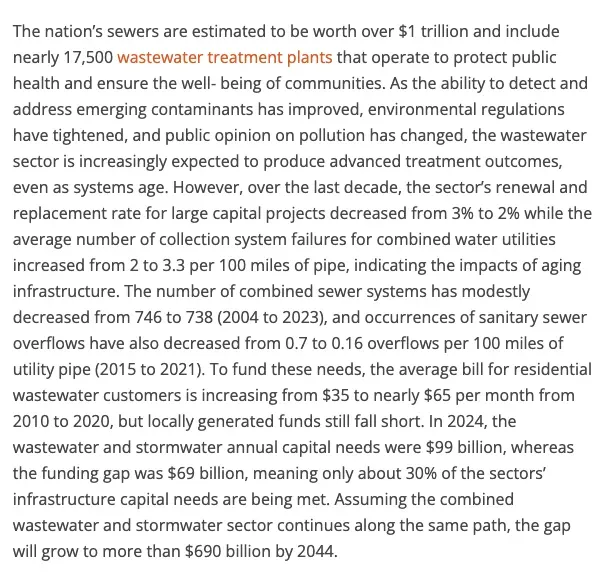 Figure 6: ASCE’s summary of US wastewater infrastructure pairs a falling sewer overflow rate with rising pipe failures and a large funding gap. Source: ASCE, 2025 Report Card for America’s Infrastructure, Wastewater, Mar 2025. Screenshot of the source page, captured 21 Oct 2026.
What do wipes do to pumps and treatment plants?
WSSC Water has spent $2.5 million to install and maintain grinders at wastewater pumping stations to deal with wipes (WSSC Water, Nov 2025).
- San Francisco’s utility calls flushable wipes the biggest headache for its wastewater treatment plants, because they must be removed by hand and sent to landfill (SFPUC, Oct 2026).
- Welsh Water removes around 420 tonnes of plastics a month from its wastewater treatment works (Welsh Water, Mar 2024).
- Severn Trent says its teams remove around two and a half tonnes of unflushables from sewers every year (Severn Trent, Oct 2025).
How big and how old are the pipes involved?
Some sewers are narrow, so a small clog is enough. South West Water says some of its sewers are just 15 cm wide (South West Water, Sep 2025).
- New York City maintains 7,500 miles of sewers that carry 1.3 billion gallons of wastewater a day to 14 treatment plants (NYC DEP, Oct 2026).
- Washington, D.C. has 1,800 miles of sewer lines (DC Water, Oct 2026).
- US sewers are estimated to be worth over $1 trillion and include nearly 17,500 wastewater treatment plants (ASCE, Mar 2025).
- Collection system failures at combined water utilities rose from about 2 to 3.3 per 100 miles of pipe, which ASCE links to aging infrastructure (ASCE, Mar 2025).
- Sanitary sewer overflows fell from 0.7 per 100 miles of pipe in 2015 to 0.16 in 2021 (ASCE, Mar 2025).
- The wastewater and stormwater funding gap was $69 billion in 2024, so only about 30% of capital needs are being met (ASCE, Mar 2025).
- The combined length of urban and rural conveyance pipes grew from 1.3 million miles in 2019 to more than 1.87 million miles in 2024 (ASCE, Mar 2025).
How much is spent in England to prevent blockages?
Water companies in England invested £181.7 million between April 2024 and March 2025 to maintain the public sewer system and prevent blockages and flooding (Environment Agency, Oct 2025).
- They also invested £139.8 million to reduce the risk of sewer flooding to properties (Environment Agency, Oct 2025).
- Another £15.9 million went to property-level protection against sewer flooding (Environment Agency, Oct 2025).
- Business plans for 2025 to 2030 commit to cutting incidents of internal sewer flooding by 27% (Environment Agency, Oct 2025).
What Do Sewer Blockages Cost?
The bill lands in three places: the utility, the ratepayer and the property owner. The first two are published. The third, the cost of clearing a private line, is where a plumber earns the call-out.
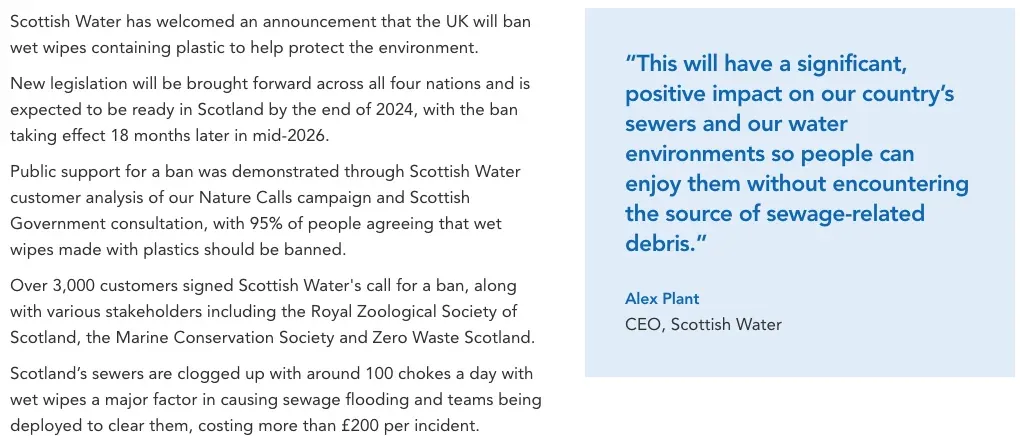 Figure 7: Scottish Water counts about 100 chokes a day and says each one costs more than £200 to clear. Source: Scottish Water, Scottish Water Welcomes UK Plastic Wet Wipe Ban, Apr 2024. Screenshot of the source page, captured 21 Oct 2026.
What does it cost a utility to clear blockages?
Scotland’s sewers have around 100 chokes a day, each costing more than £200 to clear (Scottish Water, Apr 2024).
- Scottish Water says more than £450,000 has been saved through a reduction of more than 5% in choke incidents (Scottish Water, Apr 2024).
- Thames Water clears 75,000 blockages a year from its network at a cost of £18 million (Thames Water, Aug 2025).
- The same utility puts the cost at up to £40 million a year in a later release, so the two figures differ by more than double (Thames Water, Nov 2025).
- Fat, oil and grease clearance can cost Thames Water up to £11 million a year (Thames Water, Nov 2025).
- A seasonal rise in fat blockages in December and January brings Thames Water clearance costs of £2.1 million (Thames Water, Dec 2025).
- Wessex Water spends £5 million a year resolving its blockages (Wessex Water, Oct 2026).
- The Plymouth fatberg cost nearly £100,000 to remove (South West Water, Apr 2021).
- The UK government put the national cost of dealing with wipe-related blockages at £100 million a year in 2023 (Defra, May 2023).
What does a blocked private line cost the property owner?
In New York City, it can cost between $10,000 and $15,000 to repair a sewer line (NYC DEP, Oct 2026).
- Welsh Water clears a public sewer blockage free, but charges £196.81 including VAT to clear a blockage on private pipework (Welsh Water, Oct 2026).
- In Wales, a property flooded with sewage from a public sewer can earn a payment equal to the annual sewerage bill, between £150 and £1,000 per incident (Welsh Water, Oct 2026).
- Melbourne’s South East Water offered plumbers a spotter’s fee for blockages they reported before 1 October 2022 (South East Water, Oct 2026).
Sewer Backup Statistics: How Often Do Homes Get Hit?
Backups are the part customers feel. No US agency counts the ones that start inside the house, so city complaint logs are the best proxy there is.
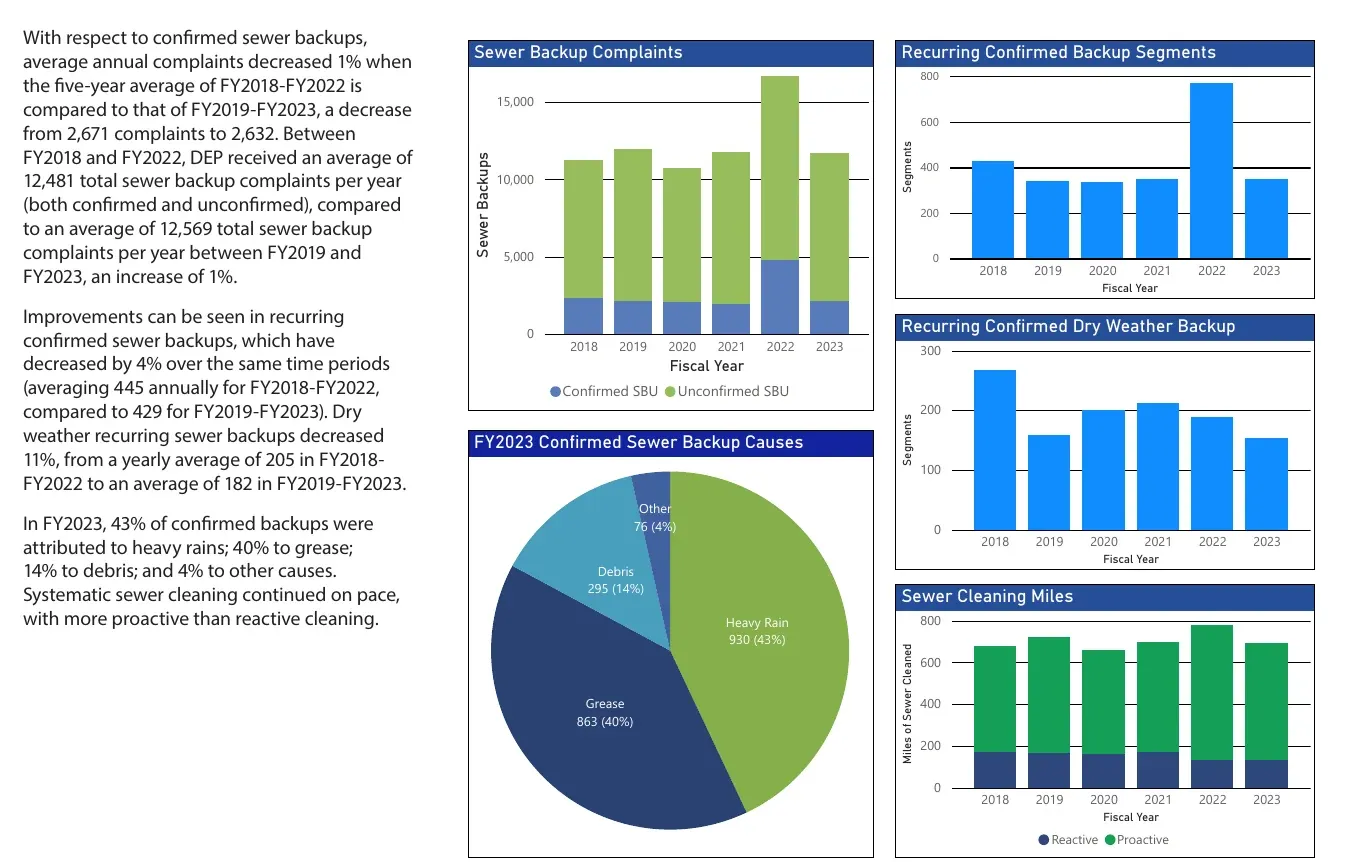 Figure 8: New York City logged over 12,000 sewer backup complaints a year, and grease explained 40% of the confirmed ones in fiscal 2023. Source: NYC DEP, State of the Sewers 2023, Jan 2024. Chart published by the source, captured 21 Oct 2026.
How many sewer backup complaints do cities get?
New York City received an average of 12,569 total sewer backup complaints a year between FY2019 and FY2023 (NYC DEP, Jan 2024).
- The average for FY2018 to FY2022 was 12,481, so the five-year average rose 1% (NYC DEP, Jan 2024).
- Confirmed backups averaged 2,632 a year over FY2019 to FY2023, down from 2,671 (NYC DEP, Jan 2024).
- Recurring confirmed backup segments averaged 429 a year, down 4% (NYC DEP, Jan 2024).
- Dry weather recurring backups fell 11%, from an average of 205 to 182 a year (NYC DEP, Jan 2024).
- Door-to-door outreach for its “Trash It. Don’t Flush It.” campaign has reached more than 50,000 people (NYC DEP, Jan 2024).
What caused the confirmed backups?
In FY2023, 43% of confirmed New York City backups were attributed to heavy rains (NYC DEP, Jan 2024).
- Grease was behind 40% of confirmed backups, 863 cases (NYC DEP, Jan 2024).
- Debris was behind 14%, 295 cases, and other causes 4%, 76 cases (NYC DEP, Jan 2024).
How often do households deal with a blocked toilet, sink or drain?
In a Thames Water survey of 2,501 adults, 46% had experienced a blocked sink (Thames Water, Nov 2025).
- 41% of those surveyed had experienced a blocked toilet (Thames Water, Nov 2025).
- 35% had experienced a blocked drain (Thames Water, Nov 2025).
- Severn Trent cleared 34,580 blockages in the year to October 2023 (Severn Trent, Oct 2023).
- It cleared 28,782 blockages in the year to May 2024 (Severn Trent, May 2024).
- It cleared around 30,000 blockages in 2024 alone (Severn Trent, Oct 2025).
- United Utilities routinely deals with around 60,000 blockages a year (United Utilities, Mar 2020).
- United Utilities cleared more than 14,000 blockages caused by wipes, fats and fatty food waste in 2025 up to November (United Utilities, Nov 2025).
- It also reports a 27% reduction in blockages over five years (United Utilities, Nov 2025).
- Wessex Water says most of its blockages are caused by wet wipes flushed down toilets (Wessex Water, Oct 2026).
What Do Flushable Labels, Standards and Bans Say?
Rules are moving faster than habits. England sets a sale ban for plastic wipes, and the US Congress has a labelling bill. Neither one removes the need to tell customers to use the bin.
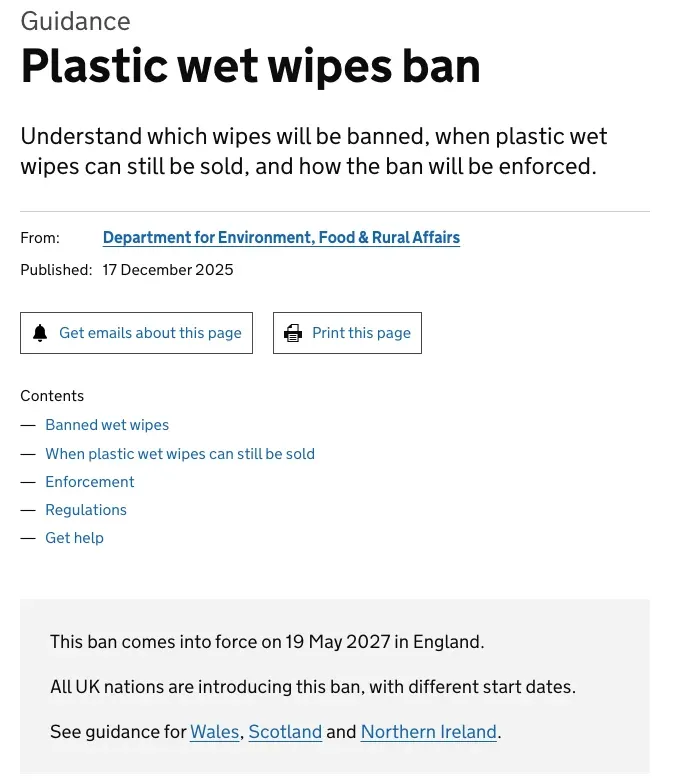 Figure 9: England’s ban on single-use wet wipes that contain plastic takes effect on 19 May 2027, and the other UK nations are setting their own dates. Source: Defra, Plastic wet wipes ban, Dec 2025. Screenshot of the source page, captured 21 Oct 2026.
What does the England ban cover?
The ban makes it illegal to sell or supply single-use wet wipes that contain plastic, and medical use is still permitted (Defra, Dec 2025).
- 95% of consultation respondents agreed or strongly agreed with the ban, and an 18-month transition period was set (Defra, Apr 2024).
- A 2021 call for evidence in England found that 96% of respondents supported a ban (Defra, Oct 2023).
- The UK-wide consultation received 1,561 responses (Defra, Apr 2024).
- The impact assessment estimates an equivalent annual net direct cost to business of £46 million (Regulatory Policy Committee, Sep 2025).
- The RPC gave that assessment a red rating, meaning not fit for purpose, in April 2025 (Regulatory Policy Committee, Sep 2025).
- EDANA says over 70% of consumer wet wipes on sale in the UK are already plastic free (EDANA, Apr 2024).
- Scottish Water cites 95% of people agreeing that plastic wipes should be banned, and over 3,000 customers signing its call for a ban (Scottish Water, Apr 2024).
- A YouGov poll of more than 1,000 adults in Scotland in October 2022 showed 88% support, up from 83% in February 2022 (Scottish Water, Apr 2024).
What would the US WIPPES Act require?
H.R. 2269 would cover wipes marketed as baby or diapering wipes, and household or personal care wipes made partly of petrochemical-derived fibres with significant potential to be flushed (US Congress, H.R. 2269, Jun 2025).
- The symbol and the label notice must each be at least 2 percent of the surface area of the principal display panel (US Congress, H.R. 2269, Jun 2025).
- The bill would apply one year after enactment, and the Federal Trade Commission would enforce it (US Congress, H.R. 2269, Jun 2025).
- It would bar states from setting labelling rules that differ from the federal text (US Congress, H.R. 2269, Jun 2025).
- The Senate version, S. 1092, was reported by the Commerce Committee with an amendment on September 19, 2025 (US Congress, S. 1092, Sep 2025).
- INDA says it worked with municipal wastewater agencies on model “Do Not Flush” labelling laws in California, Oregon, Illinois, Washington, New Jersey and Colorado (INDA, Oct 2026).
How do rules abroad define flushable?
Belgium put the earlier GD3 provisions into law in 2015 (EDANA, Feb 2019).
- Spain released standard UNE 149002 on January 31, 2019, setting the criteria to label a product flushable (EDANA, Feb 2019).
- Australia and New Zealand set the Flushable Products Standard AS/NZS 5328:2022, which Sydney Water points to on its blockages page (Sydney Water, Oct 2026).
Glossary
- SSO: sanitary sewer overflow, a release of untreated sewage from a sanitary sewer.
- CSO: combined sewer overflow, a discharge from a pipe that carries sewage and storm water together.
- FOG: fats, oils and grease.
- I/I: inflow and infiltration, storm water and groundwater that enter sewer pipes.
- UKWIR: UK Water Industry Research.
- GD4: the fourth edition of the INDA/EDANA flushability guidelines.
- WIS 4-02-06: the UK Water Industry Specification for flushable products.
- INDA and EDANA: the nonwovens industry associations for North America and Europe.
- WIPPES Act: the Wastewater Infrastructure Pollution Prevention and Environmental Safety Act, a US labelling bill.
- PET: polyethylene terephthalate, a common plastic fibre.
- RPC: the UK Regulatory Policy Committee.
- POM: products placed on the market.
Methodology and Sources
Every figure comes from the body that measured it: a regulator, a city sewer agency, a water company, a trade association, a lab study or a legislature. Where a utility quotes a study, the entry says so. Pages with no publication date, mainly live utility pages, carry the month they were read (Oct 2026). Figures from different countries measure different things, so the page never adds them together. Where two sources disagree, as with Thames Water’s cost estimates, both appear. This page is refreshed monthly.
Related pages: plumbing statistics and water leak statistics.
Sources
- EPA, Report to Congress on CSOs and SSOs
- Thames Water
- Sydney Water
- Defra
- Water Science and Technology
- Defra Impact Assessment
- NYC DEP
- London Museum
- Scientific Reports
- US Congress, H.R. 2269
- Defra
- Defra
- Severn Trent
- EDANA
- EDANA
- Northumbrian Water
- Wessex Water
- South West Water
- Welsh Water
- Thames Water
- South East Water
- EPA
- EPA
- EPA
- EPA
- Thames Water
- Wessex Water
- Thames Water
- Thames21
- Thames21
- Defra
- Water Research
- Science of the Total Environment
- Water Research
- Water UK
- EDANA
- INDA
- EBMUD
- WSSC Water
- United Utilities
- South West Water
- Thames21
- SFPUC
- Severn Trent
- South West Water
- DC Water
- ASCE
- Environment Agency
- Scottish Water
- Wessex Water
- Welsh Water
- NYC DEP
- Severn Trent
- Severn Trent
- United Utilities
- United Utilities
- Defra
- Defra
- Regulatory Policy Committee
- EDANA
- US Congress, S. 1092
- INDA