CRM statistics show a software category that is large, mature and still uneven in who uses it. Big companies adopted customer relationship management (CRM) software years ago. Small shops and trade businesses are still catching up, and AI is now a new reason to look again.
This page collects figures from government statistics offices, central banks, public company filings and market research firms. Where a number comes from a software vendor, it comes from the vendor’s filing with the US Securities and Exchange Commission, not from a blog post. We found no US government survey that asks businesses whether they use CRM software. Adoption figures therefore come mostly from Eurostat, with US data on related technology from the Census Bureau, the Federal Reserve and Pew Research Center.
Market-size forecasts differ a lot between research firms, so each one is named. Every figure is dated and linked to the document it came from. This page covers market size, adoption, mobile use, AI and barriers. It does not cover time saved or payoff figures.
Key Takeaways
- 28.51% of EU enterprises with 10 or more staff used CRM software in 2025 (Eurostat, Jan 2026).
- Small enterprises sat at 24.69% and large enterprises at 65.43%, a gap of more than 40 points (Eurostat, Jan 2026).
- Only 16.43% of EU construction firms used CRM software in 2025, against 63.14% in information and communication (Eurostat, Feb 2026).
- 30% of US small businesses use technology to manage customer relationships (U.S. Chamber of Commerce, Aug 2025).
- Research firms put the 2025 global CRM market between $79.6 billion (Grand View Research, Sep 2026) and $90.10 billion (Precedence Research, Sep 2026).
- Salesforce reported $41.5 billion in revenue for fiscal 2026, up 10% (Salesforce 10-K FY2026, Mar 2026).
- HubSpot had 306,446 customers on June 30, 2026, up 14% (HubSpot Q2 2026 results, Aug 2026).
- 23.8% of US businesses reported using AI in the last two weeks, in the Census survey cycle that closed October 4, 2026 (U.S. Census Bureau BTOS, Oct 2026).
- AI use among specialty trade contractors, the Census group that includes plumbing, rose from 6.1% to 13.8% between January and October 2026 (U.S. Census Bureau BTOS, Oct 2026).
- 91% of US adults own a smartphone (Pew Research Center, Oct 2026).
- 91.05% of EU construction firms gave staff a portable device with mobile internet in 2024 (Eurostat, Dec 2025).
- Salesforce said Agentforce annual recurring revenue exceeded $1.5 billion, up over 240% (Salesforce Q2 FY2027 results, Aug 2026).
- 56% of small employer firms with no plans to use AI said it does not apply to their business (Federal Reserve Banks SBCS, Mar 2026).
CRM Industry Statistics: How Big Is the Market?
The market is large, but nobody agrees on exactly how large. Treat each forecast as one firm’s view, and read the splits more than the totals.
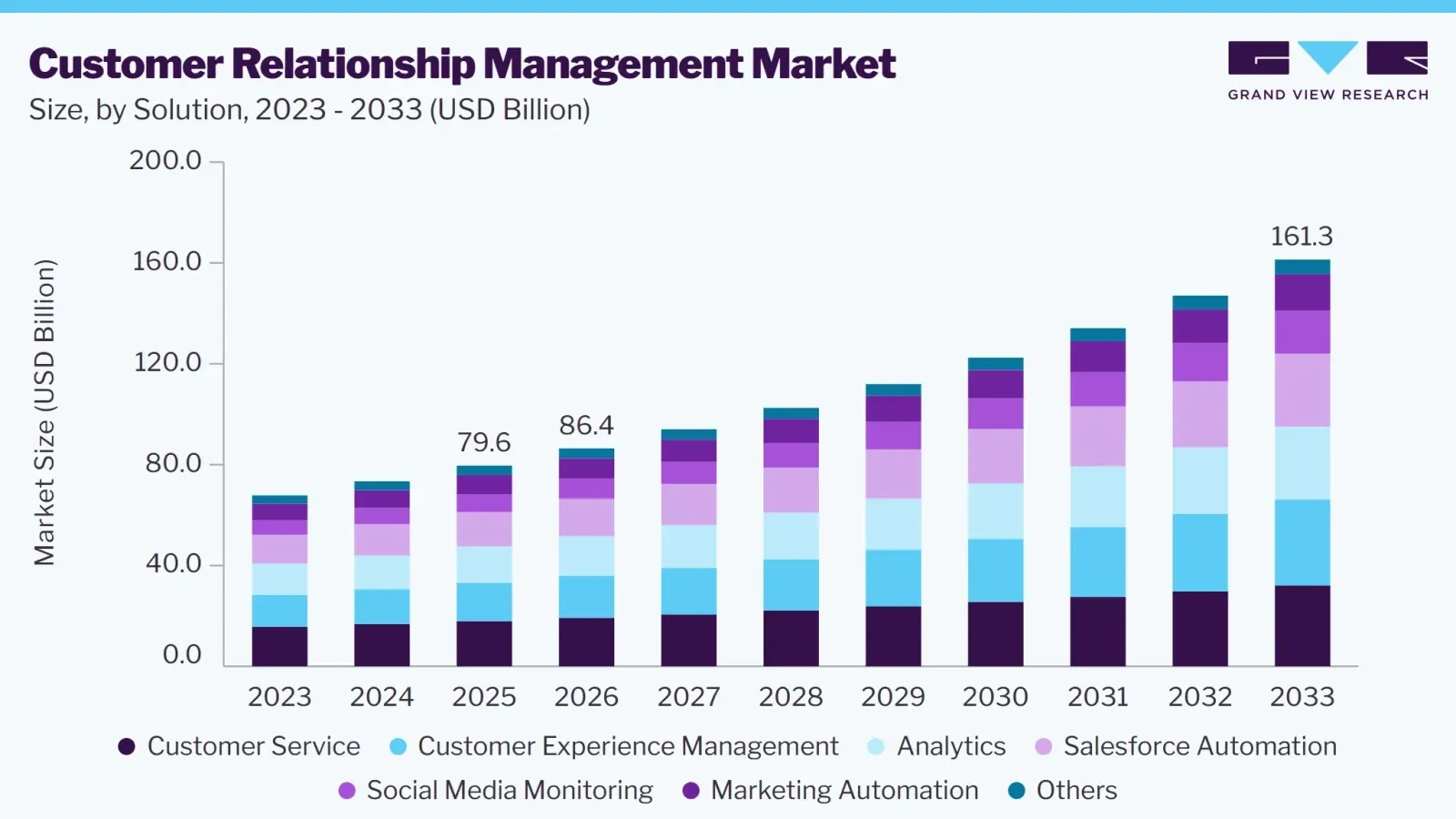 Figure 1: Grand View Research splits the global market into customer service, experience management, analytics, sales automation, social monitoring and marketing tools, and shows every layer growing. Other firms use different scopes, which is why the next section shows three estimates side by side. Source: Grand View Research, Customer Relationship Management Market Report 2026-2033, Sep 2026. Chart published by the source, captured 21 Oct 2026.
How fast will the CRM market grow?
Three research firms publish public market-size pages. Their start points, end years and growth rates all differ.
- Grand View Research projects $161.3 billion by 2033, a 9.3% compound annual growth rate from 2026 (Grand View Research, Sep 2026).
- Precedence Research sizes the 2026 market at $102.26 billion (Precedence Research, Sep 2026).
- Precedence Research forecasts $304.03 billion by 2035, a 12.93% growth rate (Precedence Research, Sep 2026).
- Mordor Intelligence sizes the 2026 market at $87.96 billion (Mordor Intelligence, Jun 2026).
- Mordor Intelligence forecasts $128.86 billion by 2031, a 7.93% growth rate (Mordor Intelligence, Jun 2026).
Where does CRM spending concentrate?
Large companies and cloud delivery take most of the spend, and North America is the biggest region. The exact shares depend on the firm.
- North America took 40.4% of 2025 revenue in Grand View Research’s estimate (Grand View Research, Sep 2026).
- Mordor Intelligence puts North America at 44.18% of 2025 revenue (Mordor Intelligence, Jun 2026).
- Cloud delivery held 59.4% of the 2025 market in Grand View Research’s estimate (Grand View Research, Sep 2026).
- Mordor Intelligence puts cloud at 80.16% of 2025 revenue (Mordor Intelligence, Jun 2026).
- Precedence Research puts cloud at 51% of 2025 revenue (Precedence Research, Sep 2026).
- Large enterprises accounted for 59.2% of 2025 revenue in Grand View Research’s estimate (Grand View Research, Sep 2026).
- Mordor Intelligence puts large enterprises at 62.66% of 2025 spending (Mordor Intelligence, Jun 2026).
- Customer service was the largest solution segment at 22.5% of 2025 revenue (Grand View Research, Sep 2026).
- Sales force automation was the largest application at 29.42% of 2025 spending (Mordor Intelligence, Jun 2026).
- Small and medium enterprises are the fastest-growing segment, at a 16.2% growth rate through 2033 (Grand View Research, Sep 2026).
What do the largest vendors report in revenue?
Audited filings give harder numbers than forecasts. They show a business that is mostly subscriptions.
- Subscription and support made up about 95 percent of Salesforce revenue in fiscal 2026 (Salesforce 10-K FY2026, Mar 2026).
- Salesforce’s Sales offering booked $9.03 billion in subscription revenue in fiscal 2026, up 8% (Salesforce 10-K FY2026, Mar 2026).
- Its Service offering booked $9.82 billion, also up 8% (Salesforce 10-K FY2026, Mar 2026).
- The Americas produced 65% of Salesforce revenue in fiscal 2026 (Salesforce 10-K FY2026, Mar 2026).
- Microsoft’s Dynamics products and cloud services revenue reached $9.0 billion in fiscal 2026, up 15% (Microsoft 10-K FY2026, Jul 2026).
Which CRM Vendors Are Growing, and How Fast?
Public vendors report audited numbers every quarter. In 2026 the largest vendor grows near 11% a year, while platforms aimed at smaller firms grow closer to 20%.
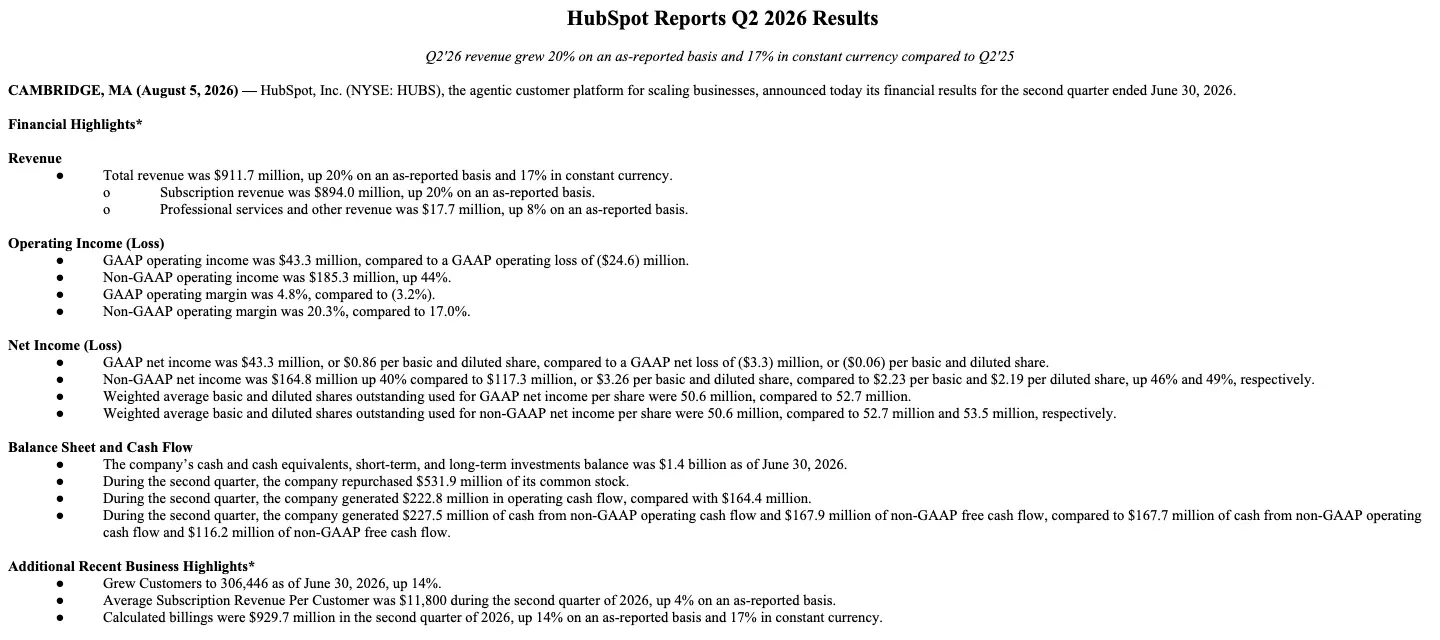 Figure 2: HubSpot sells to mid-sized businesses and publishes its customer count every quarter, which makes it a useful public gauge of how many smaller firms pay for a CRM. Source: HubSpot, Q2 2026 Results (Exhibit 99.1), Aug 2026. Screenshot of the source page, captured 21 Oct 2026.
How many customers does HubSpot report?
HubSpot sells to mid-sized businesses, so its customer count is a rough proxy for demand among smaller firms.
- HubSpot had 288,706 customers on December 31, 2025 (HubSpot 10-K 2025, Feb 2026).
- That compares with 205,091 customers at the end of 2023 (HubSpot 10-K 2025, Feb 2026).
- Its customers span more than 135 countries (HubSpot 10-K 2025, Feb 2026).
- About 53% of customers are outside the United States, and they generated about 48% of 2025 revenue (HubSpot 10-K 2025, Feb 2026).
- Average subscription revenue per customer was $11,414 in 2025 (HubSpot 10-K 2025, Feb 2026).
- HubSpot defines its target market as companies with between 2 and 2,000 employees (HubSpot 10-K 2025, Feb 2026).
How fast are CRM vendor revenues growing?
Growth is double-digit at every vendor below.
- HubSpot’s 2025 revenue was $3.1 billion, up 19% (HubSpot 10-K 2025, Feb 2026).
- HubSpot’s second-quarter 2026 revenue was $911.7 million, up 20% (HubSpot Q2 2026 results, Aug 2026).
- Salesforce’s second-quarter fiscal 2027 revenue was $11.3 billion, up 11%, including $456 million from the Informatica acquisition (Salesforce Q2 FY2027 results, Aug 2026).
- Salesforce’s revenue for the first six months of fiscal 2027 was $22.5 billion, up 12%, also including Informatica (Salesforce 10-Q Q2 FY2027, Aug 2026).
- Salesforce’s current remaining performance obligation, which is contracted revenue due within a year, was $33.5 billion, up 14% (Salesforce Q2 FY2027 results, Aug 2026).
- Salesforce guides to fiscal 2027 revenue of $46.1 billion to $46.4 billion (Salesforce Q2 FY2027 results, Aug 2026).
- Microsoft’s Dynamics 365 revenue grew 18% in fiscal 2026 (Microsoft 10-K FY2026, Jul 2026).
- Dynamics 365 growth slowed to 13% in the fiscal fourth quarter (Microsoft Q4 FY2026 results, Jul 2026).
- Freshworks reported 2025 revenue of $838.8 million, up 16% (Freshworks 10-K 2025, Feb 2026).
CRM Adoption Statistics: How Many Businesses Use CRM Software?
Most firms still run without dedicated CRM software, and adoption moves slowly. The countries at the top are in northern Europe.
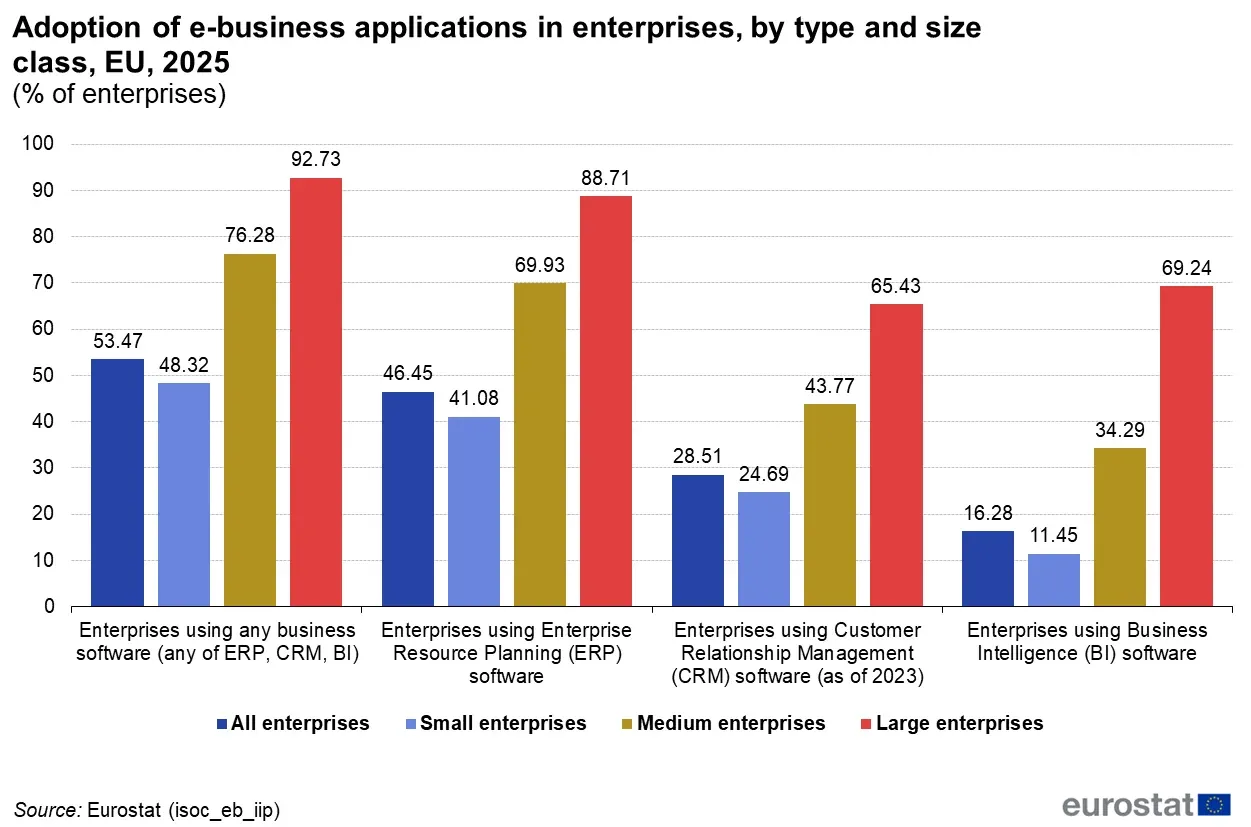 Figure 3: Eurostat’s survey shows CRM sitting well below ERP software in every size class, and the gap between small and large firms is wider for CRM than for most other tools. Source: Eurostat, Digital economy and society statistics - enterprises, Jan 2026. Chart published by the source, captured 21 Oct 2026.
Has CRM adoption grown since 2023?
Yes, slowly. Eurostat changed how it records CRM in 2023, so older and newer figures should not be joined into one line.
- CRM use among EU enterprises with 10 or more staff stood at 25.83% in 2023 (Eurostat, Feb 2026).
- Under the earlier question wording, 26.48% of enterprises used CRM software in 2010 (Eurostat, Feb 2026).
- Under that earlier wording the share reached 34.79% in 2021 (Eurostat, Feb 2026).
- More than half of EU enterprises (53.47%) used at least one of ERP, CRM or business intelligence software in 2025 (Eurostat, Jan 2026).
- ERP software was more common than CRM, at 46.45% of EU enterprises (Eurostat, Jan 2026).
- Business intelligence software was the least used of the three, at 16.28% (Eurostat, Jan 2026).
Which countries use CRM the most?
Nordic and Dutch firms lead by a wide margin, and eastern and southern Europe trail.
- Finland led at 55.79% of enterprises in 2025 (Eurostat, Feb 2026).
- The Netherlands followed at 54.12% (Eurostat, Feb 2026).
- Denmark reached 42.51% (Eurostat, Feb 2026).
- Spain reached 33.28% (Eurostat, Feb 2026).
- Germany reached 29.64% (Eurostat, Feb 2026).
- Romania was near the bottom at 13.93% (Eurostat, Feb 2026).
Small Business CRM Adoption Statistics: How Do Small Firms Compare?
Company size is the strongest predictor of CRM use. A 10-person firm is far less likely to run CRM than a 250-person firm, and US small firms say customers are their hardest problem.
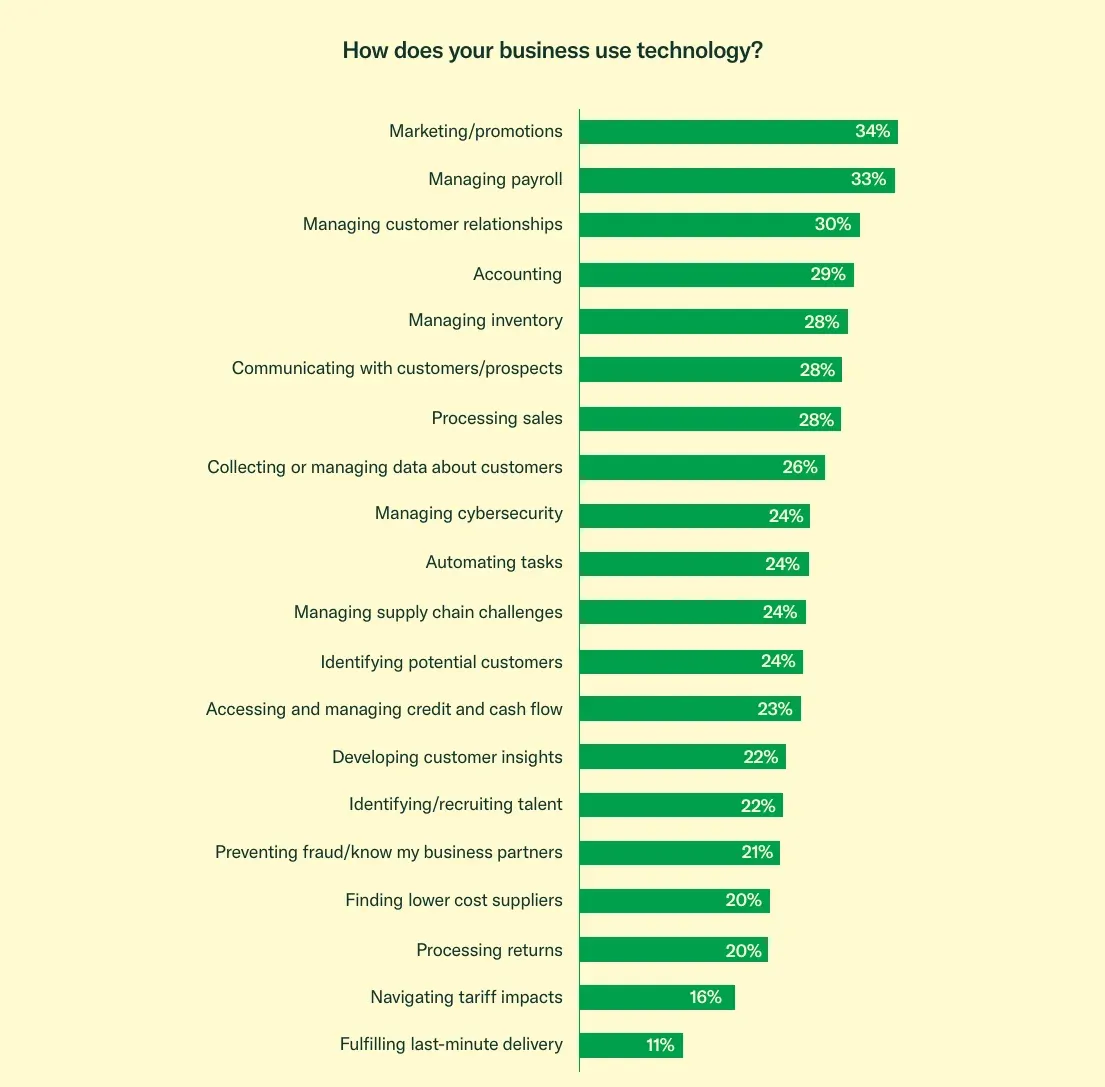 Figure 4: Managing customer relationships ranks third among the jobs US small businesses hand to technology, behind marketing and payroll. Source: U.S. Chamber of Commerce Technology Engagement Center, Empowering Small Business 2025 (page 7), Aug 2025. Screenshot of the source report page, captured 21 Oct 2026.
How big is the CRM gap between small and large firms?
The gap is large, and it has persisted across survey rounds.
- Medium enterprises with 50 to 249 staff reached 43.77% in 2025 (Eurostat, Feb 2026).
- In 2023, enterprises with 10 to 49 staff were at 22.26% (Eurostat, Feb 2026).
- In the same year, enterprises with 50 to 249 staff were at 39.58% (Eurostat, Feb 2026).
- In 2023, enterprises with 250 or more staff were at 60.6% (Eurostat, Feb 2026).
How do US small businesses use technology with customers?
The US evidence is indirect, because no federal survey asks about CRM by name. The Chamber’s survey asks what owners use technology for.
- 28% of small businesses use technology to communicate with customers and prospects (U.S. Chamber of Commerce, Aug 2025).
- 26% use it to collect or manage data about customers (U.S. Chamber of Commerce, Aug 2025).
- 24% use it to identify potential customers (U.S. Chamber of Commerce, Aug 2025).
- 22% use it to develop customer insights (U.S. Chamber of Commerce, Aug 2025).
- Over half of small businesses (58%) use four or more technology platforms (U.S. Chamber of Commerce, Aug 2025).
Why does winning customers matter so much to small firms?
Small firms name customers, not technology, as their top operating problem.
- Reaching customers and growing sales was the top operational challenge, reported by 57% of small employer firms (Federal Reserve Banks SBCS, Mar 2026).
- Hiring or retaining qualified staff came second at 46% (Federal Reserve Banks SBCS, Mar 2026).
- Utilizing technology was a challenge for 29% (Federal Reserve Banks SBCS, Mar 2026).
- Firms with fewer than 500 employees made up 99.7% of US employer establishments in 2023 (Federal Reserve Banks SBCS, Mar 2026).
- HubSpot says its customer platform starts completely free (HubSpot 10-K 2025, Feb 2026).
Do Trades and Construction Firms Use CRM Software?
Construction sits near the bottom of every CRM table. That is a gap, not a verdict: software built for the trades is growing quickly.
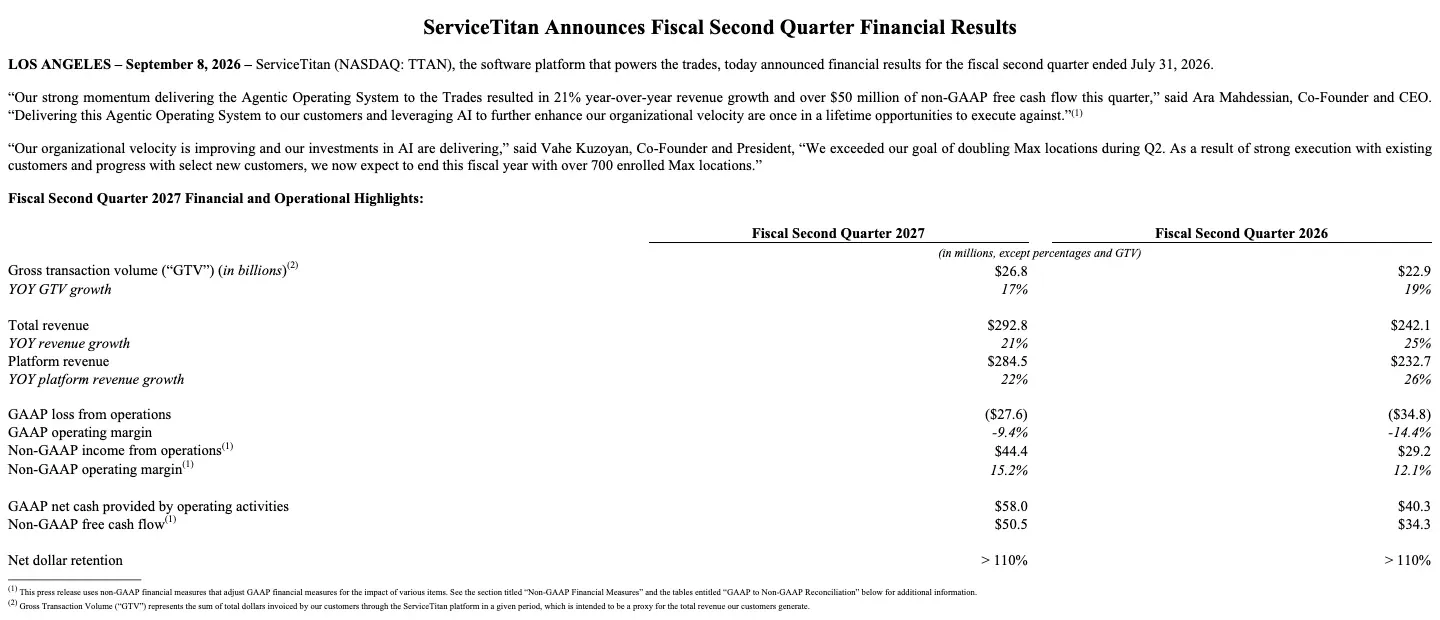 Figure 5: ServiceTitan, a public software vendor built only for trade businesses, reports the dollars its contractor customers invoice through the platform, which shows how much work already runs on trade software. Source: ServiceTitan, Fiscal Second Quarter 2027 Results (Exhibit 99.1), Sep 2026. Screenshot of the source page, captured 21 Oct 2026.
How does construction compare with other sectors?
Eurostat measures CRM use by industry for EU firms with 10 or more staff. These are not US figures, but the ranking of sectors is a useful guide.
- EU construction firms were at 13.11% in 2023, before rising in 2025 (Eurostat, Feb 2026).
- Real estate firms were at 39.6% in 2025 (Eurostat, Feb 2026).
- Retail trade was at 24.83% (Eurostat, Feb 2026).
- Water supply, sewerage and waste firms were at 23.78% (Eurostat, Feb 2026).
- Accommodation and food service firms were at 19.72% (Eurostat, Feb 2026).
- Transport and storage firms were at 18.55% (Eurostat, Feb 2026).
How big is software built for the trades?
Trade-specific platforms now carry billions of dollars of contractor invoices each quarter.
- ServiceTitan had approximately 10,800 Active Customers, meaning customers above $10,000 in annualized billings, on January 31, 2026 (ServiceTitan 10-K FY2026, Mar 2026).
- Those customers produced over 97% of its annualized billings (ServiceTitan 10-K FY2026, Mar 2026).
- ServiceTitan’s fiscal 2026 revenue was $961.0 million (ServiceTitan 10-K FY2026, Mar 2026).
- Its second-quarter fiscal 2027 revenue was $292.8 million, up 21% (ServiceTitan Q2 FY2027 results, Sep 2026).
- Customers invoiced $26.8 billion through the platform in that quarter, up 17% (ServiceTitan Q2 FY2027 results, Sep 2026).
- The company describes technology for the trades as in its early phases of adoption, with many trades businesses still relying on rudimentary workflows (ServiceTitan 10-K FY2026, Mar 2026).
- It also warns that trades businesses may be apprehensive about technology that risks significantly disrupting their established norms (ServiceTitan 10-K FY2026, Mar 2026).
What Do Businesses Use CRM Software For?
Most firms use CRM as a shared customer record first and an analysis tool second. Cloud delivery is common among large firms and rare among small ones.
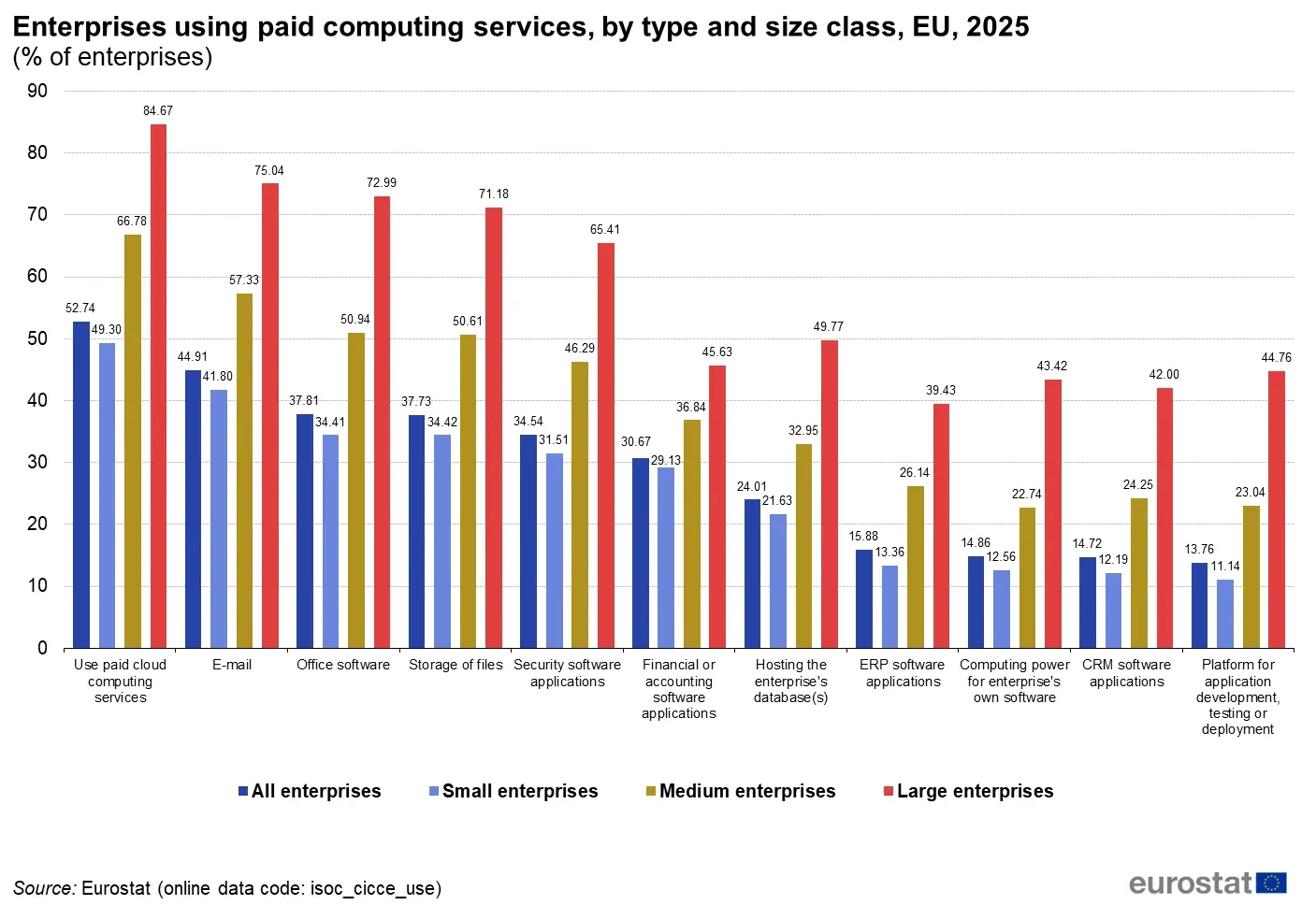 Figure 6: Eurostat’s cloud survey shows CRM among the less common cloud purchases, behind email, storage and security tools, with large firms far ahead of small ones. Source: Eurostat, Digital economy and society statistics - enterprises (Figure 7), Jan 2026. Chart published by the source, captured 21 Oct 2026.
What do firms do with customer records?
Storing and sharing customer information is the main use. Analysis for marketing is the minority use.
- 34.01% of EU enterprises used CRM to capture, store and share client information with other functions in 2021 (Eurostat, Feb 2026).
- That compares with 24.94% in 2010 (Eurostat, Feb 2026).
- 19.52% used CRM to analyse client information for marketing in 2021 (Eurostat, Feb 2026).
- That compares with 17.51% in 2010 (Eurostat, Feb 2026).
How many firms buy CRM as a cloud service?
About one firm in seven in the EU paid for cloud CRM in 2025. Size makes a large difference.
- 14.72% of EU enterprises paid for CRM as a cloud service (Eurostat, Jan 2026).
- The share was 12.19% for enterprises with 10 to 49 staff (Eurostat, Feb 2026).
- It was 24.25% for enterprises with 50 to 249 staff (Eurostat, Feb 2026).
- It was 42.0% for enterprises with 250 or more staff (Eurostat, Feb 2026).
- Only 6.83% of EU construction firms paid for cloud CRM (Eurostat, Feb 2026).
How Much CRM Work Happens on Mobile Devices?
Customers live on phones, and so do field crews. For a trade business the question is less about the market and more about whether every technician has the customer record in hand on the job.
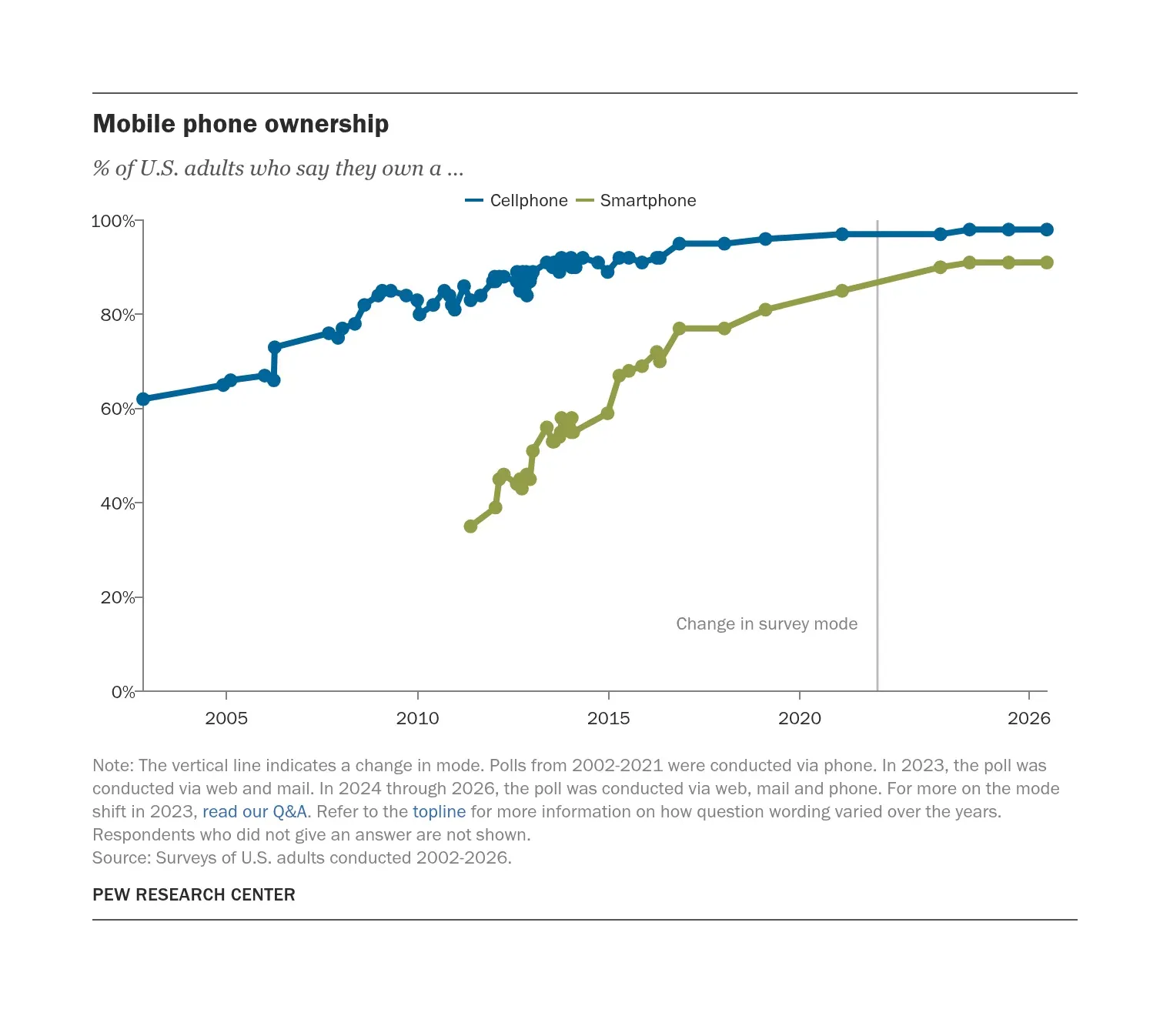 Figure 7: Smartphone ownership among US adults climbed from a small minority in 2011 to a plateau near nine in ten, so a mobile-first quote or invoice reaches almost every customer. Source: Pew Research Center, Americans’ Use of Mobile Devices in 2026, Oct 2026. Chart published by the source, captured 21 Oct 2026.
How many customers can use a mobile experience?
Nearly every US adult owns a cellphone, and the smartphone gap now comes from age and income.
- 98% of US adults own a cellphone of some kind (Pew Research Center, Oct 2026).
- Only 35% owned a smartphone in Pew’s first survey of ownership in 2011 (Pew Research Center, Oct 2026).
- 97% of adults aged 30 to 49 own a smartphone (Pew Research Center, Oct 2026).
- 79% of adults aged 65 and older own one (Pew Research Center, Oct 2026).
- 88% of rural adults own a smartphone (Pew Research Center, Oct 2026).
- 16% of US adults are smartphone-only internet users, with no home broadband (Pew Research Center, Oct 2026).
How many firms give staff mobile devices?
Most firms now supply phones or tablets with mobile internet, and about half do so for more than a fifth of their staff.
- 86.81% of EU enterprises gave at least some staff a portable device with mobile internet in 2024 (Eurostat, Dec 2025).
- 50.09% gave such a device to more than 20% of their staff (Eurostat, Dec 2025).
- In construction that share was 53.8% (Eurostat, Dec 2025).
- 37.89% of all persons employed in EU enterprises had a business portable device with mobile internet (Eurostat, Dec 2025).
- In construction that share was 41.01% (Eurostat, Dec 2025).
- ServiceTitan says customers use a web browser in the office and a mobile application in the field, mainly technicians (ServiceTitan 10-K FY2026, Mar 2026).
How Many Businesses Use AI?
AI use is the fastest-moving number on this page. In the US it has climbed through 2026, and trades started from a lower base.
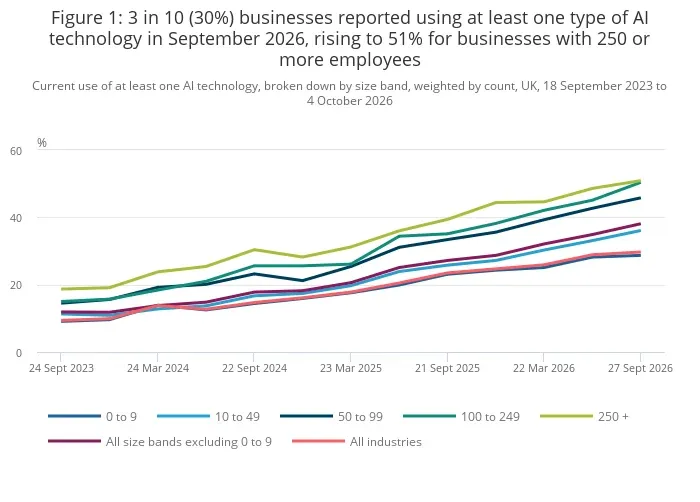 Figure 8: The UK Office for National Statistics tracks AI use every quarter, and every size band has risen since 2023, with larger firms always ahead. Source: Office for National Statistics, Business insights and impact on the UK economy, Oct 2026. Chart published by the source, captured 21 Oct 2026.
What share of US businesses use AI?
The Census Bureau asks a rotating panel of firms every two weeks.
- 17.7% of US businesses reported using AI in the survey cycle that closed January 11, 2026 (U.S. Census Bureau BTOS, Oct 2026).
- 27.7% expected to use AI in the next six months, in the cycle that closed October 4, 2026 (U.S. Census Bureau BTOS, Oct 2026).
- In the construction sector, AI use rose from 8.3% in January to 17.2% in October 2026 (U.S. Census Bureau BTOS, Oct 2026).
- Firms with 1 to 4 employees reported AI use at 17.6% in the winter 2025-26 supplement (U.S. Census Bureau BTOS, Feb 2026).
- Firms with 250 or more employees reported 30.6% in the same supplement (U.S. Census Bureau BTOS, Feb 2026).
- 46% of small employer firms said their business or its employees use AI (Federal Reserve Banks SBCS, Mar 2026).
- Another 15% of those firms planned to start within 12 months (Federal Reserve Banks SBCS, Mar 2026).
- Just 7% of AI-using small firms said AI was fully integrated into the business (Federal Reserve Banks SBCS, Mar 2026).
- 58% of small businesses said they use generative AI, up from 40% in 2024 (U.S. Chamber of Commerce, Aug 2025).
How does AI use compare in the UK and EU?
Surveys differ in wording and timing, so compare the direction, not the level.
- 30% of UK businesses reported using at least one AI technology in September 2026 (Office for National Statistics, Oct 2026).
- That was up from 9% when the question began in September 2023 (Office for National Statistics, Oct 2026).
- 29% of UK businesses with fewer than 10 employees used AI (Office for National Statistics, Oct 2026).
- 19.95% of EU enterprises with 10 or more staff used AI in 2025 (Eurostat, Jan 2026).
- EU construction firms were at 10.79% in 2025, up from 3.2% in 2023 (Eurostat, Jun 2026).
What AI Features Are CRM Vendors Shipping?
CRM vendors now sell AI agents, not only record keeping. The revenue is still small next to the core product, but it is growing at triple-digit rates.
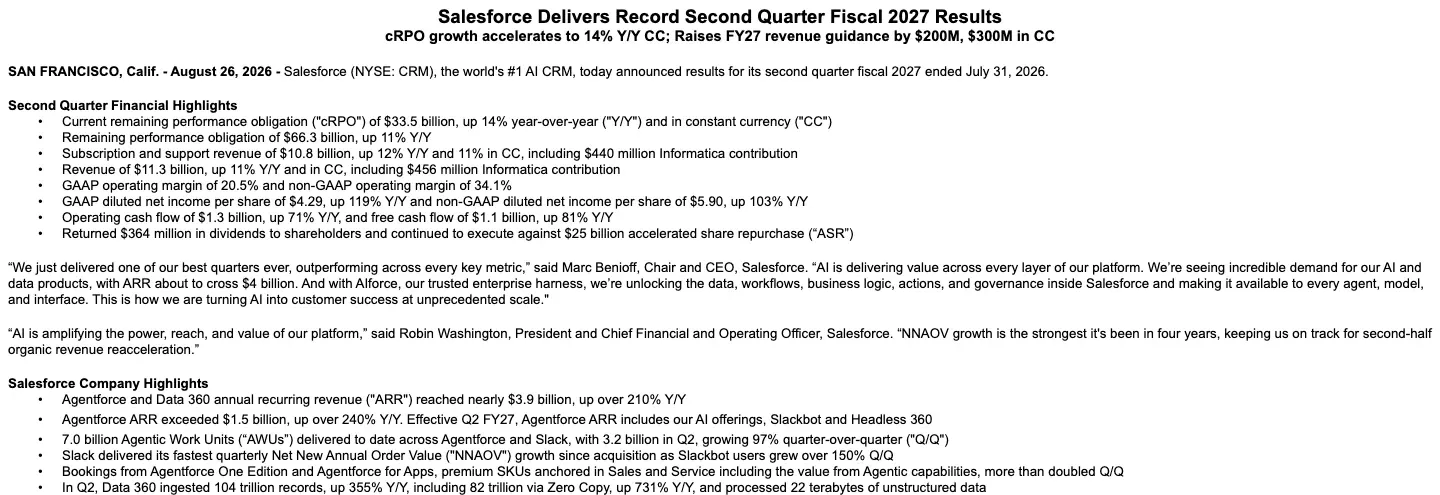 Figure 9: Salesforce’s quarterly release shows its AI products as a separate revenue line, including how much work its AI agents have completed to date. It is the clearest public sign of how fast CRM vendors are moving from software to agents. Source: Salesforce, Second Quarter Fiscal 2027 Results (Exhibit 99.1), Aug 2026. Screenshot of the source page, captured 21 Oct 2026.
Which business functions use AI today?
Sales, marketing and customer service are where firms plan to put AI next, which is the same ground a CRM covers.
- 14.3% of US businesses used AI in sales and marketing in the prior six months (U.S. Census Bureau BTOS, Feb 2026).
- 7.6% used AI in customer service (U.S. Census Bureau BTOS, Feb 2026).
- Among firms planning to use AI, 62.8% planned to use it in sales and marketing (U.S. Census Bureau BTOS, Feb 2026).
- Among the same planners, 40.0% planned to use it in customer service (U.S. Census Bureau BTOS, Feb 2026).
- Among firms using generative AI, 15.5% used it for customer support (U.S. Census Bureau BTOS, Feb 2026).
- Writing or marketing was the top use among small employer firms that use AI, at 83% (Federal Reserve Banks SBCS, Mar 2026).
- Customer service use among those AI-using firms was 29% (Federal Reserve Banks SBCS, Mar 2026).
- 6.92% of EU enterprises used AI for marketing or sales in 2025, and 2.48% of construction firms did (Eurostat, Jun 2026).
How much AI revenue do CRM vendors report?
The figures are vendor-defined, so read them as direction rather than industry totals.
- Salesforce’s Agentforce and Data 360 annual recurring revenue reached nearly $3.9 billion, up over 210% (Salesforce Q2 FY2027 results, Aug 2026).
- Salesforce said its AI agents had completed 7.0 billion agentic work units to date (Salesforce Q2 FY2027 results, Aug 2026).
- 3.2 billion of those units came in the second quarter alone, up 97% from the prior quarter (Salesforce Q2 FY2027 results, Aug 2026).
- HubSpot said in October 2026 that it would cut about 7% of staff, nearly 660 people, as it shifts toward delivering outcomes with AI (HubSpot 8-K Oct 2026, Oct 2026).
What Holds Businesses Back From Adopting New Software?
Cost is rarely the main reason. Most owners who skip AI or new software say it does not apply to them, or that they do not know enough about it.
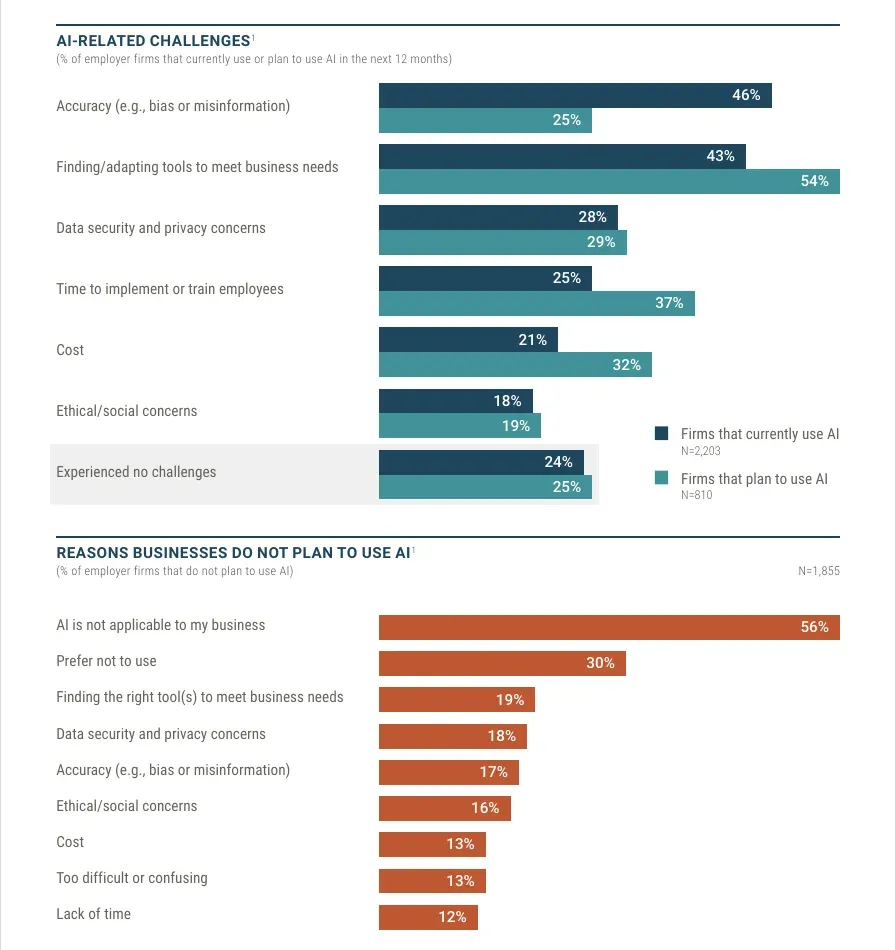 Figure 10: The Federal Reserve’s small business survey lists what firms that use or plan to use AI struggle with, and why other firms have no plans at all. Tool fit, time and trust outrank price. Source: Federal Reserve Banks, 2026 Report on Employer Firms (page 28), Mar 2026. Screenshot of the source report page, captured 21 Oct 2026.
Why do US firms say they do not plan to use AI?
Two surveys ask the same question and reach the same answer: most owners do not see the use.
- 61.6% of US businesses with no plans to use AI said it is not applicable to their business (U.S. Census Bureau BTOS, Feb 2026).
- 22.0% cited lack of knowledge about what AI can do (U.S. Census Bureau BTOS, Feb 2026).
- 20.7% cited privacy or security concerns (U.S. Census Bureau BTOS, Feb 2026).
- 6.9% cited cost (U.S. Census Bureau BTOS, Feb 2026).
- 30% of small employer firms with no AI plans said they prefer not to use it (Federal Reserve Banks SBCS, Mar 2026).
- 19% of those firms named finding the right tool as a reason (Federal Reserve Banks SBCS, Mar 2026).
- 18% named data security and privacy concerns (Federal Reserve Banks SBCS, Mar 2026).
What problems do firms hit once they start?
Firms that already use AI worry about accuracy. Firms about to start worry about finding tools and having time to learn them.
- 46% of small firms using AI named accuracy, such as bias or misinformation, as a challenge (Federal Reserve Banks SBCS, Mar 2026).
- 43% of users named finding or adapting tools to meet business needs (Federal Reserve Banks SBCS, Mar 2026).
- 54% of firms planning to start named finding tools that fit as a challenge (Federal Reserve Banks SBCS, Mar 2026).
- 37% of planners named the time needed to implement or train staff (Federal Reserve Banks SBCS, Mar 2026).
- 32% of planners named cost (Federal Reserve Banks SBCS, Mar 2026).
What do EU firms say holds them back?
Eurostat reports these reasons as a share of all enterprises, not only non-users, so the numbers look small.
- 7.76% of EU enterprises did not use AI because of a lack of relevant expertise (Eurostat, Jun 2026).
- 5.92% cited a lack of clarity about legal consequences (Eurostat, Jun 2026).
- 5.82% cited data protection and privacy concerns (Eurostat, Jun 2026).
- 4.24% cited costs that seemed too high (Eurostat, Jun 2026).
Glossary
- CRM: customer relationship management software, which keeps customer records, contacts and job history in one place.
- ERP: enterprise resource planning software, which runs finance, inventory and operations.
- BI: business intelligence software, which turns company data into reports.
- AI: artificial intelligence.
- ARR: annual recurring revenue, the yearly value of active subscriptions.
- SMB, SME: small and medium-sized business or enterprise.
- BTOS: the US Census Bureau’s Business Trends and Outlook Survey.
- SBCS: the Federal Reserve Banks’ Small Business Credit Survey.
- GTV: gross transaction volume, the dollars a vendor’s customers invoice through its platform.
- NAICS 238: the Census industry group for specialty trade contractors, which includes plumbing.
Methodology and Sources
Every figure comes from the publisher that produced it: a statistics office, a central bank, a public company filing or a research firm’s own page. We did not use roundup articles. Each figure was read in the original document and checked against it. Eurostat database figures were read from the Eurostat data service and are for enterprises with 10 or more staff in the EU unless stated. Census Bureau figures were read from the published data files. Market-size estimates from research firms are shown side by side and are not averaged, because their scopes differ. Company figures come from filings with the US Securities and Exchange Commission. This page is refreshed monthly.
Sources
- Eurostat, Digital economy and society statistics - enterprises
- Eurostat, Integration of internal processes by size class of enterprise (isoc_eb_iip)
- Eurostat, Integration of internal processes by NACE Rev. 2 activity (isoc_eb_iipn2)
- Eurostat, Cloud computing services by size class of enterprise (isoc_cicce_use)
- Eurostat, Cloud computing services by NACE Rev. 2 activity (isoc_cicce_usen2)
- Eurostat, Artificial intelligence by NACE Rev. 2 activity (isoc_eb_ain2)
- Eurostat, Use of mobile connections to the internet by NACE Rev. 2 activity (isoc_cimobe_usen2)
- Eurostat, Use of mobile connections by employees by NACE Rev. 2 activity (isoc_cimobp_usen2)
- U.S. Census Bureau, Business Trends and Outlook Survey, national data
- U.S. Census Bureau, Business Trends and Outlook Survey, sector data
- U.S. Census Bureau, Business Trends and Outlook Survey, subsector data
- U.S. Census Bureau, Business Trends and Outlook Survey, AI supplement 2026
- Federal Reserve Banks, 2026 Report on Employer Firms
- U.S. Chamber of Commerce, Empowering Small Business 2025 (PDF)
- Pew Research Center, Americans’ Use of Mobile Devices in 2026
- Office for National Statistics, Business insights and impact on the UK economy
- Grand View Research, Customer Relationship Management Market Report
- Precedence Research, Customer Relationship Management Market
- Mordor Intelligence, Customer Relationship Management Market
- Salesforce, Form 10-K for fiscal 2026
- Salesforce, Form 10-Q for the quarter ended July 31, 2026
- Salesforce, Second Quarter Fiscal 2027 Results
- HubSpot, Form 10-K for 2025
- HubSpot, Q2 2026 Results
- HubSpot, Form 8-K, October 2026
- Microsoft, Form 10-K for fiscal 2026
- Microsoft, Fiscal Year 2026 Fourth Quarter Results
- Freshworks, Form 10-K for 2025
- ServiceTitan, Form 10-K for fiscal 2026
- ServiceTitan, Fiscal Second Quarter 2027 Results