Frozen pipe statistics show how a repair that costs a few hundred dollars turns into a claim that costs tens of thousands. A pipe freezes, ice blocks the line, pressure builds, and the pipe splits. The water comes out when the ice melts, often while nobody is home.
This page collects the numbers behind that chain. It covers insurer claim data, the cost of one failure, winter storm losses, Winter Storm Uri in Texas, the cold waves of 2022 and 2026, the temperatures that matter and what prevention does. Every figure comes from the group that produced it, with a date.
Plumbers are the other half of this story. Every freeze ends with a phone call to a shop, and the numbers below show how large those call spikes get. For the wider picture, see water damage statistics, water damage claims statistics, water leak statistics and plumbing statistics. Updated October 2026.
Key Takeaways
- State Farm paid more than $628 million on over 20,000 frozen pipe and winter water claims from January 2024 through June 2025, and the average payment topped $30,000 (State Farm, Jan 2026).
- State Farm paid more than $472 million on frozen pipe claims in 2021, nearly eight times its 2020 total, after Winter Storm Uri (State Farm, Nov 2021).
- Texas insurers expected to pay about $11.2 billion on 510,772 claims from the February 2021 winter weather event (Texas Department of Insurance, Mar 2022).
- Winter Storm Uri caused $15 billion in insured losses, the costliest U.S. winter event since 1950 (Triple-I, Jan 2026).
- 31% of Texans reported water damage to their home during Winter Storm Uri (University of Houston Hobby School, Mar 2021).
- 29% of Texans had difficulty finding a plumber or other service professional during the storm (University of Houston Hobby School, Mar 2021).
- A 1/8-inch crack in a pipe can spew up to 250 gallons of water a day (State Farm, Jan 2020).
- U.S. winter storm insured losses ran from $926 million in 2017 to $15.5 billion in 2021 (Triple-I, Jan 2026).
- Over 17 million people served by Texas public water systems were placed under boil water advisories after Uri (PLOS Water, Jun 2023).
- Verisk expects freeze to be the largest driver of up to $4 billion in insured losses from Winter Storm Fern (Verisk, Feb 2026).
- 63% of Farmers frozen pipe claims from 2013 to 2016 came between December and February (Farmers Insurance, Dec 2016).
- Water and freezing damage made up about 22% of The Hartford’s small-business claims from 2020 to 2024 (The Hartford, Dec 2025).
Frozen Pipe Claims Statistics
One insurer publishes a frozen pipe loss number almost every winter, and the series tells the story better than any single year. Losses jump after each major cold event, and the average claim keeps climbing.
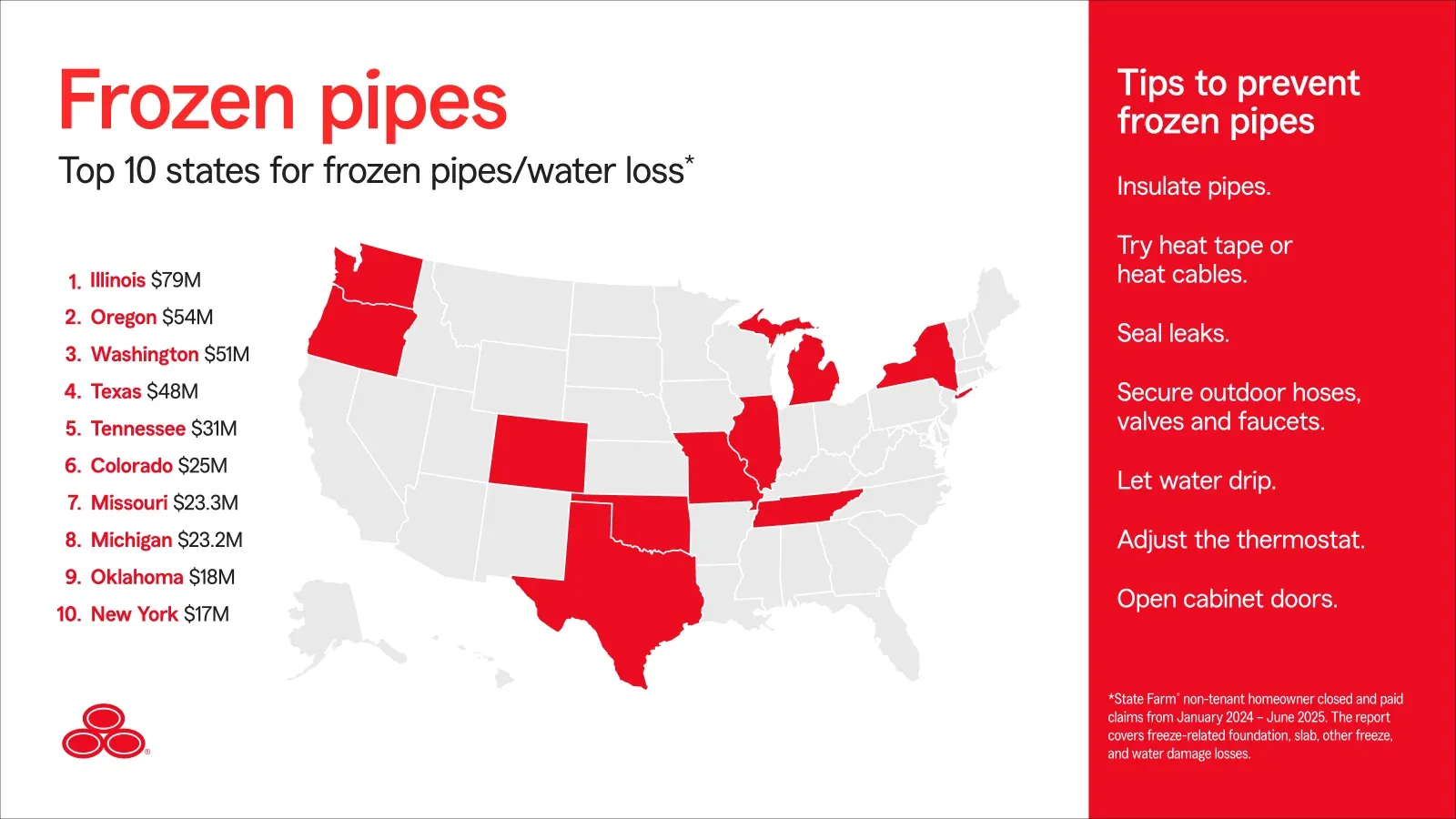 Figure 1: Illinois led State Farm’s frozen pipe and water loss ranking at $79 million, with Oregon, Washington and Texas next, so the problem is not tied to one region. Source: State Farm, Frozen Pipes? Not So Nice. Beat Winter Water Woes Before They Strike, Jan 2026. Chart published by the source, captured 21 Oct 2026.
How much do insurers pay for frozen pipe claims each year?
State Farm reported that frozen pipe losses in 2018 totaled more than $270 million (State Farm, Jan 2019). The rest of the series shows how far one year can swing.
- Frozen pipe losses in 2018 rose by more than $162 million from 2017 (State Farm, Jan 2019).
- State Farm paid more than $200 million in 2019 (State Farm, Jan 2020).
- The 2019 payments covered over 11,000 homeowners claims, not counting renters and condo unit owners (State Farm, Jan 2020).
- State Farm said frozen pipes affect a quarter-million families each winter (State Farm, Jan 2020).
- Its loss mitigation administrator called frozen pipe damage the most common winter loss claim (State Farm, Jan 2020).
- In 2022 State Farm paid over $181 million on nearly 9,000 frozen pipe claims (State Farm, Dec 2022).
- The average 2022 claim came in just over $20,000 (State Farm, Dec 2022).
- From August 2022 to August 2023 it paid out over $806 million on more than 32,000 frozen pipe and water damage claims (State Farm, Jan 2024).
- Those claims averaged $25,000 (State Farm, Jan 2024).
- In calendar 2023 State Farm received more than 17,200 frozen pipe claims and paid more than $432.5 million (State Farm, Dec 2024).
- The 2023 average was just over $23,500 (State Farm, Dec 2024).
Which states lose the most to frozen pipes?
The leader changes with the weather, which is the main lesson. State Farm named Illinois the top state for frozen pipe water loss claims in 2019 (State Farm, Jan 2020).
- In 2018 the top five states were Illinois, New York, Pennsylvania, Tennessee and Texas (State Farm, Jan 2019).
- Winter Storm Uri moved Texas to first place in 2021, ahead of Illinois, which had led the two years before (State Farm, Nov 2021).
- Texas stayed first in 2022 with $64 million in claim costs (State Farm, Dec 2022).
- New York was second in 2022 at $17 million (State Farm, Dec 2022).
- From August 2022 to August 2023 Georgia led all states with $100 million in claim costs (State Farm, Jan 2024).
- Illinois was second in that period at $78.3 million (State Farm, Jan 2024).
- For January 2024 to June 2025, Oregon ranked second at $54 million (State Farm, Jan 2026).
- Washington ranked third at $51 million, ahead of Texas at $48 million (State Farm, Jan 2026).
What do other insurers see in their claims data?
Farmers found that frozen pipe claims fell 53% between the 2013-2014 winter and the unusually warm 2015-2016 winter (Farmers Insurance, Dec 2016). Mild winters hide the risk, and then a hard freeze brings it back.
- Farmers also saw extreme temperature claims fall 82% over the same two winters (Farmers Insurance, Dec 2016).
- At The Hartford, water and freezing damage claims rose from 15% to 20% of small-business claims over ten years (The Hartford, Dec 2025).
- Those claims were the fourth most costly type, averaging $34,600 (The Hartford, Dec 2025).
- The Hartford drew its figures from more than 1 million small-business property and liability policies (The Hartford, Dec 2025).
Burst Pipe Statistics
A burst pipe is cheap to fix and expensive to ignore. The plumbing is the small line on the bill, and the water damage is the large one.
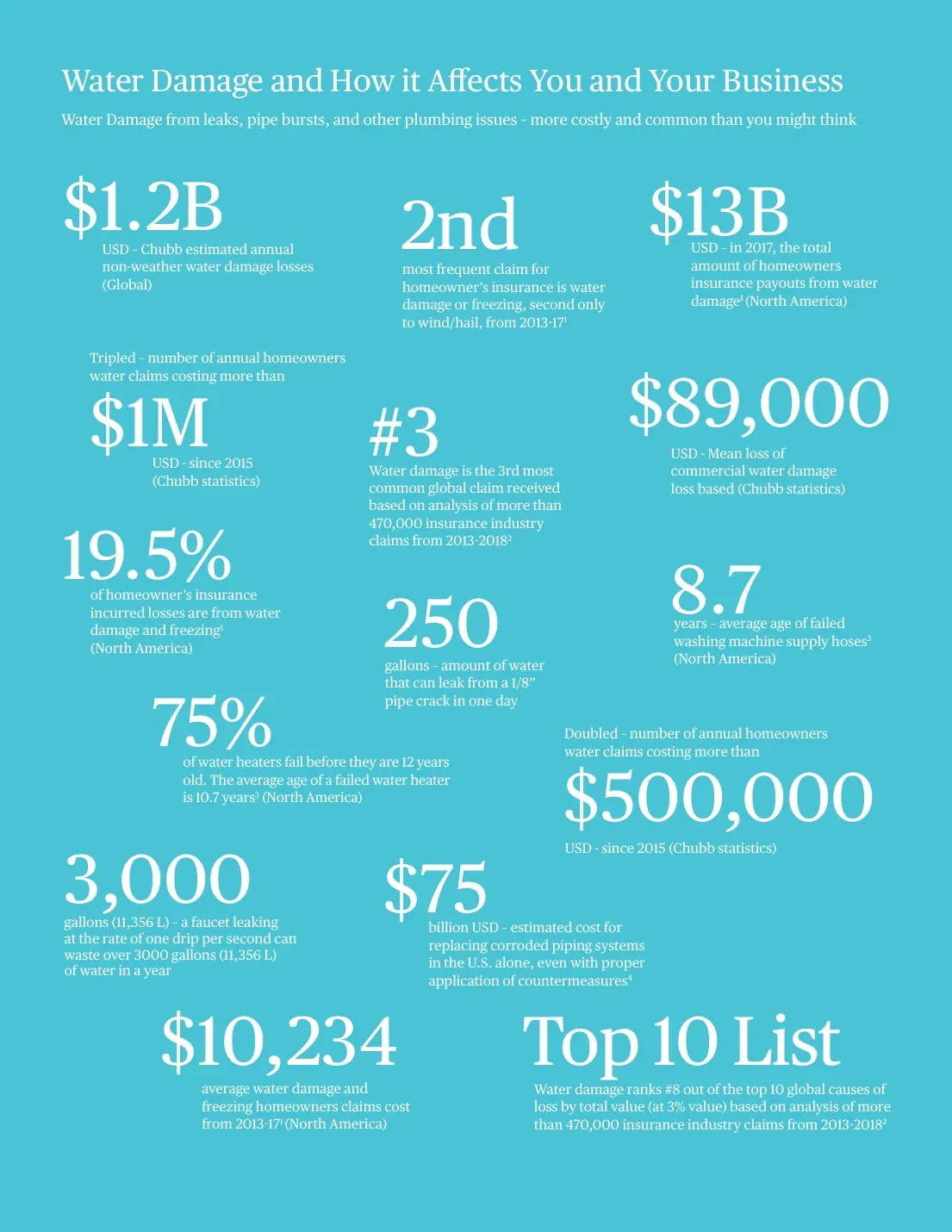 Figure 2: Chubb’s risk engineers lay out the scale of pipe and plumbing losses, from the 250 gallons a day that a small crack can leak to the share of homeowner losses that come from water damage and freezing. Source: Chubb, Preventing Water Damage, Feb 2021. Screenshot of the source page, captured 21 Oct 2026.
How much does it cost to repair a burst pipe?
The national average cost to repair a burst pipe is $500 (Angi, Oct 2026). The range is wide, and most of it depends on where the pipe sits.
- Most homeowners pay between $200 and $3,000 (Angi, Oct 2026).
- Complex repairs, such as underground pipe replacement, can reach $5,000 (Angi, Oct 2026).
- Labor makes up roughly 80% of the cost (Angi, Oct 2026).
- Emergency call fees add $100 to $300 on top of the base rate (Angi, Oct 2026).
- Thawing a frozen pipe that has not burst usually costs a flat fee of around $100 (Angi, Jul 2026).
- A burst pipe inside a wall costs $150 to $500 to repair, and the drywall adds $50 to $75 per square foot (Angi, Oct 2026).
- Accessible basement pipes cost $200 to $600, but pipes in concrete can reach $4,500 (Angi, Oct 2026).
How much water does a burst pipe release?
A pipe that bursts in a medical building after a cold snap can send over 200,000 gallons onto the floors below (Chubb, Feb 2021). A house has far less pipe than a hospital, but the pattern is the same: the water runs until someone finds the valve.
- That hospital loss was over $4 million (Chubb, Feb 2021).
- An educational building lost steam pressure for over three hours on a January night, and pipes froze in several places for $4.5 million in losses (Chubb, Feb 2021).
- A pipe burst in a manufacturing plant in midwinter caused a $3 million business interruption loss (Chubb, Feb 2021).
What causes a frozen pipe to split?
Water expands by about 8% by volume when it freezes (University of Illinois Building Research Council, 1996). The ice alone does not split the pipe. A University of Illinois study found that a pipe bursts when ice blocks the line and further ice growth squeezes the trapped water against a closed outlet.
- In the lab, water pressure in a confined pipe section built to thousands of pounds per square inch (University of Illinois Building Research Council, 1996).
- The test pipe held normal system pressure of around 42 psi for the first two and a half hours of ice growth (University of Illinois Building Research Council, 1996).
- Failure can occur at any point in the water system, and the weakest link gives way, so the break may sit far from the ice (University of Illinois Building Research Council, 1996).
Winter Storm Insured Losses
Winter storms are the most uneven catastrophe in U.S. insurance. Some years barely register, and then one event writes a check larger than the five years before it combined.
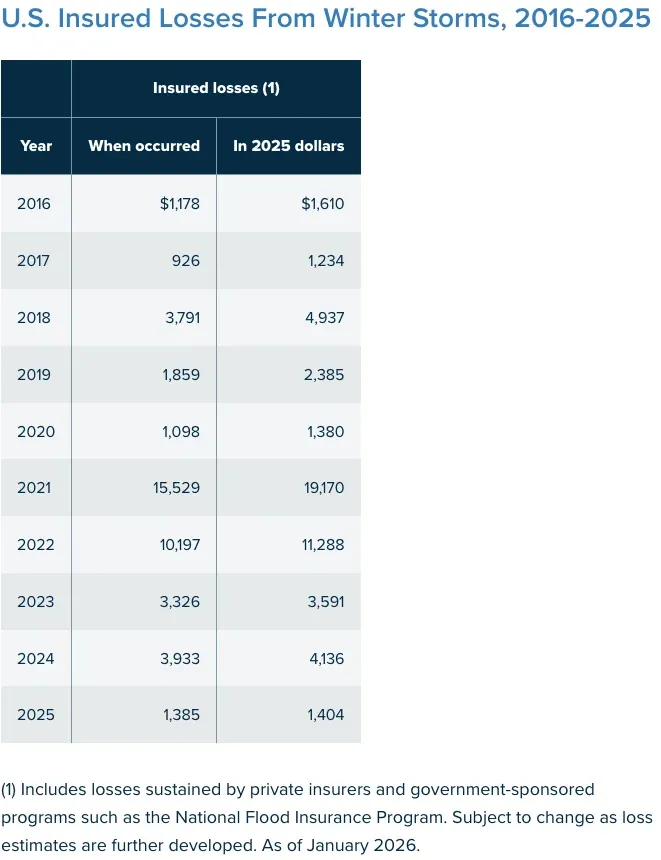 Figure 3: Insured winter storm losses stayed near $1 billion to $4 billion in most years, then jumped past $10 billion in 2021 and 2022. Source: Triple-I, Facts + Statistics: Winter storms, with data from Aon, Jan 2026. Screenshot of the source page, captured 21 Oct 2026.
How much did winter storms cost insurers in recent years?
Winter storms caused nearly $1.4 billion in insured losses in 2025, the fourth-lowest total of the last ten years (Triple-I, Jan 2026).
- Winter storms cost insurers $1.2 billion in 2016 (Triple-I, Jan 2026).
- The 2018 total was $3.8 billion (Triple-I, Jan 2026).
- The 2022 total was $10.2 billion (Triple-I, Jan 2026).
- The 2023 total was $3.3 billion (Triple-I, Jan 2026).
- The 2024 total was $3.9 billion (Triple-I, Jan 2026).
What are the costliest winter events on record?
The December 2022 storm known as Winter Storm Elliott ranks second at $7.7 billion in insured losses when it happened (Triple-I, Jan 2026).
- The March 1993 blizzard ranks third at $2.0 billion when it happened (Triple-I, Jan 2026).
- The February 2015 winter storm cost insurers $2.1 billion (Triple-I, Jan 2026).
- The January 2014 cold wave cost $1.75 billion (Triple-I, Jan 2026).
- NOAA puts the total economic cost of the February 2021 winter storm and cold wave at $22.7 billion (NOAA NCEI Billion-Dollar Disasters, Feb 2021).
- NOAA counted 262 deaths from that event (NOAA NCEI Billion-Dollar Disasters, Feb 2021).
- NOAA says nearly 10 million people were without power at the peak of the outage (NOAA NCEI Billion-Dollar Disasters, Feb 2021).
- NOAA says frozen pipes burst on thawing and caused water damage to buildings (NOAA NCEI Billion-Dollar Disasters, Feb 2021).
- NOAA calls it the costliest U.S. winter storm on record, more than doubling the inflation-adjusted cost of the 1993 Storm of the Century (NOAA NCEI Billion-Dollar Disasters, Feb 2021).
- The December 2022 storm cost $8.4 billion in economic losses and 87 deaths (NOAA NCEI Billion-Dollar Disasters, Dec 2022).
- The January 2024 cold wave caused $1.9 billion in damage and 41 deaths (NOAA NCEI Billion-Dollar Disasters, Jan 2024).
- NOAA counted two billion-dollar winter storm events among 27 billion-dollar disasters in 2024 (NOAA NCEI Billion-Dollar Disasters, Dec 2024).
- Early estimates put the Texas economic loss from Uri at $80 billion to $130 billion (Federal Reserve Bank of Dallas, Apr 2021).
- Early estimates put insured losses from the same freeze at $10 billion to $20 billion (Federal Reserve Bank of Dallas, Apr 2021).
Winter Storm Uri and Texas Homes
Uri is the case study every plumber in the South remembers. A state built for heat lost power for days, the temperature stayed below freezing for most of a week, and pipes failed in houses across Texas.
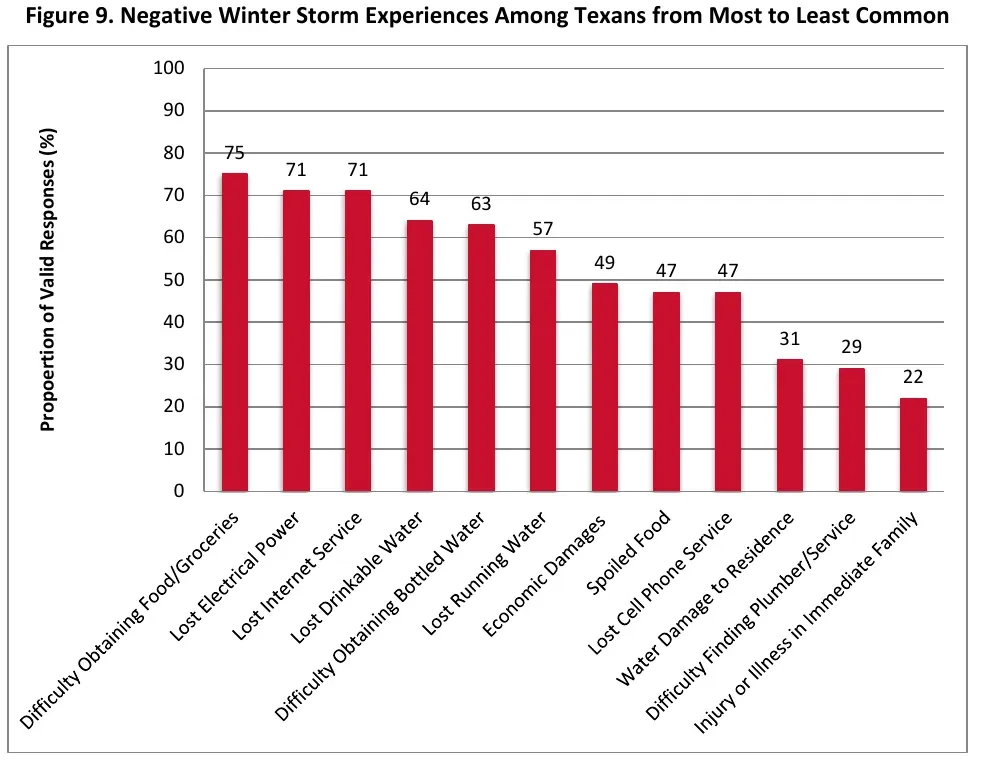 Figure 4: Water damage to the home and difficulty finding a plumber were the least common problems in the survey, yet they still reached about three in ten Texans. The report’s own tally puts loss of running water at 49% in its Figure 3, while this chart shows 57% for a slightly different question. Source: University of Houston Hobby School of Public Affairs, The Winter Storm of 2021, Mar 2021. Chart published by the source, captured 21 Oct 2026.
How many Uri insurance claims did Texas insurers receive?
Insurers reported 380,532 claims on residential property policies with replacement cost coverage (Texas Department of Insurance, Mar 2022). About 85% of all claims were on residential property policies (Texas Department of Insurance, Mar 2022).
- Insurers had paid $8.3 billion to policyholders by March 2022 (Texas Department of Insurance, Mar 2022).
- Another $2.1 billion sat in reserves for unpaid claims (Texas Department of Insurance, Mar 2022).
- The average incurred loss on a residential property claim was about $17,600 (Texas Department of Insurance, Mar 2022).
- The average commercial property claim was about $149,100 (Texas Department of Insurance, Mar 2022).
- Closed residential claims took 56.6 days to close on average (Texas Department of Insurance, Mar 2022).
- 37.9% of claims closed without a payment to the policyholder (Texas Department of Insurance, Mar 2022).
- Insurers expected reinsurance to cover about $3.4 billion of the loss, or 31% (Texas Department of Insurance, Mar 2022).
- Harris County had 112,052 reported claims, the most of any county (Texas Department of Insurance, Mar 2022).
- Dallas County had 48,420 claims (Texas Department of Insurance, Mar 2022).
- Bexar County had 44,232 claims (Texas Department of Insurance, Mar 2022).
- Travis County had 31,823 claims (Texas Department of Insurance, Mar 2022).
- A Harvard-led study of 502,040 claims found that 39.2% were denied (Health Affairs Scholar, Nov 2023).
What did Texans report in the survey after Uri?
69% of Texans lost electrical power at some point from February 14 to 20, for an average of 42 hours (University of Houston Hobby School, Mar 2021).
- 49% lost access to running water, and the average Texan who lost it went without for 52 hours (University of Houston Hobby School, Mar 2021).
- Only 18% of those with water damage believed insurance would likely cover the full cost (University of Houston Hobby School, Mar 2021).
- 17% of them said they had no insurance (University of Houston Hobby School, Mar 2021).
- 7% of Texans rated the difficulty finding a plumber as extremely serious (University of Houston Hobby School, Mar 2021).
How did Uri affect Texas water systems?
More than 14 million people in cities including Austin, Houston and San Antonio were ordered to boil water, because of broken pipes and power outages that lowered pressure (FERC and NERC, Nov 2021).
- Texas Commission on Environmental Quality records list 2,080 community water systems that issued a boil water advisory (PLOS Water, Jun 2023).
- Large urban systems issued advisories of 5 to 7 days (PLOS Water, Jun 2023).
- Small rural systems issued some advisories of 20 days or more (PLOS Water, Jun 2023).
- Uri was the largest known boil water event in U.S. history (PLOS Water, Jun 2023).
- In a survey of large water utilities, 85% lost power (PLOS Water, Jun 2023).
What did Uri cost the grid and the public?
More than 4.5 million people in Texas lost power, and some went without it for as long as four days (FERC and NERC, Nov 2021).
- Texans were exposed to below-freezing temperatures for over six days (FERC and NERC, Nov 2021).
- Grid operators shed 23,418 MW of load, the largest controlled firm load shed in U.S. history (FERC and NERC, Nov 2021).
- Departures from normal low temperatures ranged from 40 to 50 degrees (FERC and NERC, Oct 2023).
- The state health department confirmed 246 winter storm related deaths (Texas DSHS, Dec 2021).
- FEMA has approved individual assistance for 60,329 households under the Texas major disaster declaration (FEMA, Oct 2026).
- FEMA individual and household program approvals total $202.9 million (FEMA, Oct 2026).
Winter Storm Elliott and Winter Storm Fern
Two storms in four years show the problem is not limited to Texas. Elliott in December 2022 and Fern in January 2026 each sent freezing air into places where pipes are not built for it.
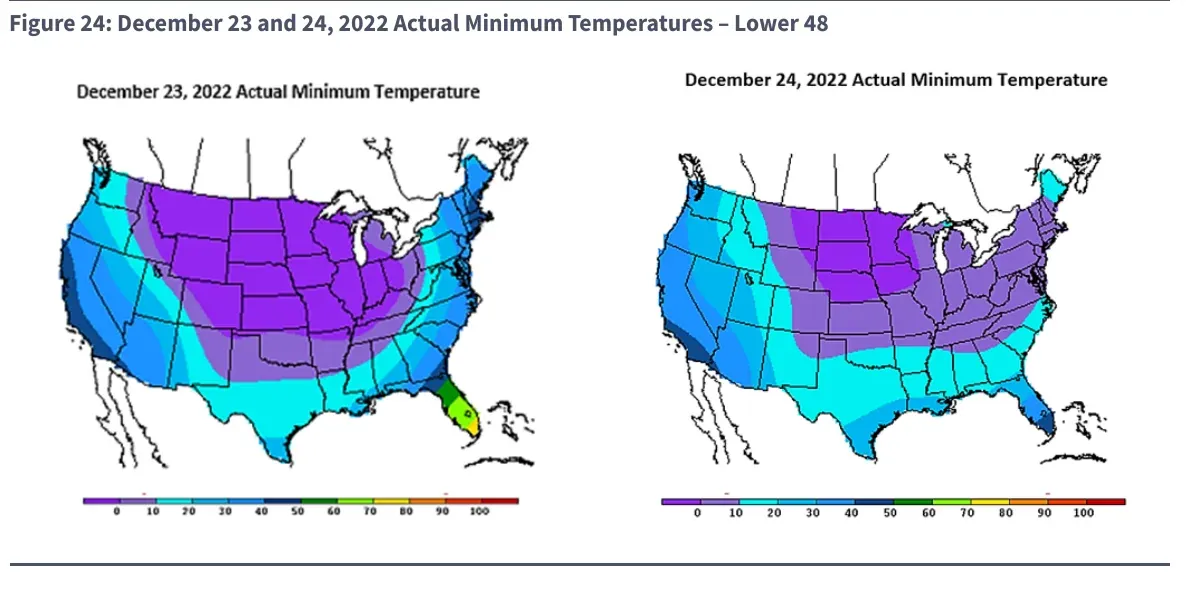 Figure 5: On December 24, 2022, nearly every state east of the Rockies had lows below 20 degrees F, the threshold where uninsulated pipes start to freeze. Source: FERC, NERC and Regional Entity staff, Inquiry into Bulk-Power System Operations During December 2022 Winter Storm Elliott, Oct 2023. Chart published by the source, captured 21 Oct 2026.
How fast did temperatures fall during Winter Storm Elliott?
Temperatures in Charleston, West Virginia dropped 42 degrees in six hours (FERC and NERC, Oct 2023).
- The Tennessee Valley Authority reported a drop of 46 degrees in five hours (FERC and NERC, Oct 2023).
- Chattanooga, Tennessee fell from 49 degrees to 7 degrees by December 23 (FERC and NERC, Oct 2023).
- Elliott’s departures from normal low temperatures were mostly 15 to 30 degrees (FERC and NERC, Oct 2023).
- About 240 million people were under winter weather warnings and advisories on December 23 (NOAA NCEI National Climate Report, Dec 2022).
- Chicago and Des Moines had over 80 consecutive hours of subzero wind chills (NOAA NCEI National Climate Report, Dec 2022).
- NOAA says more than a million customers lost power from Texas to Maine, and frozen pipes caused extensive water damage in homes and businesses (NOAA NCEI Billion-Dollar Disasters, Dec 2022).
- Grid operators shed 5,400 MW of firm load in the Eastern Interconnection (FERC and NERC, Oct 2023).
What did Winter Storm Fern cost in 2026?
Verisk’s initial analysis ranks Fern as the third costliest U.S. winter storm on record, behind Elliott and Uri (Verisk, Feb 2026).
- Verisk said 14 states, from Texas to Massachusetts, may each exceed USD 50 million in insured losses (Verisk, Feb 2026).
- Freezing rain reached up to 1 inch in eastern Texas, northern Louisiana, Mississippi, Tennessee and Kentucky, which raised the odds of burst pipes (Verisk, Feb 2026).
- State Farm had received over 20,000 home and auto claims by February 9, 2026 (State Farm, Feb 2026).
- Tennessee, Louisiana, Mississippi, Georgia and Texas had the most claims, and frozen pipes were among the main causes of loss (State Farm, Feb 2026).
- Mississippi insurers reported more than 12,000 claims and more than $107 million in incurred losses by late February (Mississippi Insurance Department, Feb 2026).
- More than 10,000 of those Mississippi claims were residential (Mississippi Insurance Department, Feb 2026).
- 55% of the Mississippi claims were closed, and more than $60 million had been paid (Mississippi Insurance Department, Feb 2026).
- FEMA has approved individual assistance for 49,175 households in Mississippi (FEMA, Oct 2026).
- FEMA individual and household program approvals in Mississippi total $211.7 million (FEMA, Oct 2026).
- Tennessee has 37,514 households approved for individual assistance (FEMA, Oct 2026).
How cold was Fern?
More than 1,200 counties and parishes across 27 states set at least one new daily minimum temperature record between January 23 and 27 (NOAA NCEI National Climate Report, Jan 2026).
- NOAA called it the most significant winter storm to strike the Southern Region since February 2021 (NOAA NCEI National Climate Report, Jan 2026).
- Dallas-Fort Worth Airport spent 58 consecutive hours at or below freezing (NWS Fort Worth, Jan 2026).
- The airport had 74 nonconsecutive hours at or below freezing during the event (NWS Fort Worth, Jan 2026).
- DFW set a record low maximum temperature of 21 degrees on January 25 (NWS Fort Worth, Jan 2026).
- The old record of 23 degrees dated to 1940 (NWS Fort Worth, Jan 2026).
- Western Canada’s January 2024 deep freeze caused over $180 million in insured damage (Insurance Bureau of Canada, Mar 2024).
- The Insurance Bureau of Canada said about 70% of claims from that event were personal property claims (Insurance Bureau of Canada, Mar 2024).
How Cold Does It Get Before Pipes Freeze?
The danger line sits at a hard freeze, not a blizzard. Southern cities cross it only a few nights a year, which helps explain why homes there are often built with little freeze protection.
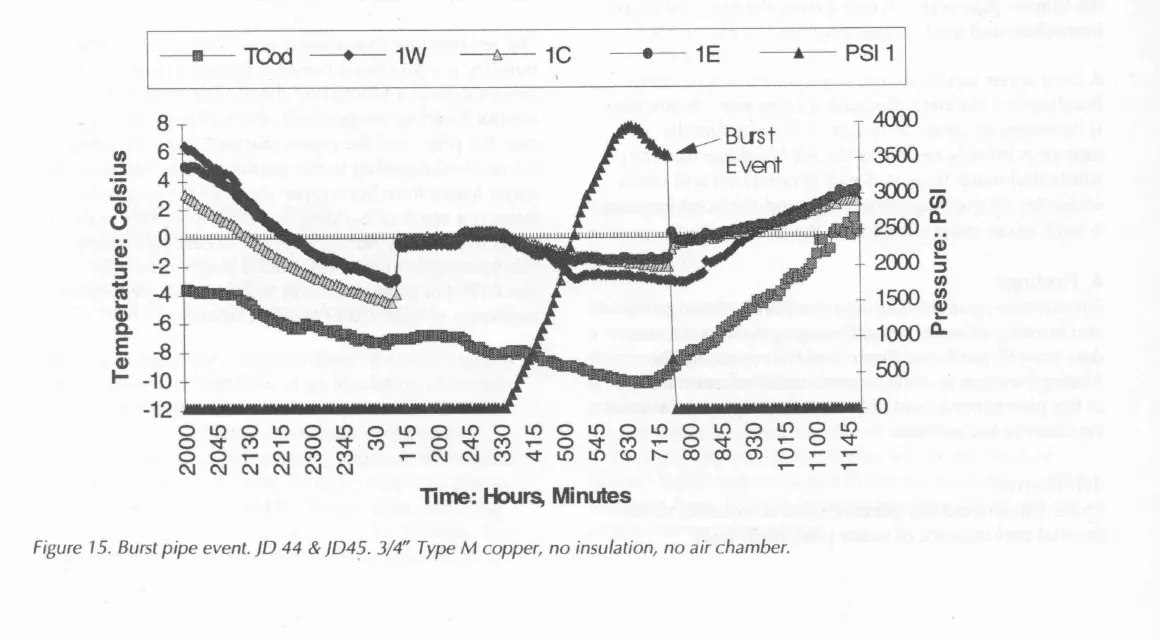 Figure 6: In a University of Illinois test, pressure in an unprotected copper pipe stayed near normal for hours, then climbed toward 4,000 psi once ice sealed the line. Source: University of Illinois Building Research Council, An Investigation into Freezing and Bursting Water Pipes in Residential Construction, 1996. Screenshot of the source page, captured 21 Oct 2026.
At what temperature do pipes freeze?
State Farm says pipes in homes with too little insulation may freeze and break when the outside temperature drops below 20 degrees F (State Farm, Jan 2019).
- State Farm also says that below 32 degrees F, pipes can freeze and burst whether they are plastic or copper (State Farm, Dec 2024).
- In a University of Illinois freezer test, a pipe held at 20 degrees F formed a complete ice blockage in 11.5 hours (University of Illinois Building Research Council, 1996).
- At 10 degrees F the blockage formed in 6.5 hours (University of Illinois Building Research Council, 1996).
- At 0 degrees F it took about 4.75 hours (University of Illinois Building Research Council, 1996).
- The Illinois researchers said the problem is worst in southern states, where builders use methods that do not protect pipes from occasional hard freezes (University of Illinois Building Research Council, 1996).
- The Insurance Institute for Property Loss Reduction estimated that insured freeze-related losses over the prior decade exceeded $4 billion (University of Illinois Building Research Council, 1996).
- A cold spell on December 22 and 23, 1989 caused damage from Texas to Florida and hundreds of thousands of insurance claims (University of Illinois Building Research Council, 1996).
- Homes in warmer climates face more risk because pipes often run through uninsulated attics or crawl spaces (State Farm, Dec 2022).
How many hard-freeze nights does each city get?
Houston averages 0.1 days a year with a low at or below 20 degrees F and 10.1 days at or below 32 (NOAA NCEI Climate Normals, May 2021). That small number is why a single event does so much damage.
- Austin averages 1.7 days at or below 20 degrees F and 33.0 days at or below 32 (NOAA NCEI Climate Normals, May 2021).
- Dallas-Fort Worth averages 2.5 days at or below 20 degrees F and 29.2 days at or below 32 (NOAA NCEI Climate Normals, May 2021).
- Jackson, Mississippi averages 2.8 days at or below 20 degrees F and 39.6 days at or below 32 (NOAA NCEI Climate Normals, May 2021).
- Atlanta averages 3.8 days at or below 20 degrees F and 35.7 days at or below 32 (NOAA NCEI Climate Normals, May 2021).
- Memphis averages 5.9 days at or below 20 degrees F and 44.4 days at or below 32 (NOAA NCEI Climate Normals, May 2021).
- Charlotte averages 7.2 days at or below 20 degrees F and 58.3 days at or below 32 (NOAA NCEI Climate Normals, May 2021).
- New York’s Central Park averages 17.1 days at or below 20 degrees F and 67.3 days at or below 32 (NOAA NCEI Climate Normals, May 2021).
- Chicago O’Hare averages 50.0 days at or below 20 degrees F and 121.3 days at or below 32 (NOAA NCEI Climate Normals, May 2021).
- Minneapolis-St. Paul averages 81.8 days at or below 20 degrees F and 147.3 days at or below 32 (NOAA NCEI Climate Normals, May 2021).
Does Prevention Work?
Prevention is mostly small jobs, and most people wait for the forecast to do them. Even ahead of the worst freeze in decades, fewer than half of Texans insulated their pipes.
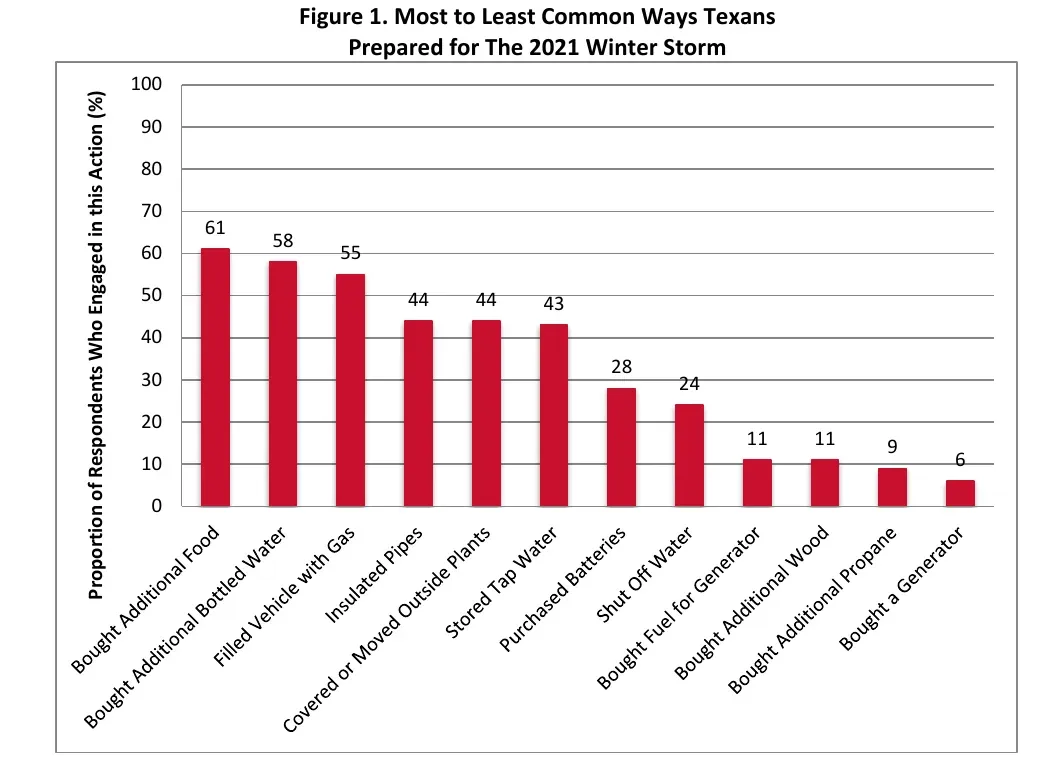 Figure 7: Texans bought food and water first, and fewer than half insulated their pipes before the storm hit. Source: University of Houston Hobby School of Public Affairs, The Winter Storm of 2021, Mar 2021. Chart published by the source, captured 21 Oct 2026.
How many people prepare their pipes before a freeze?
44% of Texans insulated the pipes in their home before Uri (University of Houston Hobby School, Mar 2021).
- 24% shut off the water in their home (University of Houston Hobby School, Mar 2021).
- State Farm lists three central causes of frozen pipes: quick drops in temperature, poor insulation and thermostats set too low (State Farm, Jan 2024).
- IBHS advises setting the thermostat to at least 55 degrees F, even when no one is home (IBHS, Nov 2024).
- Chubb’s 2017 survey found that only 18% of homeowners had installed a water leak detection device (Chubb, Aug 2017).
- The same survey found that 94% had installed fire and smoke alarms (Chubb, Aug 2017).
What Do Freezes Mean for Plumbers?
A freeze sends a flood of calls to local shops at the same time. The numbers show how hard it was to find help during Uri and how far Texas went to add plumbers.
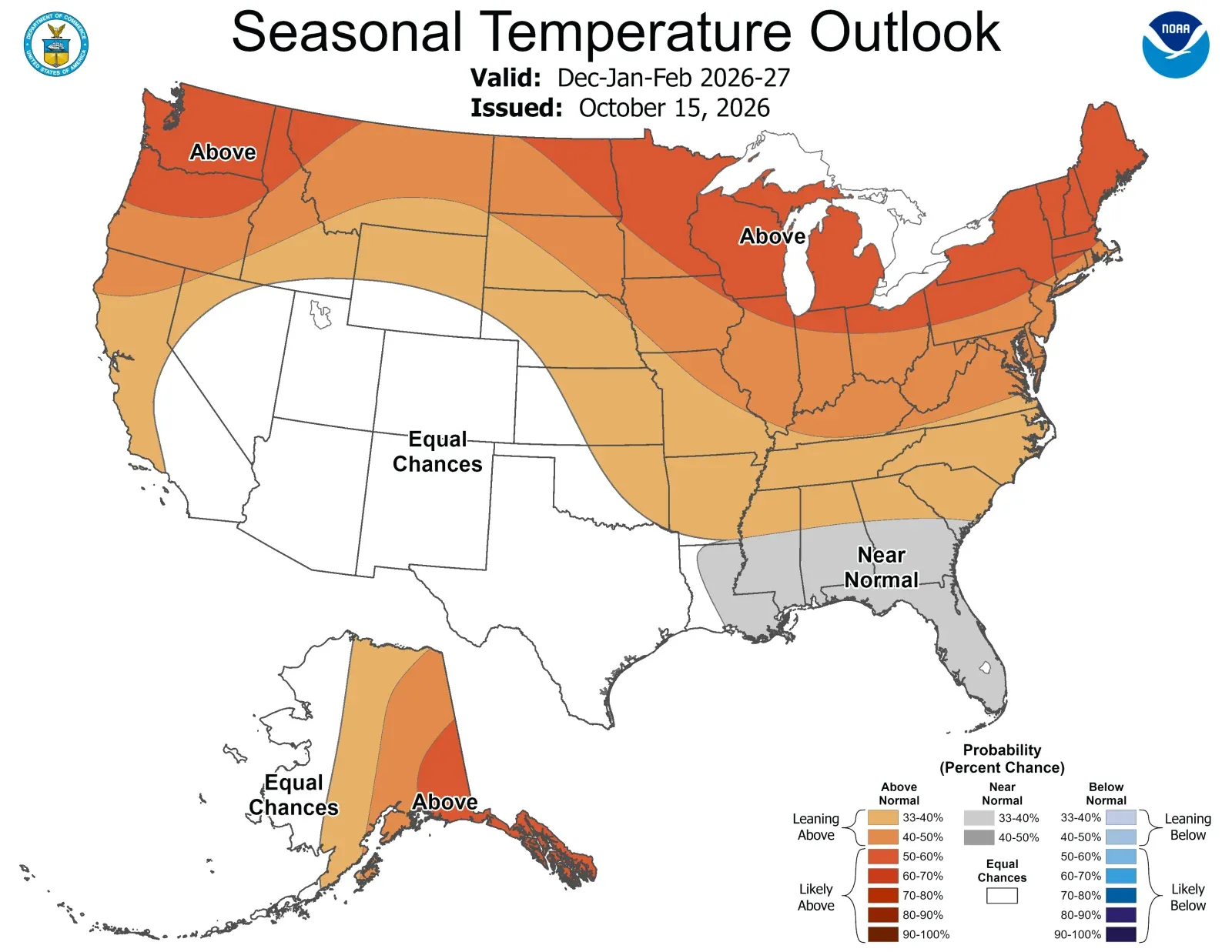 Figure 8: NOAA expects a warmer than average winter across the north and much of the East, with equal chances in Texas and the Southwest, which means hard freezes are still possible where homes are least prepared. Source: NOAA, El Nino looms large over U.S. Winter Outlook, Oct 2026. Chart published by the source, captured 21 Oct 2026.
How did Texas add plumbers during Uri?
The Texas State Board of Plumbing Examiners let qualified apprentices with Drain Cleaner or Residential Utility Installer endorsements make repairs under the general supervision of a Responsible Master Plumber (Texas State Board of Plumbing Examiners, Feb 2021).
- The board let plumbers whose licenses had expired for more than two years reinstate without the exam (Texas State Board of Plumbing Examiners, Feb 2021).
- It waived continuing education for licenses expiring from February through April 2021 (Texas State Board of Plumbing Examiners, Feb 2021).
- In a February 23, 2021 announcement, the governor and the board said they had identified an additional 500 licensees able to work under general supervision (Office of the Texas Governor, Feb 2021).
What does NOAA expect for winter 2026-27?
NOAA’s outlook favors warmer than average temperatures for the northern U.S. from December 2026 to February 2027 (NOAA, Oct 2026).
- It expects wetter than average conditions across the southern U.S. from California to Florida (NOAA, Oct 2026).
- NOAA’s weather service director said a very strong El Nino tilts the odds toward stormier weather across the South (NOAA, Oct 2026).
- Near normal temperatures are most likely for parts of the Southeast, including Florida (NOAA, Oct 2026).
Methodology and Sources
Statistics were selected for relevance to frozen and burst pipes, and each one was traced to the group that produced it: insurers and insurance regulators, federal agencies, state agencies, universities and trade bodies. Aggregator pages and roundups were used only to find leads and are not cited. State Farm publishes its figures over different windows, so each is labeled with its period and not blended. Texas Department of Insurance data comes from its March 2022 compilation, read through the Texas State Library’s archived copy of the report. Several storm figures are estimates and may change as losses mature. This page is reviewed monthly.
Sources
- Angi, How Much Does Burst Pipe Repair Cost?
- Angi, What To Do If Your Pipes Freeze
- Chubb, Preventing Water Damage
- Chubb, Chubb Survey Identifies Overlooked Home Risks (2017 Water Risk Survey)
- FEMA, OpenFEMA disaster summary, DR-4586 Texas
- FEMA, OpenFEMA disaster summary, DR-4898 Tennessee
- FEMA, OpenFEMA disaster summary, DR-4899 Mississippi
- FERC and NERC, The February 2021 Cold Weather Outages in Texas and the South Central United States
- FERC and NERC, Inquiry into Bulk-Power System Operations During December 2022 Winter Storm Elliott
- Farmers Insurance, Nearly Two-Thirds of Freezing Pipes and Temperature Claims in Homes Occur Between December and February
- Federal Reserve Bank of Dallas, Cost of Texas’ 2021 deep freeze justifies weatherization
- Health Affairs Scholar, Disparities in property insurance relief among socially vulnerable Texas communities after Winter Storm Uri
- IBHS, IBHS Winter Weather Ready guide
- Insurance Bureau of Canada, Western Canada deep freeze causes over $180 million in insured damage
- Mississippi Insurance Department, Winter Storm Fern Losses Exceed $107 Million
- NOAA, El Nino looms large over U.S. Winter Outlook
- NOAA NCEI Billion-Dollar Disasters, U.S. Billion-Dollar Weather and Climate Disasters
- NOAA NCEI Billion-Dollar Disasters, U.S. Billion-Dollar Weather and Climate Disasters 1980-2024, event list
- NOAA NCEI Climate Normals, 1991-2020 Annual/Seasonal Normals, USW00003927
- NOAA NCEI Climate Normals, 1991-2020 Annual/Seasonal Normals, USW00003940
- NOAA NCEI Climate Normals, 1991-2020 Annual/Seasonal Normals, USW00012960
- NOAA NCEI Climate Normals, 1991-2020 Annual/Seasonal Normals, USW00013874
- NOAA NCEI Climate Normals, 1991-2020 Annual/Seasonal Normals, USW00013881
- NOAA NCEI Climate Normals, 1991-2020 Annual/Seasonal Normals, USW00013893
- NOAA NCEI Climate Normals, 1991-2020 Annual/Seasonal Normals, USW00013904
- NOAA NCEI Climate Normals, 1991-2020 Annual/Seasonal Normals, USW00014922
- NOAA NCEI Climate Normals, 1991-2020 Annual/Seasonal Normals, USW00094728
- NOAA NCEI Climate Normals, 1991-2020 Annual/Seasonal Normals, USW00094846
- NOAA NCEI National Climate Report, National Climate Report, December 2022
- NOAA NCEI National Climate Report, National Climate Report, January 2026
- NWS Fort Worth, January 2026 winter storm summary
- Office of the Texas Governor, Governor Abbott, TSBPE Announce Additional 500 Licensees To Assist Texans With Plumbing Repairs
- PLOS Water, Disparities in disruptions to public drinking water services in Texas communities during Winter Storm Uri 2021
- State Farm, Freeze & Thaw: Bad Mix For All
- State Farm, Frozen Pipe Losses Up in 2018
- State Farm, Frozen Pipes Can Be Costly
- State Farm, Frozen Pipes? Not So Nice. Beat Winter Water Woes Before They Strike
- State Farm, Cold weather snaps can break your pipes and burst your budget
- State Farm, State Farm responds to widespread winter catastrophe
- State Farm, Water & Ice: Not So Nice
- State Farm, Winter prep 101
- Texas DSHS, February 2021 Winter Storm-Related Deaths, Texas
- Texas Department of Insurance, Insured Losses Resulting from the February 2021 Texas Winter Weather Event (data as of March 31, 2022)
- Texas State Board of Plumbing Examiners, Winter Storm 2021 Regulation Changes
- The Hartford, Water And Freezing Damage, Burglary Lead The Hartford’s Top Five Small-Business Claims
- Triple-I, Facts + Statistics: Winter storms (data from Aon)
- University of Houston Hobby School, The Winter Storm of 2021
- University of Illinois Building Research Council, An Investigation into Freezing and Bursting Water Pipes in Residential Construction
- Verisk, Verisk Estimates Insured Losses for Winter Storm Fern Could Reach USD 4 Billion
Glossary
- DFW: Dallas-Fort Worth International Airport.
- FEMA: Federal Emergency Management Agency.
- FERC: Federal Energy Regulatory Commission.
- IBHS: Insurance Institute for Business and Home Safety.
- MW: megawatt, a unit of electric power.
- NCEI: NOAA National Centers for Environmental Information.
- NERC: North American Electric Reliability Corporation.
- NOAA: National Oceanic and Atmospheric Administration.
- psi: pounds per square inch, a unit of pressure.