Plumbers using AI phone calling 2025 statistics are hard to find, because no government survey asks plumbers how they answer the phone. The closest data covers specialty trade contractors, construction firms and small businesses in general, plus the filings of the software companies that now sell AI call answering to home service shops.
This page keeps to primary sources: Census Bureau surveys, the Federal Reserve, the US Chamber of Commerce, Pew Research Center, Gartner, the Bureau of Labor Statistics, the Federal Communications Commission and public company filings. Vendor blog posts and roundup pages are left out. We found no government or academic dataset on how many calls plumbing shops miss, so this page has no missed-call rate. Updated October 2026.
Read the numbers as a direction, not as a count of plumbers. Trade firms started far below the national average, they are closing the gap, and customers are split on talking to a machine. For the wider picture of software use in small shops, see CRM statistics. For the size of the trade itself, see plumbing industry statistics.
Key Takeaways
- Only 1.4% of US construction firms used AI in the Census Bureau’s 2024 snapshot, which covered September 2023 to February 2024 (U.S. Census Bureau CES 24-16, Mar 2024).
- 47% of small construction businesses said they use AI in the US Chamber of Commerce’s 2025 survey (U.S. Chamber of Commerce, Aug 2025).
- 16.9% of specialty trade contractors, the Census group that includes plumbing, expected to use AI in the next six months, in the cycle that closed October 4, 2026 (U.S. Census Bureau BTOS, Oct 2026).
- 21.6% of AI-using firms used virtual agents or chatbots and 15.9% used speech or voice recognition, in the Census Bureau’s 2024 snapshot (U.S. Census Bureau CES 24-16, Mar 2024).
- 44% of customer service leaders were exploring a customer-facing generative AI voicebot, 11% were piloting one and 5% had one live, in a 2024 Gartner survey (Gartner, Dec 2024).
- ServiceTitan’s annual report says its Virtual Agents use AI to handle overflow and after-hours calls and to book, reschedule and confirm appointments (ServiceTitan 10-K FY2026, Mar 2026).
- Yelp Host, Yelp’s AI call answering service for restaurants, reached an annual run rate of 2.4 million calls handled in July 2026, more than triple January 2026 (Yelp 10-Q Q2 2026, Aug 2026).
- Yelp bought Hatch, an AI lead management company for service businesses, for about $271.2 million in cash (Yelp 10-Q Q2 2026, Aug 2026).
- Google Search can call local businesses to get pricing and availability for a customer, and it began rolling out to all US Search users in July 2025 (Google, Jul 2025).
- 64% of customers would prefer that companies did not use AI in customer service, and 53% would consider switching to a competitor (Gartner, Jul 2024).
- 49% of US adults use AI chatbots, up from 33% in 2024 (Pew Research Center, Jun 2026).
- The FCC said the Telephone Consumer Protection Act (TCPA) does not extend to technologies used to answer inbound calls (Federal Communications Commission, Aug 2024).
- 95.7% of businesses that use AI said it caused no change in their total employment (U.S. Census Bureau BTOS, Feb 2026).
- The BLS projects customer service representative employment to fall 5% from 2025 to 2035 (BLS Occupational Outlook Handbook, Aug 2026).
AI in Plumbing Statistics: How Many Trade Businesses Use AI?
Trade shops are among the last to pick up AI, and the gap with office industries is wide. The gap is closing, but the trade samples are small and the monthly readings move around.
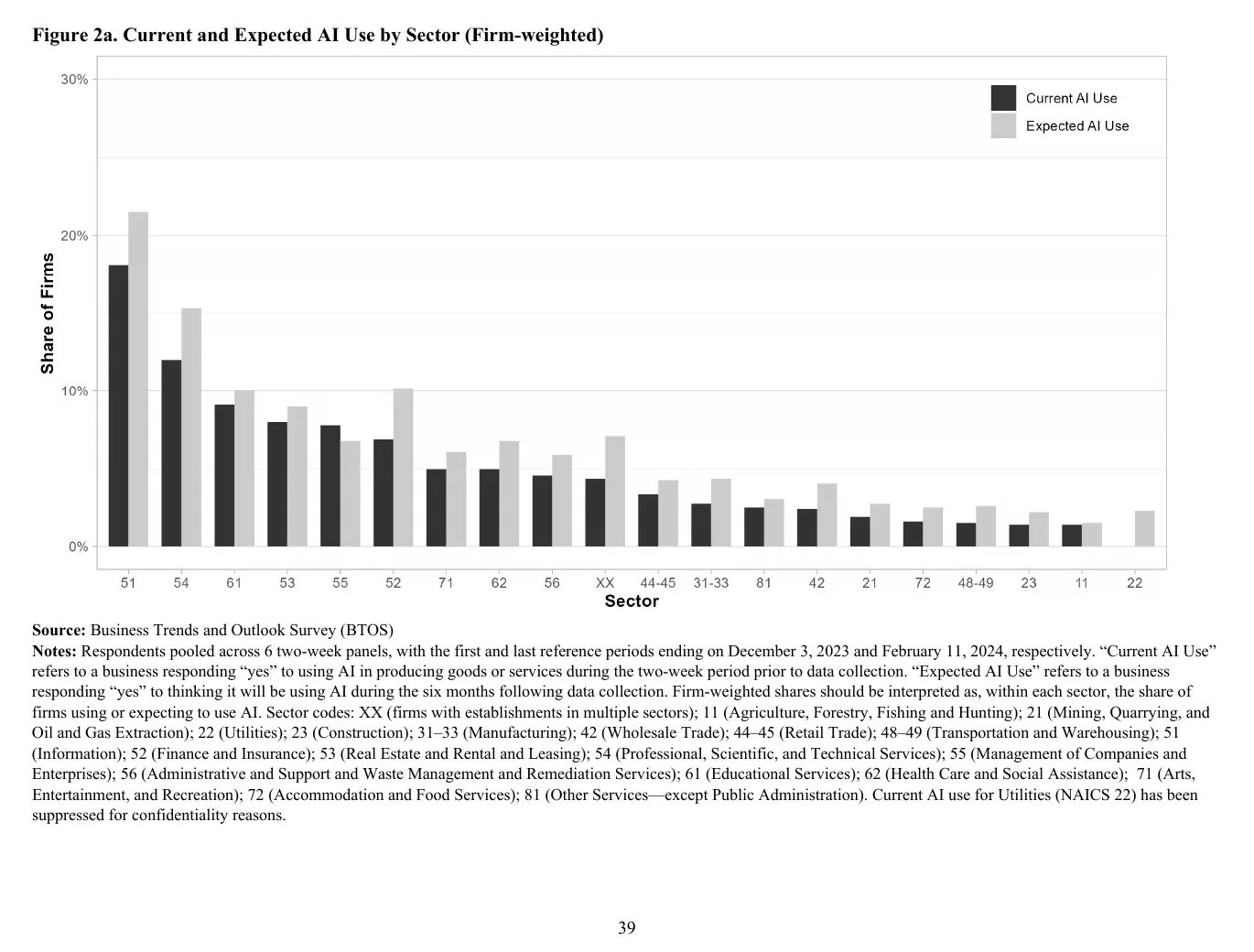 Figure 1: In the Census Bureau’s 2024 AI snapshot, information and professional services led while construction (sector 23) sat near the bottom, which is the starting line for any trade business today. Source: U.S. Census Bureau, Tracking Firm Use of AI in Real Time, Figure 2a, Mar 2024. Screenshot of the source report page, captured 21 Oct 2026.
How many specialty trade contractors use AI?
The Census Bureau does not break out plumbers, but its specialty trade contractor group (NAICS 238) includes them, along with the electrical, heating and cooling trades. Its AI use rate climbed through 2025 and 2026.
- 5.7% of specialty trade contractors used AI in the survey cycle that closed November 30, 2025, the first cycle with data in the Census file (U.S. Census Bureau BTOS, Oct 2026).
- 9.0% used AI in the cycle that closed June 28, 2026 (U.S. Census Bureau BTOS, Oct 2026).
- 14.3% used AI in the cycle that closed September 20, 2026, the highest reading in the file (U.S. Census Bureau BTOS, Oct 2026).
- 10.0% expected to use AI in the next six months in the cycle that closed November 30, 2025 (U.S. Census Bureau BTOS, Oct 2026).
- 14.7% expected to use AI in the next six months in the cycle that closed August 9, 2026 (U.S. Census Bureau BTOS, Oct 2026).
- Construction of buildings, a neighboring group, reported 25.4% AI use in the cycle that closed October 4, 2026 (U.S. Census Bureau BTOS, Oct 2026).
How does AI use in the trades compare with other industries?
Office-based industries use AI at several times the rate of trade contractors. Every reading below is from the cycle that closed October 4, 2026.
- Information firms: 50.2% (U.S. Census Bureau BTOS, Oct 2026).
- Professional, scientific and technical services: 42.7% (U.S. Census Bureau BTOS, Oct 2026).
- Real estate: 32.2% (U.S. Census Bureau BTOS, Oct 2026).
- Health care and social assistance: 24.8% (U.S. Census Bureau BTOS, Oct 2026).
- Administrative and support services: 21.7% (U.S. Census Bureau BTOS, Oct 2026).
- Other services, which includes repair and maintenance: 12.7% (U.S. Census Bureau BTOS, Oct 2026).
- Accommodation and food services: 10.1% (U.S. Census Bureau BTOS, Oct 2026).
What do small business surveys add?
Three other surveys help size the trend. The Census Bureau’s 2024 snapshot gives the baseline, its 2026 supplement gives construction and shop-size detail, and the Chamber surveys small firms directly.
- Nationwide AI use rose from 3.7% to 5.4% of firms between September 2023 and February 2024 (U.S. Census Bureau CES 24-16, Mar 2024).
- The Census Bureau expected about 6.6% of firms to use AI by early fall 2024 (U.S. Census Bureau CES 24-16, Mar 2024).
- In the winter 2025-26 supplement, 17.9% of all US businesses used AI, against 9.2% in construction (U.S. Census Bureau BTOS, Feb 2026).
- Firms with 5 to 9 employees reported 17.0% AI use, and firms with 10 to 19 employees reported 17.2% (U.S. Census Bureau BTOS, Feb 2026).
- Among small businesses in the Chamber’s survey, 77% of technology firms used AI (U.S. Chamber of Commerce, Aug 2025).
- The same survey put retail at 54%, manufacturing at 46% and transportation at 46% (U.S. Chamber of Commerce, Aug 2025).
Plumbers Using AI Statistics: What Do Firms Use It For?
Most AI in small businesses is writing help and search, not phone work. Voice agents and chatbots exist in the data, but they are a small slice.
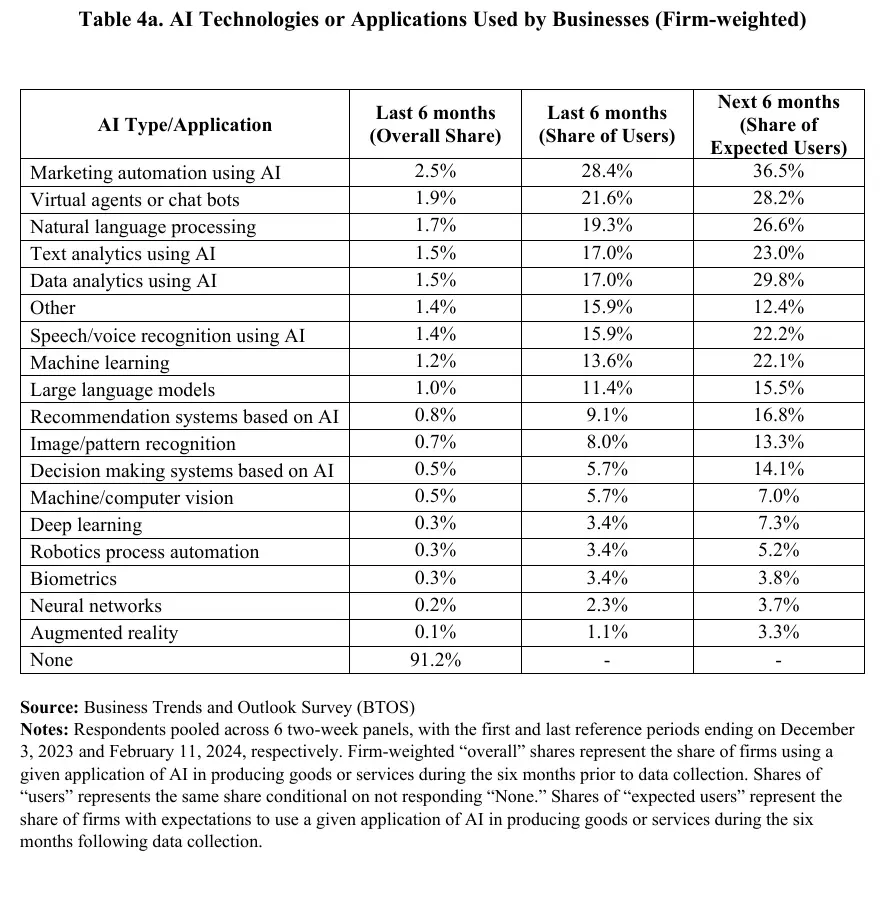 Figure 2: The Census Bureau’s 2024 table lists every kind of AI it asked about. Virtual agents rank second among AI users and speech recognition seventh, and 91.2% of all firms used none of the listed kinds. Source: U.S. Census Bureau, Tracking Firm Use of AI in Real Time, Table 4a, Mar 2024. Screenshot of the source report page, captured 21 Oct 2026.
Which AI tools do firms use, and how much of it is voice?
In the Census Bureau’s 2024 snapshot, marketing automation was the most common application among AI users. Virtual agents came second, and speech or voice recognition sat near the middle.
- Marketing automation was used by 28.4% of AI-using firms (U.S. Census Bureau CES 24-16, Mar 2024).
- Natural language processing was used by 19.3% (U.S. Census Bureau CES 24-16, Mar 2024).
- Large language models were used by 11.4% (U.S. Census Bureau CES 24-16, Mar 2024).
- Virtual agents or chatbots were used by 1.9% of all firms (U.S. Census Bureau CES 24-16, Mar 2024).
- Speech or voice recognition was used by 1.4% of all firms (U.S. Census Bureau CES 24-16, Mar 2024).
- Among firms expecting to use AI, 28.2% expected to use virtual agents in the next six months (U.S. Census Bureau CES 24-16, Mar 2024).
- Among the same group, 22.2% expected to use speech or voice recognition (U.S. Census Bureau CES 24-16, Mar 2024).
Which business functions use AI in construction?
Construction firms used AI mostly for strategy, sales and marketing, and least for the work itself. Customer service sat in the middle. All readings cover the six months before the winter 2025-26 supplement.
- Sales and marketing: 7.7% of construction firms (U.S. Census Bureau BTOS, Feb 2026).
- Strategy and business development: 7.5% (U.S. Census Bureau BTOS, Feb 2026).
- Customer service: 4.4% (U.S. Census Bureau BTOS, Feb 2026).
- Provision of services, products or merchandise: 1.5% (U.S. Census Bureau BTOS, Feb 2026).
- Production of goods, which includes construction work: 0.7% (U.S. Census Bureau BTOS, Feb 2026).
Which functions do shops plan to add next?
Among construction firms that plan to use AI, sales and marketing leads and customer service sits in the middle of the list. Firms with 5 to 19 employees, across all industries, plan customer service use at higher rates than construction firms do.
- 62.4% of construction firms planning AI expected to use it in sales and marketing (U.S. Census Bureau BTOS, Feb 2026).
- 37.9% expected to use it in customer service (U.S. Census Bureau BTOS, Feb 2026).
- 16.6% expected to use it to provide services (U.S. Census Bureau BTOS, Feb 2026).
- Among planners with 5 to 9 employees, 43.2% expected to use it in customer service (U.S. Census Bureau BTOS, Feb 2026).
- Among planners with 10 to 19 employees, 44.3% did (U.S. Census Bureau BTOS, Feb 2026).
What do firms use AI for day to day?
Small firms use AI as a helper for writing and thinking, not as a replacement for staff. The Federal Reserve and the Census Bureau agree on that.
- Among small employer firms that use AI, 61% used it for individual productivity (Federal Reserve Banks SBCS, Mar 2026).
- 51% used it for planning or analysis (Federal Reserve Banks SBCS, Mar 2026).
- 38% used it for administrative business functions (Federal Reserve Banks SBCS, Mar 2026).
- 21% used it for process automation (Federal Reserve Banks SBCS, Mar 2026).
- 20.8% of businesses said their employees used generative AI for work in the prior six months (U.S. Census Bureau BTOS, Feb 2026).
- Of those, 85.4% used it for writing or editing documents, emails or communications (U.S. Census Bureau BTOS, Feb 2026).
Does AI cost jobs at the firms that use it?
Almost never, according to the firms themselves. The pattern held from the 2024 Census snapshot to the latest data.
- 43.7% of AI-using firms used AI to supplement or enhance a task done by an employee (U.S. Census Bureau BTOS, Feb 2026).
- 10.1% used it to perform a task previously done by an employee (U.S. Census Bureau BTOS, Feb 2026).
- 10.6% used it to introduce a new task (U.S. Census Bureau BTOS, Feb 2026).
- Of firms replacing employee tasks, 70.9% said AI replaced a small number of tasks (U.S. Census Bureau BTOS, Feb 2026).
- 2.3% of AI users said AI increased their total employment and 2.0% said it decreased it (U.S. Census Bureau BTOS, Feb 2026).
- In the 2024 snapshot, 94.6% of AI-using firms reported no net change in employment from AI (U.S. Census Bureau CES 24-16, Mar 2024).
- Among small employer firms that reported a change in labor costs from AI, 10% said they added employees and 11% said they cut employees (Federal Reserve Banks SBCS, Mar 2026).
- To use AI, 15.0% of AI users trained current staff and 15.4% developed new workflows (U.S. Census Bureau BTOS, Feb 2026).
- Only 1.3% hired staff trained in AI, and 3.8% used vendors or consultants (U.S. Census Bureau BTOS, Feb 2026).
How Many Shops Plan to Add AI, and What Holds Them Back?
Planning is running ahead of doing, and the biggest barrier is not cost. It is the belief that AI does not apply to the business.
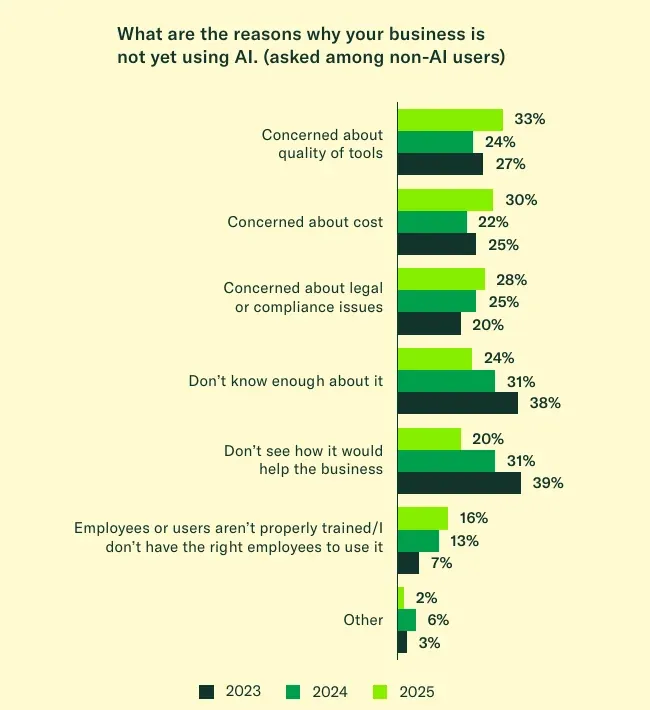 Figure 3: Among small businesses that do not use AI, worry about tool quality and cost rose in 2025 while “I don’t know enough about it” and “I don’t see how it would help” fell. Source: U.S. Chamber of Commerce, Empowering Small Business 2025, page 21, Aug 2025. Screenshot of the source report page, captured 21 Oct 2026.
How many shops expect to use AI soon?
About one in five US businesses expected to use AI in the next six months in the winter supplement, and construction ran below that. Many current users also have doubts.
- 21.6% of all US businesses expected to use AI in the next six months (U.S. Census Bureau BTOS, Feb 2026).
- 12.9% of construction firms expected to (U.S. Census Bureau BTOS, Feb 2026).
- 20.6% of firms with 5 to 9 employees expected to (U.S. Census Bureau BTOS, Feb 2026).
- 21.9% of firms with 10 to 19 employees expected to (U.S. Census Bureau BTOS, Feb 2026).
- Of firms using AI in the 2024 snapshot, 67.9% expected to keep using it (U.S. Census Bureau CES 24-16, Mar 2024).
- 14.5% of those users did not expect to keep using it (U.S. Census Bureau CES 24-16, Mar 2024).
- 22.9% of all firms did not know whether they would use AI in the future (U.S. Census Bureau CES 24-16, Mar 2024).
- 33% of small employer firms had no plans to use AI, and 6% were unsure (Federal Reserve Banks SBCS, Mar 2026).
- 80% of small businesses in the Chamber’s survey said competitors’ use of AI sped up their own plans (U.S. Chamber of Commerce, Aug 2025).
- 80% of small business owners said they believe AI will help their business, up 20 points in a year (U.S. Chamber of Commerce, Aug 2025).
Why do firms say AI does not fit?
Most firms that do not plan to use AI say it does not apply to them. Tool quality, legal worries and lack of knowledge come next.
- 69.0% of construction firms with no AI plans said AI is not applicable to the business (U.S. Census Bureau BTOS, Feb 2026).
- 22.4% cited a lack of knowledge about what AI can do (U.S. Census Bureau BTOS, Feb 2026).
- 18.9% cited privacy or security concerns (U.S. Census Bureau BTOS, Feb 2026).
- 10.4% said AI is not mature enough yet (U.S. Census Bureau BTOS, Feb 2026).
- 4.9% said it is too expensive (U.S. Census Bureau BTOS, Feb 2026).
- Across all US firms with no plans, 13.0% said AI is not mature enough, 8.6% cited bias and 2.8% cited laws or regulations (U.S. Census Bureau BTOS, Feb 2026).
- Among small business non-users in the Chamber’s survey, 33% were concerned about the quality of tools (U.S. Chamber of Commerce, Aug 2025).
- 30% were concerned about cost and 28% about legal or compliance issues (U.S. Chamber of Commerce, Aug 2025).
- 20% said they do not see how AI would help the business (U.S. Chamber of Commerce, Aug 2025).
- Among small employer firms with no AI plans, 17% named accuracy (Federal Reserve Banks SBCS, Mar 2026).
- 13% said AI is too difficult or confusing, and 12% said they lack the time (Federal Reserve Banks SBCS, Mar 2026).
How do firms that adopt AI handle training and tools?
Adopters mostly buy AI built by others, and they train staff on the job. Few have gone all the way in.
- 63% of small business AI users in the Chamber’s survey mostly or entirely use AI tools built by other companies (U.S. Chamber of Commerce, Aug 2025).
- Only 8% mainly build their own AI tools (U.S. Chamber of Commerce, Aug 2025).
- 98% of small business AI users said they are working to upskill employees (U.S. Chamber of Commerce, Aug 2025).
- 41% give staff AI tools and hope they learn them (U.S. Chamber of Commerce, Aug 2025).
- 36% have added AI skills to their hiring process (U.S. Chamber of Commerce, Aug 2025).
- Among small employer firms using AI, 49% said they were experimenting and 44% said AI was partially integrated (Federal Reserve Banks SBCS, Mar 2026).
- 42% of AI users called AI somewhat important to their core goods or services, and 37% called it not important (Federal Reserve Banks SBCS, Mar 2026).
- Users named data security and privacy (28%), time to implement or train (25%) and cost (21%) as challenges (Federal Reserve Banks SBCS, Mar 2026).
Who Sells AI Phone Answering to Home Service Shops?
The AI call answering market is now real enough that public companies report on it in their filings. Most of the numbers are from software vendors, so treat them as signs of supply, not proof that plumbers get results.
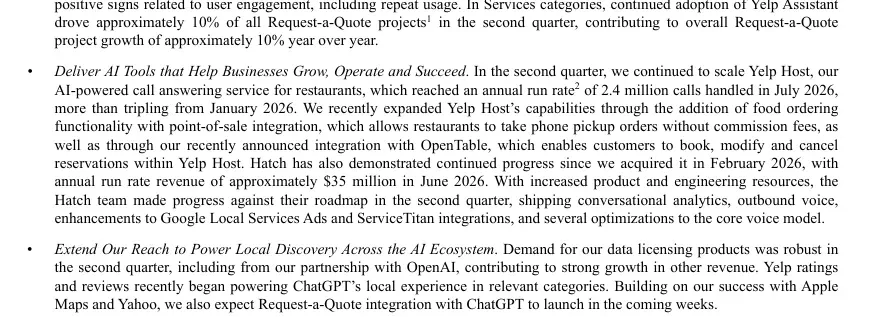 Figure 4: Yelp’s quarterly filing describes its AI call answering service for restaurants and its newly bought AI lead tool for service businesses, which integrates with ServiceTitan and Google Local Services Ads. Source: Yelp, Form 10-Q for the quarter ended June 30, 2026, Aug 2026. Excerpt of the source filing, captured 21 Oct 2026.
What do trade software vendors say their AI does on calls?
ServiceTitan began with plumbing and now sells call tools to all trades. Its annual report lists call booking, call tracking and AI features side by side.
- ServiceTitan began by serving a single trade, plumbing (ServiceTitan 10-Q Q2 FY2027, Sep 2026).
- Its Phones Pro system reports call abandonment rates and average call duration (ServiceTitan 10-K FY2026, Mar 2026).
- Phones Pro also provides call transcripts and automated alerts for escalation (ServiceTitan 10-K FY2026, Mar 2026).
- Lead tracking assigns a unique phone number to each marketing campaign so the shop can see which sources produce calls (ServiceTitan 10-K FY2026, Mar 2026).
- Call Booking and Recording attaches a recording to the related job so owners can review calls for quality (ServiceTitan 10-K FY2026, Mar 2026).
- Second Chance Leads uses AI to find interactions that failed to book an appointment and are worth a second attempt (ServiceTitan 10-K FY2026, Mar 2026).
- Contact Center Pro is described as an AI-powered cloud contact center built for the trades (ServiceTitan 10-K FY2026, Mar 2026).
- Scheduling Pro lets customers book work orders at any time, including when sales staff are busy or after hours (ServiceTitan 10-K FY2026, Mar 2026).
- ServiceTitan said it exceeded its goal of doubling Max locations in its second fiscal quarter of 2027 (ServiceTitan Q2 FY2027 results, Sep 2026).
- It now expects to end the fiscal year with over 700 enrolled Max locations (ServiceTitan Q2 FY2027 results, Sep 2026).
How fast is Yelp’s AI phone service growing?
Yelp launched two AI call answering products in 2025, one for restaurants and one for service pros. It then spent real money to add AI lead handling for service businesses.
- Since its roll-out in the third quarter of 2025, Yelp Host had answered more than 190,000 calls by early 2026 (Yelp 10-K 2025, Feb 2026).
- Yelp Receptionist asks questions to capture project details, qualify leads and collect what is needed to give an accurate quote or book an appointment (Yelp 10-K 2025, Feb 2026).
- Hatch is an AI lead management tool whose AI agents work across text, email and live calls for service businesses (Yelp 10-K 2025, Feb 2026).
- Yelp closed the Hatch purchase on February 2, 2026 (Yelp 10-Q Q2 2026, Aug 2026).
- Yelp is also paying $30.0 million to continuing Hatch employees over two to three years (Yelp 10-Q Q2 2026, Aug 2026).
- Hatch had annual run rate revenue of about $35 million in June 2026 (Yelp 10-Q Q2 2026, Aug 2026).
- In the second quarter of 2026, the Hatch team shipped outbound voice and better integrations with Google Local Services Ads and ServiceTitan (Yelp 10-Q Q2 2026, Aug 2026).
- Yelp Assistant drove about 10% of all Request-a-Quote projects in the second quarter of 2026 (Yelp 10-Q Q2 2026, Aug 2026).
- Yelp is targeting an annual run rate of $250 million in other revenue by the end of 2028 (Yelp 10-Q Q2 2026, Aug 2026).
An AI that takes a call can gather the details of a job. A quote still needs a price list the shop trusts, and an invoice still has to follow the job.
Is Google calling businesses for customers?
Yes, in limited form. Google’s agentic calling feature starts from a search and ends with a phone call to the business, so a shop’s phone setup now matters even to people who never dial.
- Google’s examples were pet grooming and dry cleaning, and the search result shows a “Have AI check pricing” option (Google, Jul 2025).
- Google said businesses stay in control through their Business Profile settings (Google, Jul 2025).
How Do Customers Feel About Talking With AI?
Customers are using AI more each year, but they do not want it standing between them and a person. The risk for a shop is the same as it is for any call center: a caller who cannot reach a human.
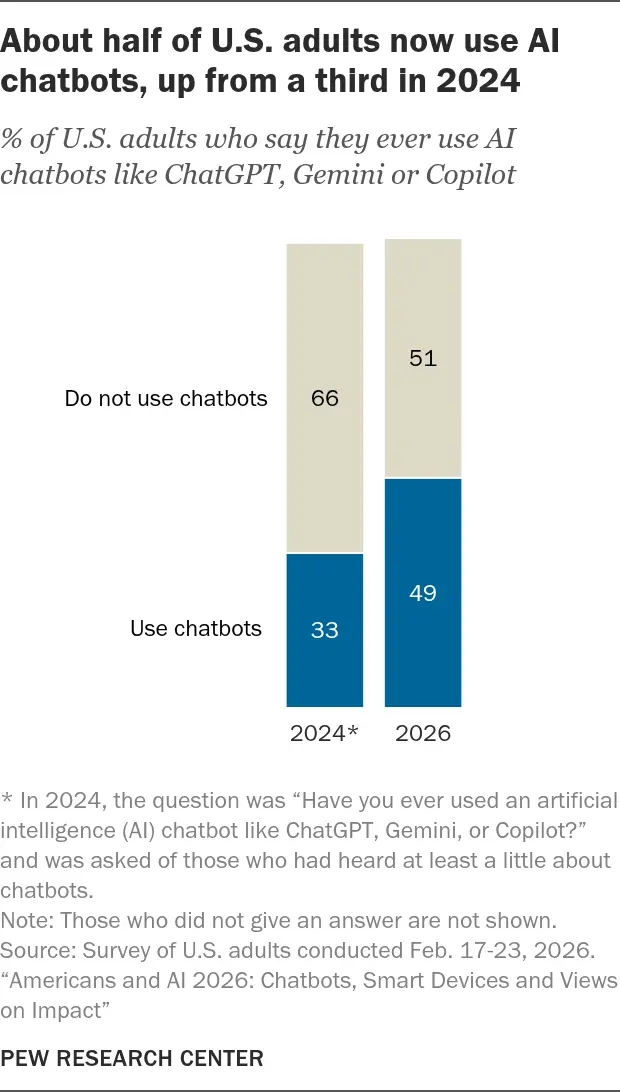 Figure 5: Pew Research Center’s February 2026 survey shows chatbot use jumping in two years, though the 2024 question was asked of a narrower group, so more callers already know how to talk to an AI. Source: Pew Research Center, Americans and AI 2026, Jun 2026. Chart published by the source, captured 21 Oct 2026.
Do customers want AI on service calls?
Not by default. Gartner’s survey found that the top worry is not being able to reach a person, and service leaders are under pressure to adopt AI anyway.
- Gartner surveyed 5,728 customers in December 2023 (Gartner, Jul 2024).
- The top concern about AI in customer service was that it would get harder to reach a person, followed by AI displacing jobs and AI giving wrong answers (Gartner, Jul 2024).
- 60% of customer service and support leaders said they were under pressure to adopt AI (Gartner, Jul 2024).
- In a separate survey of 187 service leaders in July and August 2024, 85% said they would explore or pilot a customer-facing conversational generative AI tool in 2025 (Gartner, Dec 2024).
- More than 75% of those leaders said executives were pressing them to implement generative AI (Gartner, Dec 2024).
How do Americans feel about AI in general?
Wary. Pew found concern outweighs excitement, and most people want to know when they are talking to a machine.
- 50% of US adults were more concerned than excited about AI in daily life in June 2025, up from 37% in 2021 (Pew Research Center, Sep 2025).
- 10% were more excited than concerned (Pew Research Center, Sep 2025).
- 76% said it is extremely or very important to be able to tell whether content was made by AI or a person (Pew Research Center, Sep 2025).
- 53% were not too confident or not at all confident they could tell the difference (Pew Research Center, Sep 2025).
- 57% rated the societal risks of AI as high, against 25% who rated the benefits as high (Pew Research Center, Sep 2025).
- 17% were comfortable with the amount of control they have over AI in their lives (Pew Research Center, Sep 2025).
- In February 2026, 63% said AI is advancing too quickly (Pew Research Center, Jun 2026).
- 71% said AI will make their personal information less secure (Pew Research Center, Jun 2026).
- 67% had little or no confidence in the US government to regulate AI effectively (Pew Research Center, Jun 2026).
- 40% expected AI to have a negative effect on society over the next 20 years (Pew Research Center, Jun 2026).
- 31% expected a negative effect on them personally, and 23% expected a positive one (Pew Research Center, Jun 2026).
How many customers already use AI themselves?
Half of adults, and the share is growing fast. Older adults lag far behind the young.
- 24% of US adults use AI chatbots daily (Pew Research Center, Jun 2026).
- 38% of employed adults use chatbots for tasks at work (Pew Research Center, Jun 2026).
- ChatGPT use rose from 18% of adults in 2023 to 44% in 2026 (Pew Research Center, Jun 2026).
- 35% of adults have an AI-enabled smart speaker (Pew Research Center, Jun 2026).
- 66% of adults ages 18 to 29 use chatbots, against 23% of those 65 and older (Pew Research Center, Oct 2026).
- Among adults who do not use chatbots, 60% call lack of interest a major reason (Pew Research Center, Oct 2026).
- 54% call concern about how their personal information will be used a major reason (Pew Research Center, Oct 2026).
- 45% call distrust of the accuracy of the information a major reason (Pew Research Center, Oct 2026).
Does a voice agent work when people talk to it?
In one large field test, yes. The owners’ own view in the Chamber’s survey is also positive, though it is opinion and not measured behavior.
- A field experiment with 70,000 job applicants randomly assigned some to AI voice agents and some to human recruiters (SSRN, Aug 2025).
- Applicants interviewed by AI voice agents were 12% more likely to receive job offers (SSRN, Aug 2025).
- Among small business AI users, 37% strongly agreed and 49% somewhat agreed that customers appreciate having access to AI when interacting with the business (U.S. Chamber of Commerce, Aug 2025).
- 38% strongly agreed and 48% somewhat agreed that AI helped them find new customers (U.S. Chamber of Commerce, Aug 2025).
- 38% strongly agreed and 49% somewhat agreed that AI helped them communicate more with customers (U.S. Chamber of Commerce, Aug 2025).
- Among small businesses currently using AI, 85% said sales increased and 84% said profits increased, as reported by the owners (U.S. Chamber of Commerce, Aug 2025).
What Rules Apply to AI Phone Calls?
The rules depend on direction. An AI that dials out is treated like a robocall. An AI that picks up the phone is not covered by the same rule, according to the FCC’s own proposal.
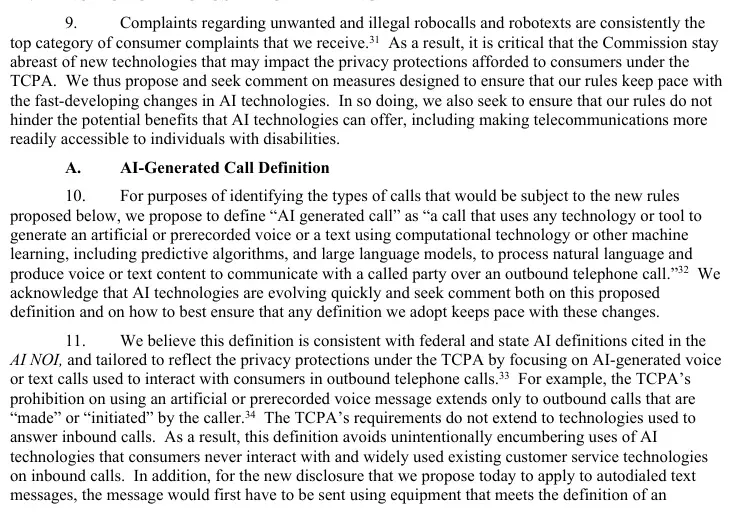 Figure 6: The FCC’s August 2024 proposal defines an AI-generated call as an outbound call and says the Telephone Consumer Protection Act does not reach technology that answers inbound calls. Source: Federal Communications Commission, FCC 24-84, page 5, Aug 2024. Screenshot of the source document page, captured 21 Oct 2026.
Does federal law treat an AI voice as a robocall?
For outbound calls, yes. The FCC ruled in February 2024 that AI-generated voices count as an artificial voice under the TCPA.
- The FCC adopted the ruling on February 2, 2024 and released it on February 8, 2024 (Federal Communications Commission, Feb 2024).
- It confirmed that the TCPA’s limits on an artificial or prerecorded voice cover current AI technologies that generate human voices (Federal Communications Commission, Feb 2024).
- Such calls need the prior express consent of the called party, unless there is an emergency purpose or an exemption (Federal Communications Commission, Feb 2024).
- The FCC wrote that the TCPA does not allow a carve-out for technology that purports to provide the equivalent of a live agent (Federal Communications Commission, Feb 2024).
- AI voice calls must also identify the business that starts the call and offer a way to opt out (Federal Communications Commission, Feb 2024).
- On August 7, 2024 the FCC proposed a definition of an AI-generated call and new disclosure rules for outbound calls (Federal Communications Commission, Aug 2024).
- It said complaints about unwanted robocalls and robotexts are consistently the top category of consumer complaint it receives (Federal Communications Commission, Aug 2024).
What can a violation cost?
The statute lets a person sue for actual loss or $500 per violation, whichever is greater. A court can raise that.
- 47 U.S.C. 227 lets a person recover actual monetary loss or $500 in damages for each violation, whichever is greater (47 U.S.C. 227, Oct 2026).
- For willful or knowing violations, a court may increase the award to not more than 3 times that amount (47 U.S.C. 227, Oct 2026).
- ServiceTitan’s annual report says TCPA penalties range from $500 to $1,500 per violation and have been read to mean per call or text (ServiceTitan 10-K FY2026, Mar 2026).
How ready are small businesses for AI disclosure laws?
Not very. The Chamber asked about state rules that would make businesses tell customers when AI is involved.
- Fewer than 1 in 3 small businesses said they were well prepared to comply with proposed AI disclosure and oversight laws (U.S. Chamber of Commerce, Aug 2025).
- 95% of small business owners said they would face challenges complying (U.S. Chamber of Commerce, Aug 2025).
- 35% named staying informed about new compliance requirements (U.S. Chamber of Commerce, Aug 2025).
- 31% named increased legal or compliance costs, up from 19% a year earlier (U.S. Chamber of Commerce, Aug 2025).
- 24% said disclosures could scare away customers, up from 18% a year earlier (U.S. Chamber of Commerce, Aug 2025).
What Does It Cost to Staff the Phone?
Answering the phone is a real job, and it is shrinking in the federal outlook. Whoever answers, human or machine, still needs a price to quote and a way to book the job.
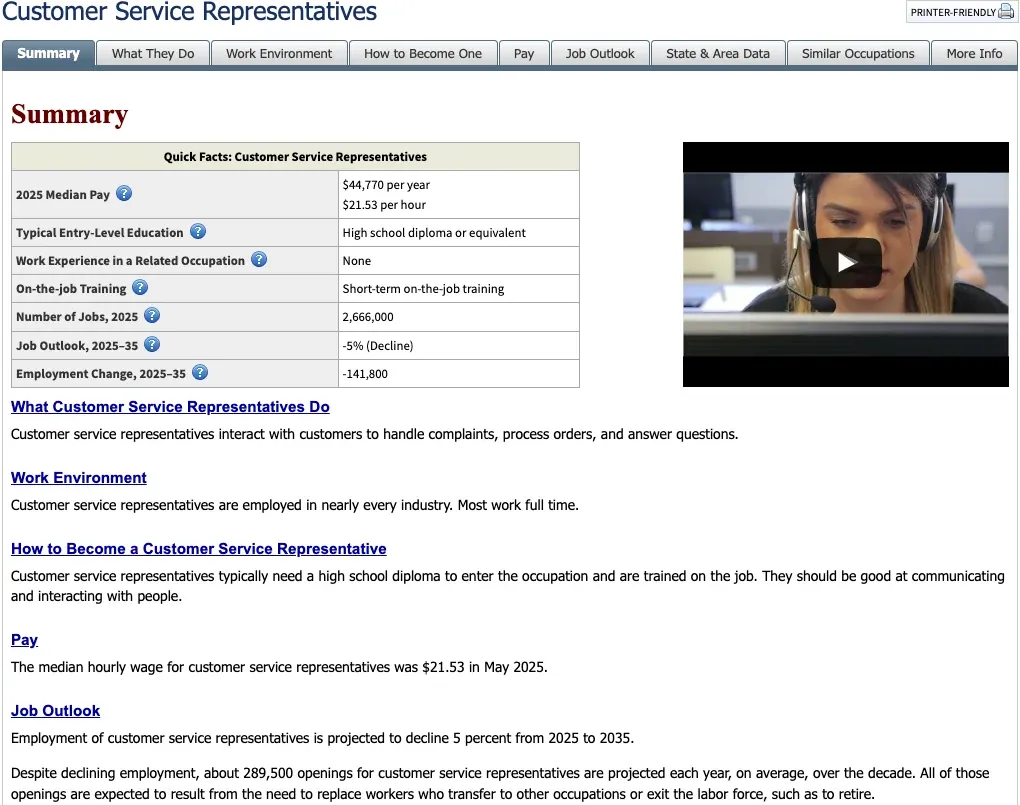 Figure 7: The BLS Occupational Outlook Handbook gives the size, pay and outlook of the people who answer service calls, and it projects a decline to 2035 as tasks are automated. Source: U.S. Bureau of Labor Statistics, Occupational Outlook Handbook: Customer Service Representatives, Aug 2026. Screenshot of the source page (Internet Archive copy of 13 Oct 2026), captured 21 Oct 2026.
How many people answer phones for pay?
Several million, at wages near $20 an hour. The BLS expects both occupations to shrink while still hiring to replace people who leave.
- There were 2,666,000 customer service representative jobs in 2025 (BLS Occupational Outlook Handbook, Aug 2026).
- The median pay was $44,770 a year, or $21.53 an hour (BLS Occupational Outlook Handbook, Aug 2026).
- The BLS projects a loss of 141,800 jobs from 2025 to 2035 (BLS Occupational Outlook Handbook, Aug 2026).
- It still projects about 289,500 openings a year, all from workers who move or leave the labor force (BLS Occupational Outlook Handbook, Aug 2026).
- The BLS says demand falls as tasks are automated through self-service systems, social media and mobile applications (BLS Occupational Outlook Handbook, Aug 2026).
- There were 947,500 receptionist jobs in 2025, and the median pay was $38,010 a year, or $18.27 an hour (BLS Occupational Outlook Handbook, Aug 2026).
- The BLS projects receptionist employment to decline 2% from 2025 to 2035, a loss of 16,000 jobs (BLS Occupational Outlook Handbook, Aug 2026).
- It still projects about 105,100 openings a year (BLS Occupational Outlook Handbook, Aug 2026).
- It says employment will be constrained as organizations automate or consolidate administrative functions (BLS Occupational Outlook Handbook, Aug 2026).
Does AI make phone and chat staff faster?
For new staff, by a lot. A study of 5,179 customer support agents is the best-known test of AI help on live customer conversations.
- The study followed 5,179 customer support agents who got a generative AI assistant (NBER, Nov 2023).
- Access to the tool raised issues resolved per hour by 14% on average (NBER, Nov 2023).
- Novice and low-skilled workers improved by 34% (NBER, Nov 2023).
Methodology and Sources
Every number here comes from the organization that produced it: a statistics agency, a central bank, a regulator, a research firm’s own release, a public company filing or a peer-reviewed or working-paper study. We did not use roundup pages or vendor blog posts. We found no primary dataset on missed calls or answer rates for plumbing shops, so none is shown. Census Bureau readings come from the Business Trends and Outlook Survey data files, which are survey estimates with sampling error, and trade subsector readings are noisy because the samples are small. The Census question about AI changed in late 2025, so the 2025-26 series is not directly comparable with the 2023-24 snapshot. Gartner and Bureau of Labor Statistics pages block automated reads, so those numbers were checked in archived copies of the same pages. Vendor filings describe products and the vendor’s own plans, not results for plumbers. The page is refreshed monthly.
Glossary
- AI: artificial intelligence.
- BTOS: the Census Bureau’s Business Trends and Outlook Survey.
- BLS: the US Bureau of Labor Statistics.
- FCC: the US Federal Communications Commission.
- NAICS 238: the Census industry group for specialty trade contractors, which includes plumbing.
- TCPA: the Telephone Consumer Protection Act, the US law on robocalls and robotexts.
- Virtual agent: software that talks with a customer by chat or voice and can book or answer without a person.
- Run rate: a result for one month or quarter multiplied to a full year.
Sources
- U.S. Census Bureau, Business Trends and Outlook Survey, national data
- U.S. Census Bureau, Business Trends and Outlook Survey, sector data
- U.S. Census Bureau, Business Trends and Outlook Survey, subsector data
- U.S. Census Bureau, Business Trends and Outlook Survey, AI supplement 2026
- U.S. Census Bureau, Tracking Firm Use of AI in Real Time (CES 24-16)
- U.S. Chamber of Commerce, Empowering Small Business 2025 (PDF)
- Federal Reserve Banks, 2026 Report on Employer Firms
- Pew Research Center, How Americans View AI and Its Impact on People and Society
- Pew Research Center, Americans and AI 2026
- Pew Research Center, Why Don’t Some People Use Chatbots?
- Gartner, customers and AI in customer service (July 2024)
- Gartner, customer service leaders and conversational generative AI (December 2024)
- U.S. Bureau of Labor Statistics, Customer Service Representatives
- U.S. Bureau of Labor Statistics, Receptionists
- Federal Communications Commission, FCC 24-17 Declaratory Ruling
- Federal Communications Commission, FCC 24-84 Notice of Proposed Rulemaking
- 47 U.S.C. 227, Restrictions on use of telephone equipment
- ServiceTitan, Form 10-K for fiscal 2026
- ServiceTitan, Form 10-Q for fiscal second quarter 2027
- ServiceTitan, Fiscal Second Quarter 2027 Results
- Yelp, Form 10-K for 2025
- Yelp, Form 10-Q for the second quarter of 2026
- Google, New AI features in Google Search: Call a business or do research
- NBER, Generative AI at Work (Working Paper 31161)
- SSRN, Voice AI in Firms: A Natural Field Experiment on Automated Job Interviews