Water heater statistics describe an appliance that almost every US home has, that few owners think about, and that gets attention mostly when it fails. This page collects figures from federal agencies, a trade association, a state air district and one public company’s annual filing. Where a number comes from a market research firm, the firm is named.
The main US count of home water heaters is the 2020 Residential Energy Consumption Survey from the US Energy Information Administration (EIA). A newer survey has been run, but its water heating tables are not out yet, so the 2020 tables are still the latest count by fuel, size and age. Every figure on this page is dated and linked to the document it came from.
The page covers the installed base, age and lifespan, energy use, shipments, tankless and heat pump savings, efficiency rules, safety and recalls. It does not cover leaks, burst pipes or water damage claims, which have their own pages: water leak statistics, water damage claims statistics and water usage statistics. For the trade that installs and repairs these units, see plumbing industry statistics.
Key Takeaways
- Natural gas heated water in 59.33 million US homes and electricity in 57.04 million, out of 123.53 million occupied homes (EIA, Mar 2023).
- 8.98 million US homes still ran a main water heater that was 20 years old or more (EIA, Mar 2023).
- Homes with a tankless main water heater grew from 3.0 million in 2015 (EIA, Feb 2017) to 8.03 million in 2020 (EIA, Mar 2023).
- Heating water used 1,737 trillion Btu of site energy in US homes in 2020 (EIA, Mar 2024).
- Manufacturers shipped 4,252,075 residential gas and 5,028,226 residential electric storage water heaters in 2025 (AHRI, Feb 2026).
- Heat pump models were about 3 percent of electric storage water heater sales in 2023, roughly 0.14 million units (DOE, May 2024).
- An ENERGY STAR certified heat pump water heater can save a household of four about $550 a year, with a 2.7 year payback (ENERGY STAR, Oct 2026).
- DOE’s consumer water heater standards apply from May 6, 2029 and are projected to save 17.6 quads of energy over 30 years (DOE, May 2024).
- DOE estimates the average life of a storage water heater at about 15 years (DOE, May 2024).
- An estimated 9 non-fire carbon monoxide deaths in 2022 were linked to water heaters (CPSC, May 2026).
- About 616,000 A. O. Smith Ultra-Low NOx gas water heaters were recalled in 2018 because the burner screen can tear (CPSC, Nov 2018).
- Water at 150 degrees Fahrenheit gives most adults third-degree burns in two seconds (CPSC, Mar 2012).
- A. O. Smith says the significant majority of the markets it serves are for replacement of existing products (A. O. Smith, Feb 2026).
Which Fuels Heat the Water in US Homes?
Gas and electricity split the country almost evenly, and the split follows the type of home more than anything else. For a plumber, the fuel decides the parts, the venting and the permit before the truck leaves the shop.
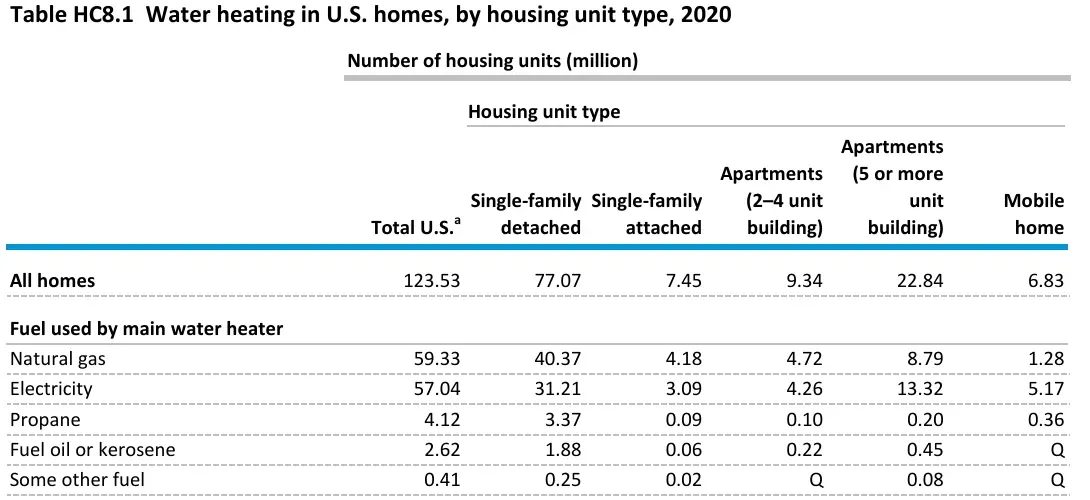 Figure 1: Natural gas and electricity each heat water in nearly half of US homes, and the split flips between detached houses and apartments. Source: EIA, 2020 Residential Energy Consumption Survey, Table HC8.1, Mar 2023. Screenshot of the source table, captured 21 Oct 2026.
Which fuel is used in the most homes?
Natural gas edges out electricity, and together they heat water in nearly every home. The other fuels are small but not rare.
- Propane was the main water heater fuel in 4.12 million homes (EIA, Mar 2023).
- Fuel oil or kerosene was the main fuel in 2.62 million homes (EIA, Mar 2023).
- In the 2015 survey, natural gas heated water in 56.3 million homes and electricity in 54.6 million, out of 118.2 million (EIA, Feb 2017).
- EIA says about 60% of US homes use natural gas for space and water heating, cooking and clothes drying (EIA, Oct 2024).
- The 2024 survey represents 132.5 million occupied housing units (EIA, Sep 2026).
- EIA lists the 2024 survey’s water heating tables for release in spring 2027 (EIA, Oct 2026).
Does the fuel change with the type of home?
Yes. Houses lean toward gas, and apartments and mobile homes lean toward electricity.
- Single-family detached homes used gas in 40.37 million homes and electricity in 31.21 million (EIA, Mar 2023).
- Buildings with five or more apartments used electricity in 13.32 million units and gas in 8.79 million (EIA, Mar 2023).
- Mobile homes used electricity in 5.17 million units and gas in 1.28 million (EIA, Mar 2023).
- Renters used electricity in 22.37 million homes and gas in 16.90 million (EIA, Mar 2023).
- Owners used gas in 42.44 million homes and electricity in 34.68 million (EIA, Mar 2023).
Does the fuel change with the region?
Yes. The South runs on electricity, and the other three census regions run mostly on gas.
- The South used electricity in 31.27 million homes and gas in 14.14 million (EIA, Mar 2023).
- The West used gas in 17.63 million homes and electricity in 8.94 million (EIA, Mar 2023).
- The Midwest used gas in 16.17 million homes and electricity in 9.65 million (EIA, Mar 2023).
- The Northeast had 2.38 million homes on fuel oil or kerosene, far more than any other region (EIA, Mar 2023).
- In hot-humid climates, electricity heated water in 15.85 million homes and gas in 5.72 million (EIA, Mar 2023).
How Old Are the Water Heaters in US Homes?
Most units are younger than ten years, but a large tail is already past the age when makers and agencies say to plan a replacement. Every one of those old tanks is a future service call, and the call is cheaper for everyone if it is planned.
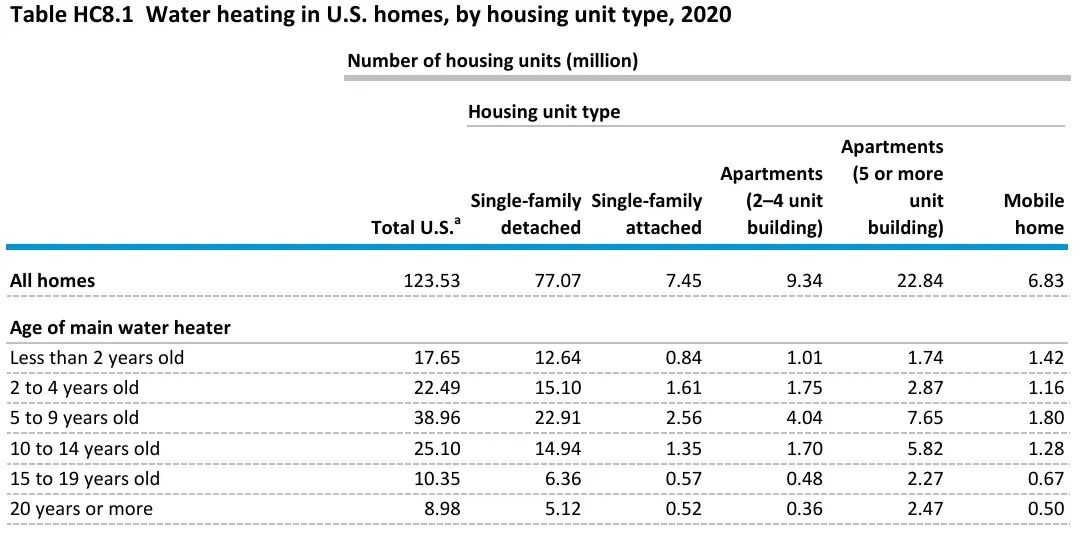 Figure 2: The largest group of main water heaters is 5 to 9 years old, and millions are 15 years or older. Source: EIA, 2020 Residential Energy Consumption Survey, Table HC8.1, Mar 2023. Screenshot of the age rows of the source table, captured 21 Oct 2026.
How many water heaters are past 10 years old?
A large group is past 10 years. The biggest single age band is 5 to 9 years, which puts the next wave of replacements five to ten years out.
- 38.96 million homes had a main water heater that was 5 to 9 years old, the largest age group (EIA, Mar 2023).
- 25.10 million homes had one that was 10 to 14 years old (EIA, Mar 2023).
- 10.35 million homes had one that was 15 to 19 years old (EIA, Mar 2023).
- 17.65 million homes had one under 2 years old, and 22.49 million had one that was 2 to 4 years old (EIA, Mar 2023).
- In the 2015 survey, 8.6 million homes had a main water heater that was 20 years or older (EIA, Feb 2017).
- DOE built its lifetime estimate from RECS surveys between 1990 and 2020 and Census American Housing Survey data from 1974 to 2021 (DOE, May 2024).
Which homes have the oldest units?
Older homes, apartment buildings and one-person households skew old, but detached houses hold the most units in absolute terms.
- Single-family detached homes had 5.12 million water heaters aged 20 years or more (EIA, Mar 2023).
- Buildings with five or more apartments had 2.47 million water heaters aged 20 years or more (EIA, Mar 2023).
- Owners had 5.85 million water heaters of 20 years or more, and renters had 3.14 million (EIA, Mar 2023).
- Homes built before 1950 had 1.91 million water heaters aged 20 years or more (EIA, Mar 2023).
- One-person households had 3.19 million water heaters aged 20 years or more, against 0.56 million in homes with five or more people (EIA, Mar 2023).
- The Northeast had 2.15 million water heaters aged 20 years or more (EIA, Mar 2023).
How Big Are the Tanks, and How Common Is Tankless?
The medium tank is still the standard, but tankless units grew faster than any other type between 2015 and 2020. They also skew toward high-income homes.
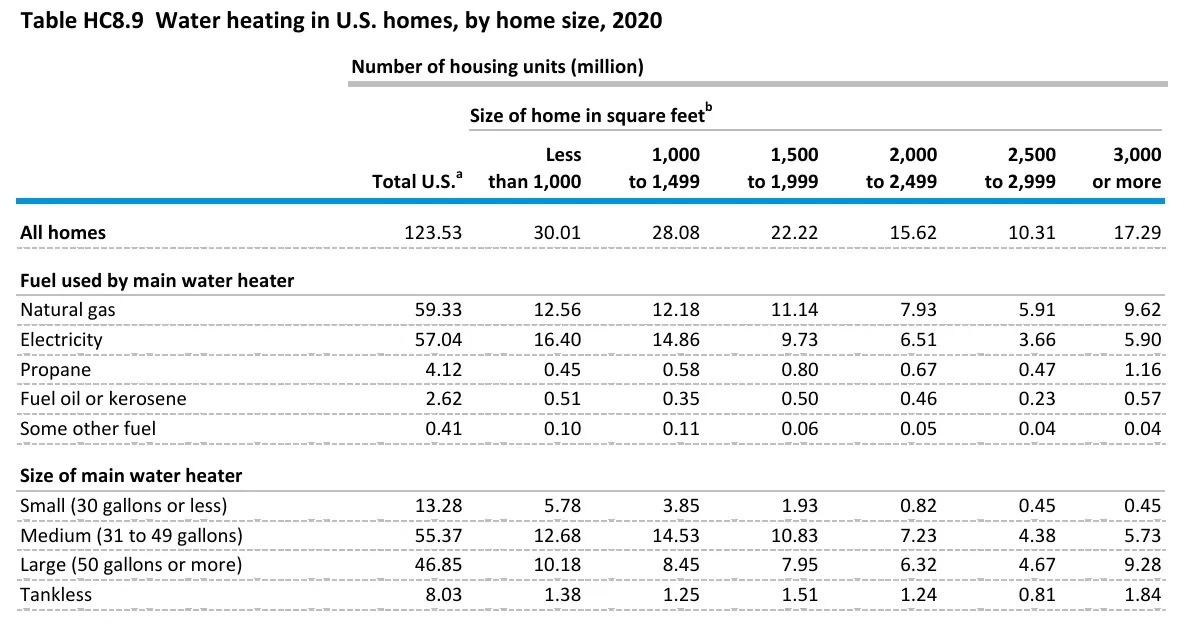 Figure 3: Big tanks cluster in big homes and small tanks in small ones, and tankless units are spread across every home size. Source: EIA, 2020 Residential Energy Consumption Survey, Table HC8.9, Mar 2023. Screenshot of the source table, captured 21 Oct 2026.
What size water heater do most homes have?
Most homes have a medium tank of 31 to 49 gallons, followed by large tanks of 50 gallons or more.
- 55.37 million homes had a medium main water heater of 31 to 49 gallons (EIA, Mar 2023).
- 46.85 million homes had a large main water heater of 50 gallons or more (EIA, Mar 2023).
- 13.28 million homes had a small main water heater of 30 gallons or less (EIA, Mar 2023).
- In 2015, 31.8 million homes had a large main water heater of 50 gallons or more (EIA, Feb 2017).
- Homes of 3,000 square feet or more had 9.28 million large water heaters, and homes under 1,000 square feet had 5.78 million small ones (EIA, Mar 2023).
- A. O. Smith says its residential and commercial water heaters mostly come in 40 to 80 gallon sizes (A. O. Smith, Feb 2026).
Who buys tankless water heaters?
Tankless units skew toward higher incomes, and every region has them.
- Homes earning $150,000 or more had 2.08 million tankless main water heaters (EIA, Mar 2023).
- Homes earning $20,000 to $39,999 had 0.99 million (EIA, Mar 2023).
- The South had 2.60 million tankless main water heaters and the West 2.26 million (EIA, Mar 2023).
- The Northeast had 1.99 million tankless main water heaters and the Midwest 1.17 million (EIA, Mar 2023).
- ENERGY STAR rates tankless units by gallons per minute: 2.5 for a shower or bathtub, 3.3 for a clothes washer, 2.2 for a sink and 1.3 for a dishwasher (ENERGY STAR, Oct 2026).
- ENERGY STAR certified gas tankless models must reach a Uniform Energy Factor of 0.95 or more and deliver at least 2.8 gallons per minute over a 67 degree rise (ENERGY STAR, Oct 2026).
How Much Energy Does Heating Water Use?
Water heating is a year-round energy cost, and in a large apartment building it can be the single biggest one. Heat that goes into the tank is energy a homeowner pays for whether or not a faucet is running.
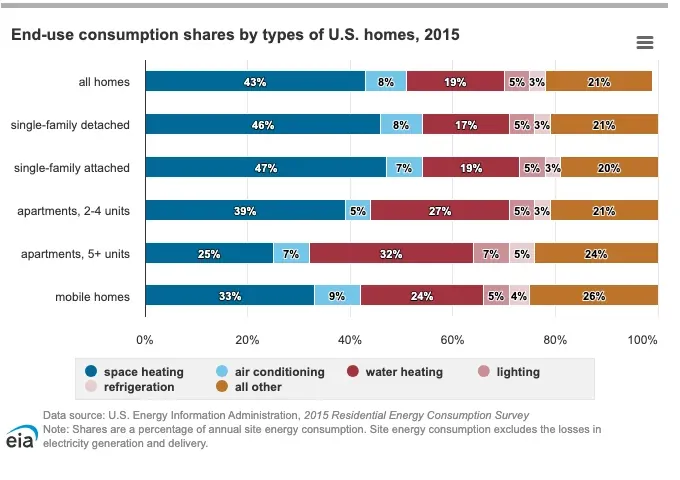 Figure 4: Water heating takes a bigger share of energy in apartments than in detached houses, because apartments use far less space heating. Source: EIA, Use of energy in homes, chart from the 2015 Residential Energy Consumption Survey, Dec 2023. Screenshot of the source chart, captured 21 Oct 2026.
What share of home energy goes to water heating?
Between a tenth and a fifth, depending on the source and the survey year. EIA’s chart shows how much it varies by home type.
- Water heating was 19% of site energy use in all US homes in the 2015 survey (EIA, Dec 2023).
- It was 32% in buildings with five or more apartments (EIA, Dec 2023).
- Water heating, lighting and refrigeration together were 25% of annual home energy use in 2020 (EIA, Dec 2023).
- Water heating was 12% of site electricity use in US homes in 2020 (EIA, Dec 2023).
- ENERGY STAR says water heaters use about 12% of a home’s energy (ENERGY STAR, Oct 2026).
- ENERGY STAR also says homeowners spend up to 20 percent of household energy on water heating (ENERGY STAR, Apr 2024).
Which fuels and regions use the most?
Gas does most of the work, and cold regions use more.
- Natural gas supplied 1,081 trillion Btu of water heating, electricity 533, propane 69 and fuel oil 53 (EIA, Mar 2024).
- The average Northeast household used 16.1 million Btu on water heating, against 12.0 million in the South (EIA, Mar 2024).
- The average Midwest household used 14.3 million Btu and the West 15.9 million (EIA, Mar 2024).
- US households spent $232.76 billion on all energy in 2020, an average of $1,884 per household (EIA, Mar 2024).
How Long Does a Water Heater Last Before Replacement?
Nobody plans for a water heater until it fails. DOE notes that emergency replacements lean strongly toward like-for-like swaps because there is no time to compare options. The shop that has a price ready for the job wins it.
 Figure 5: ENERGY STAR advises planning a replacement by age, before an emergency forces the choice. Source: ENERGY STAR, When Should You Replace Your Water Heater?, Feb 2024. Screenshot of the source page, captured 21 Oct 2026.
How long does a water heater last?
About 15 years for a storage tank by DOE’s estimate, and longer for tankless units.
- ENERGY STAR says to consider replacement once a water heater is more than 10 years old (ENERGY STAR, Feb 2024).
- ENERGY STAR gives a life expectancy of 20 years for tankless water heaters (ENERGY STAR, Oct 2026).
- DOE uses a 20 year average lifetime for gas-fired instantaneous water heaters (DOE, Dec 2024).
- DOE puts commercial water heating equipment lifetimes at 10 years for gas-fired storage and 25 years for instantaneous water heaters and hot water supply boilers (DOE, Oct 2023).
- ENERGY STAR’s heat pump savings model assumes a 13 year lifespan (ENERGY STAR, Oct 2026).
What does replacement involve besides the unit?
Fuel switches and heat pump installs add cost that a flat price list has to account for.
- DOE’s cost model adds extra installation costs for heat pump water heaters that range from $0 to $4,000, averaging $2,000 (DOE, May 2024).
- DOE says switching between electric and gas equipment can add more than $1,000 on top of the installed cost (DOE, May 2024).
- Only 25 percent of homes with an electric storage water heater use natural gas, and another 25 percent say gas is available in the neighborhood (DOE, May 2024).
- 22% of US adults had a major house or appliance repair in the prior 12 months (Federal Reserve, May 2026).
- 63% of adults said they would cover a $400 emergency expense with cash or its equivalent (Federal Reserve, May 2026).
How Many Water Heaters Do US Makers Ship?
Shipments are the best monthly signal of how many units are being sold. They run a little over 9 million residential storage units a year, and 2026 has started lower.
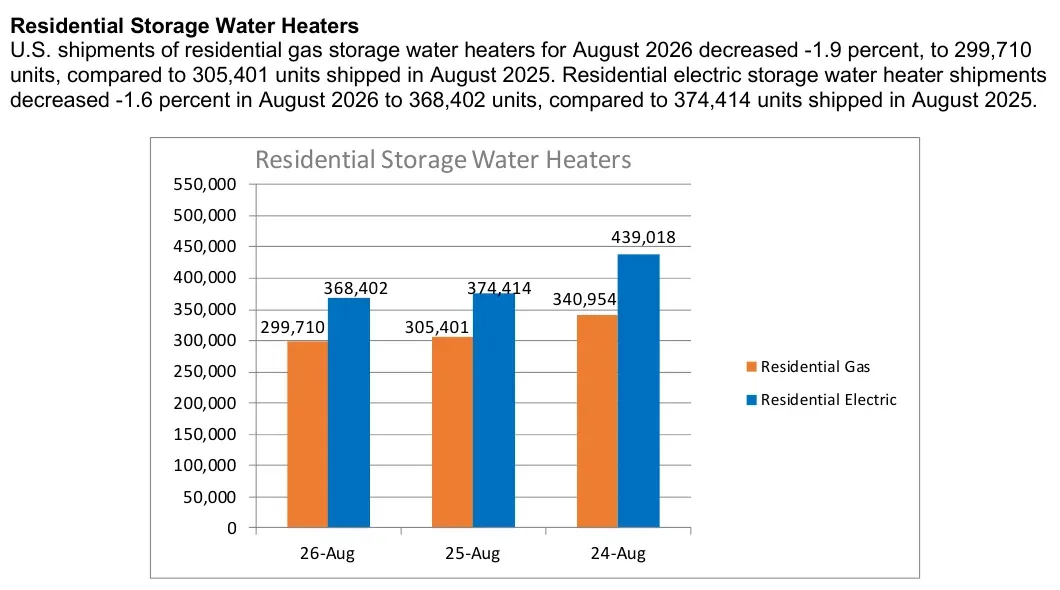 Figure 6: August residential storage shipments fell slightly in 2026 after falling in 2025, and electric units outsell gas. Source: AHRI, August 2026 U.S. Heating and Cooling Equipment Shipment Data, Oct 2026. Chart published by the source, captured 21 Oct 2026.
How many residential storage units ship each year?
A little over 9 million units a year, split roughly evenly between gas and electric.
- In 2024, manufacturers shipped 4,177,148 residential gas and 5,057,208 residential electric storage water heaters (AHRI, Feb 2026).
- In 2023, they shipped 4,292,062 residential gas and 4,905,071 residential electric storage water heaters (AHRI, Feb 2026).
- December 2025 residential gas shipments rose 19.3 percent to 418,518 units against 350,875 a year earlier (AHRI, Feb 2026).
- December 2025 residential electric shipments rose 16.8 percent to 462,252 units against 395,719 a year earlier (AHRI, Feb 2026).
- Through August 2026, residential gas shipments were down 2.4 percent at 2,787,099 units, and electric were down 4.8 percent at 3,245,594 (AHRI, Oct 2026).
- August 2026 residential shipments were 299,710 gas and 368,402 electric units, down 1.9 and 1.6 percent (AHRI, Oct 2026).
- August 2024 residential shipments were 340,954 gas and 439,018 electric units (AHRI, Oct 2026).
What is happening in commercial shipments?
Commercial units are a small fraction of the total, but they are moving because a federal rule is coming.
- In 2025, commercial gas storage shipments rose 3.0 percent to 86,640 units, and electric rose 5.6 percent to 162,233 (AHRI, Feb 2026).
- Through August 2026, commercial gas storage shipments rose 1.0 percent to 60,181 units, and electric fell 2.2 percent to 111,172 (AHRI, Oct 2026).
- Industry commercial water heater volumes grew about five percent in 2025, and A. O. Smith expects mid-single digit growth in 2026 as buyers get ahead of the October 2026 federal rule (A. O. Smith, Feb 2026).
Is replacement demand growing?
No, replacement volume is flat, and new construction is the weak spot.
- Industry-wide replacement volume of water heaters was flat in 2025 compared with 2024 (A. O. Smith, Feb 2026).
- A. O. Smith estimates 2025 residential industry unit volumes were flat and projects 2026 to be flat to down, driven by weaker new construction (A. O. Smith, Feb 2026).
Does a Tankless Water Heater Save Energy?
Yes, but the savings are modest for a gas unit compared with a standard gas tank. The tankless case rests more on life expectancy, space and endless hot water than on the energy bill.
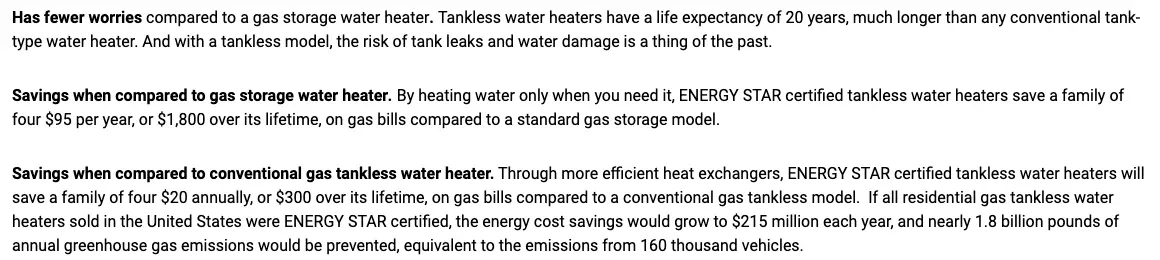 Figure 7: ENERGY STAR puts dollar figures on the saving for a family of four and also lists the life expectancy of a tankless unit. Source: ENERGY STAR, Save More with ENERGY STAR Gas Tankless Water Heaters, Oct 2026. Screenshot of the source page, captured 21 Oct 2026.
How much energy does a tankless water heater save?
About $95 a year for a family of four against a standard gas tank, by ENERGY STAR’s estimate.
- A certified gas tankless unit saves a family of four $95 a year, or $1,800 over its lifetime, against a standard gas storage model (ENERGY STAR, Oct 2026).
- It saves $20 a year, or $300 over its lifetime, against a conventional gas tankless model (ENERGY STAR, Oct 2026).
- If every residential gas tankless unit sold were certified, savings would reach $215 million a year and nearly 1.8 billion pounds of greenhouse gas emissions would be avoided (ENERGY STAR, Oct 2026).
- A certified gas storage water heater uses 8 percent less energy than a standard model and saves a family of four $25 a year (ENERGY STAR, Oct 2026).
- If every gas storage unit under 55 gallons sold were certified, savings would reach $970 million a year (ENERGY STAR, Oct 2026).
How efficient are tankless and storage models?
Efficiency is rated by Uniform Energy Factor, and gas models sit in a narrow band.
- Most traditional water heaters have a Uniform Energy Factor between 0.63 and 0.95 (ENERGY STAR, Apr 2024).
- ENERGY STAR certified gas storage models must reach 0.81 in the medium draw pattern and 0.86 in the high draw pattern (ENERGY STAR, Oct 2026).
- DOE found average life-cycle cost savings of $112 for consumers affected by its 2024 gas-fired instantaneous standard, with a simple payback of 8.9 years (DOE, Dec 2024).
- DOE projected 0.58 quads of savings over 30 years from that standard, or 1.9 percent of the energy those products would otherwise use (DOE, Dec 2024).
- DOE valued consumer benefits of that standard at $0.87 billion to $3.06 billion (DOE, Dec 2024).
- DOE has since delayed and then withdrawn the consumer gas-fired instantaneous water heater standard in 2025 (DOE, Apr 2026).
What Do Heat Pump Water Heaters Save?
Heat pump models use a fraction of the electricity of a standard electric tank, and the open question is whether the house can take the install. They are still a small slice of what ships.
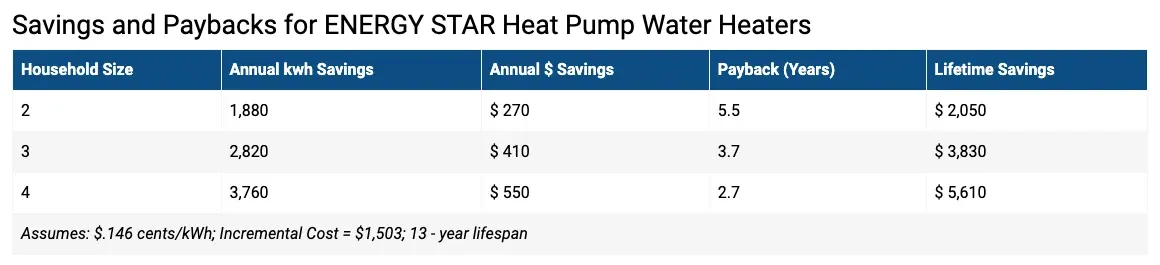 Figure 8: ENERGY STAR’s table shows payback getting shorter as the household gets bigger, because a bigger household uses more hot water. Source: ENERGY STAR, Save More with ENERGY STAR Certified Heat Pump Water Heaters, Oct 2026. Screenshot of the source table, captured 21 Oct 2026.
How much does a heat pump water heater save?
Hundreds of dollars a year, and the saving grows with household size. ENERGY STAR’s pages use different assumptions, so figures differ from page to page.
- A two-person household saves 1,880 kWh and $270 a year, with a 5.5 year payback and $2,050 over the lifetime (ENERGY STAR, Oct 2026).
- A three-person household saves 2,820 kWh and $410 a year, with a 3.7 year payback and $3,830 over the lifetime (ENERGY STAR, Oct 2026).
- The table assumes $0.146 per kWh, an extra cost of $1,503 and a 13 year lifespan (ENERGY STAR, Oct 2026).
- If every electric water heater sold were an ENERGY STAR heat pump model, energy cost savings would reach about $8 billion a year (ENERGY STAR, Oct 2026).
- Certified heat pump models typically have a Uniform Energy Factor from 3.3 to 4.1, which ENERGY STAR describes as 330 to 410 percent efficiency (ENERGY STAR, Apr 2024).
- Integrated heat pump models must reach a Uniform Energy Factor of 3.30 and a first-hour rating of 45 gallons per hour to be certified (ENERGY STAR, Oct 2026).
Do heat pump water heaters work in cold rooms?
Mostly yes, with limits on the room they sit in.
- ENERGY STAR says heat pump models work best where the surrounding air stays at or above 40 degrees Fahrenheit (ENERGY STAR, Apr 2024).
- Split systems with an outdoor compressor can run at outdoor temperatures as low as minus 25 degrees Fahrenheit (ENERGY STAR, Apr 2024).
- ENERGY STAR advises 1,000 cubic feet of air space around the unit in a room that stays between 40 and 90 degrees Fahrenheit (ENERGY STAR, Oct 2026).
- ENERGY STAR cites minimal temperature reductions in the home, averaging 2.3 degrees Fahrenheit, from heat pump water heaters (ENERGY STAR, Aug 2024).
How common are heat pump water heaters?
Still rare today, but DOE expects the share to jump if its standard stands.
- DOE expects heat pump models to be about 61 percent of electric storage water heater sales in 2030 at the adopted standard level (DOE, May 2024).
- Without a standard, DOE projects heat pumps at only 12 percent of the medium electric storage market in 2030, though they would cost less over their life for 64 percent of those consumers (DOE, May 2024).
What Do Federal Efficiency Rules Require?
The federal rules are in flux. One consumer rule is on the books for 2029, one commercial rule lands in October 2026 and has drawn a petition to delay it, and one gas rule has been withdrawn.
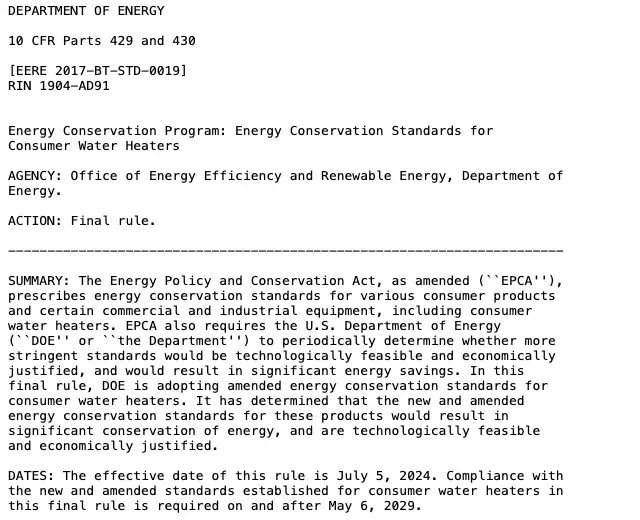 Figure 9: The summary and dates of DOE’s final rule for consumer water heaters, which is the legal basis for the 2029 compliance date. Source: DOE, Energy Conservation Standards for Consumer Water Heaters, Federal Register, May 2024. Screenshot of the source document, captured 21 Oct 2026.
What does the 2024 consumer rule do?
It sets new efficiency levels for gas, oil and electric storage water heaters, with most electric storage models moving to heat pump technology.
- The rule took effect on July 5, 2024 (DOE, May 2024).
- DOE valued consumer benefits at $25 billion to $82 billion, depending on the discount rate (DOE, May 2024).
- DOE projects 332 million metric tons of carbon dioxide avoided over the period (DOE, May 2024).
- At a 7 percent discount rate, DOE counts $5,655 million a year in reduced operating costs against $2,623 million in increased equipment costs (DOE, May 2024).
- DOE expects about 24 percent of consumer water heater shipments to meet the new levels by the 2030 analysis year (DOE, May 2024).
- Industry conversion costs are estimated at $239.8 million (DOE, May 2024).
What is happening to the commercial rule?
It takes effect in October 2026, and gas groups have asked DOE to push it back.
- The 2023 commercial rule projects 0.70 quads of savings over 30 years, or 5.6 percent of use, and 38 million metric tons of carbon dioxide avoided (DOE, Oct 2023).
- It sets thermal efficiency at 95% for gas-fired storage water heaters and 96% for gas-fired instantaneous water heaters and hot water supply boilers, with compliance on October 6, 2026 (DOE, Apr 2026).
- Gas and propane trade groups petitioned DOE on February 19, 2026 to move the compliance date to January 1, 2030 (DOE, Apr 2026).
- DOE valued the commercial rule’s consumer benefits at $0.43 billion to $1.43 billion (DOE, Oct 2023).
What are local rules adding?
Some air districts are going further than DOE.
- The Bay Area Air District’s zero-NOx rules for water heaters and furnaces start in 2027, 2029 and 2031, depending on equipment (BAAQMD, Oct 2026).
- The district board will consider changes to its water heater rule on November 4, 2026, which would add exemptions and extend the compliance date (BAAQMD, Oct 2026).
How Risky Are Water Heaters for Gas and Hot Water Burns?
Water heaters are not a leading cause of carbon monoxide deaths, but the deaths are real and cluster around gas units. Scalds are the other risk, and the fix is a thermostat setting.
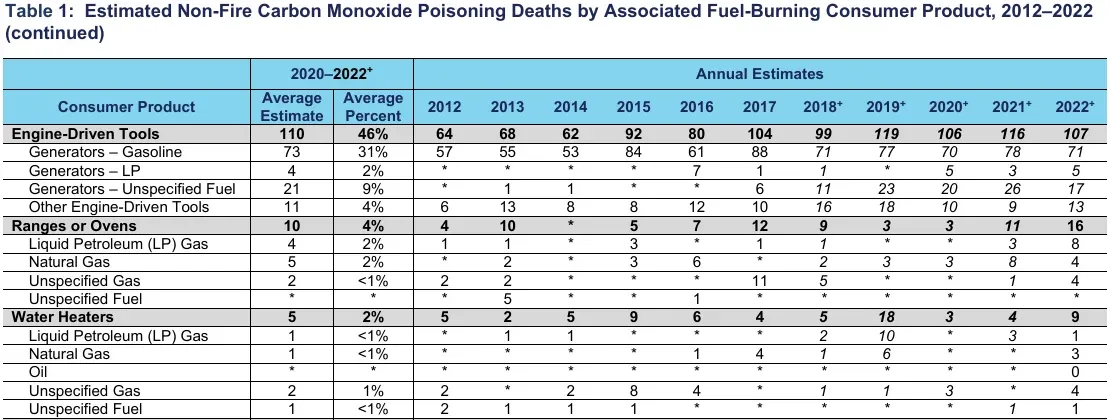 Figure 10: Water heater carbon monoxide deaths are small each year but spiked in 2019, mostly from LP gas units. Source: CPSC, Non-Fire Carbon Monoxide Deaths Associated with the Use of Consumer Products, 2022 Annual Estimates, May 2026. Screenshot of the source table, captured 21 Oct 2026.
How many carbon monoxide deaths involve water heaters?
A handful each year.
- CPSC estimated 274 non-fire carbon monoxide deaths from consumer products in 2022 (CPSC, May 2026).
- Water heaters averaged 5 estimated deaths a year from 2020 to 2022, about 2 percent of the total (CPSC, May 2026).
- Water heater deaths peaked at an estimated 18 in 2019 (CPSC, May 2026).
- Heating systems of all kinds were linked to 76 estimated deaths, or 28 percent, in 2022 (CPSC, May 2026).
- The 2020 to 2022 annual average across all consumer products was 238 estimated deaths (CPSC, May 2026).
- CPSC says using a natural gas water heater with LP gas was linked to an estimated 4 deaths in 2019 (CPSC, May 2026).
- 64 percent of the 2022 deaths came from exposure in a home (CPSC, May 2026).
How hot is too hot for tap water?
Hotter than 120 degrees, and the burn time falls fast.
- At 140 degrees Fahrenheit, a burn takes six seconds (CPSC, Mar 2012).
- At 130 degrees, a burn takes thirty seconds (CPSC, Mar 2012).
- At 120 degrees, a five minute exposure can cause third-degree burns (CPSC, Mar 2012).
- CPSC urges all users to lower their water heaters to 120 degrees Fahrenheit (CPSC, Mar 2012).
What Do Water Heater Recalls Show About Failures?
Recalls are the best public record of how water heaters fail: burners, control panels, valves and vents. Several of the recalled models were sold through plumbers and supply houses, which means the shop that installed them is often the first call.
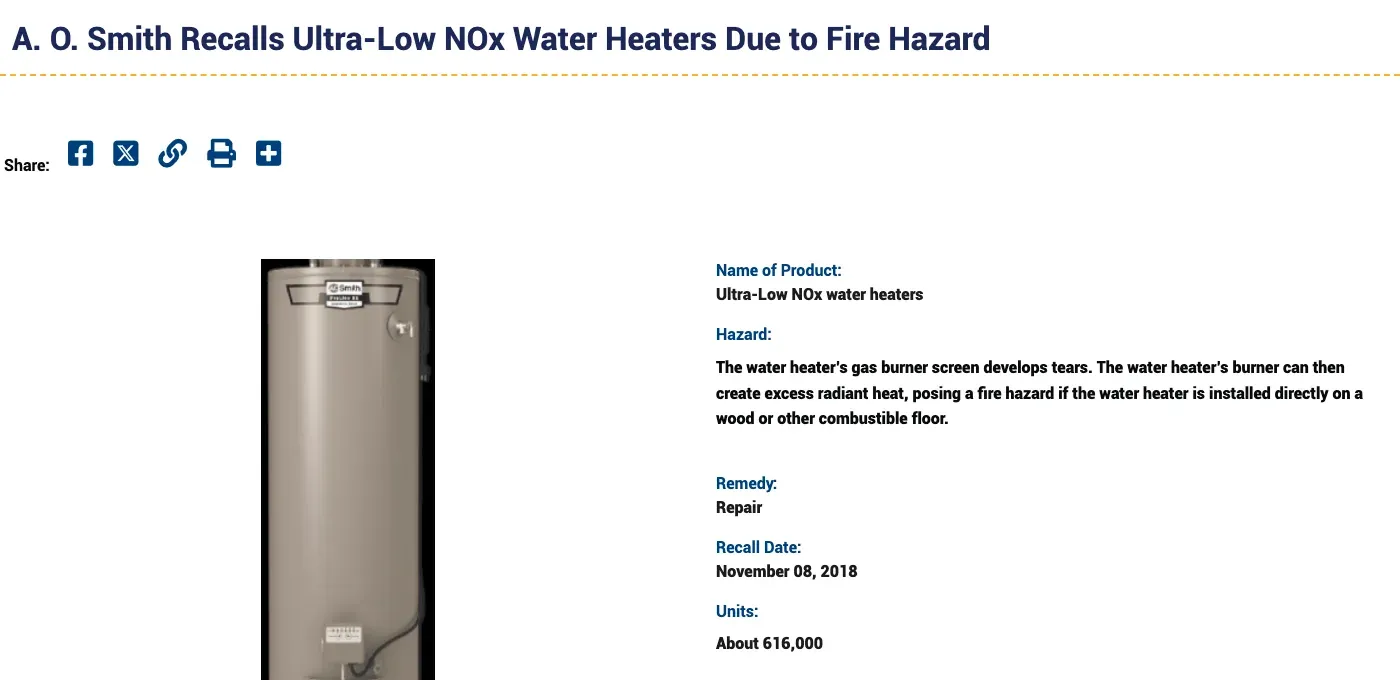 Figure 11: The 2018 A. O. Smith recall was the largest water heater recall returned by CPSC’s recall database, and it covered gas units sold mainly in California. Source: CPSC, A. O. Smith Recalls Ultra-Low NOx Water Heaters Due to Fire Hazard, Nov 2018. Screenshot of the source page, captured 21 Oct 2026.
How many water heater recalls are there?
37 recalls since 1977 have “water heater” in the title, and about a third came after 2010.
- A search of the CPSC recall database returns 37 recalls with “water heater” in the title, the earliest in 1977 (CPSC, Oct 2026).
- 12 of those results, counted from the database response, were announced between 2010 and 2025 (CPSC, Oct 2026).
What went wrong in recent recalls?
The causes are small parts: screens, panels, collars and ducts.
- The A. O. Smith recall had six reports of fires, and the units sold for $500 to $1,000 mainly in California from April 2011 to December 2016 (CPSC, Nov 2018).
- Rheem recalled about 54,000 electric water heaters in 2016 after 296 reports of overheating control panels and one fire with $5,800 in damage (CPSC, May 2016).
- Water Heating Technologies recalled about 14,400 gas water heaters sold through plumbing contractors for $400 to $820 (CPSC, May 2016).
- VESTA.DS recalled about 36,700 VST tankless units in the United States in 2025 after 33 reports of cracked exhaust ducts, sold through plumbing supply stores for $480 to $1,340 (CPSC, Oct 2025).
- Camplux recalled about 42,000 portable tankless units in 2024 for gas leaks at the regulator connection (CPSC, Feb 2024).
- Daesung recalled about 29,000 tankless units in the United States in 2014 after 40 overheating reports, including four with burns on the wall and two with fires (CPSC, Nov 2014).
- Navien recalled about 13,000 tankless units in 2011 that sold for $1,500 to $2,100 through wholesale distributors to in-home installers (CPSC, Dec 2011).
- Rheem and Paloma recalled about 42,200 power vent tankless units in 2007 for a carbon monoxide hazard (CPSC, Feb 2007).
- Robertshaw recalled about 178,000 gas control valves in 2005 after screws on some valves could break and leak gas (CPSC, Sep 2005).
How Big Is the Water Heater Business?
Market-size figures from research firms vary widely, so this section names the firm. The most reliable view is the annual filing of the largest manufacturer.
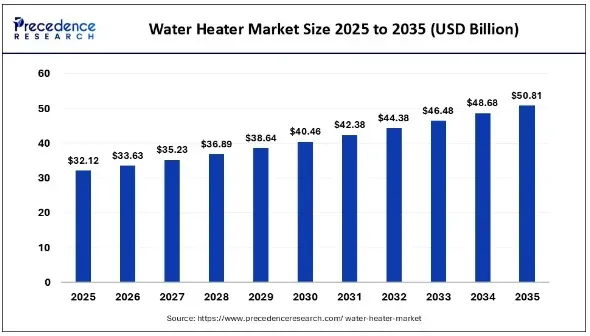 Figure 12: Precedence Research projects steady growth in the global market every year to 2035, though other firms size it differently. Source: Precedence Research, Water Heater Market Size 2026 to 2035, Sep 2026. Chart published by the source, captured 21 Oct 2026.
How large is the global market?
Tens of billions of dollars, with Asia ahead.
- Precedence Research sizes the global market at $33.63 billion in 2026 and forecasts $50.81 billion by 2035, a 4.69% annual growth rate (Precedence Research, Sep 2026).
- Asia Pacific held 37.28% of the global market in 2025 (Precedence Research, Sep 2026).
- Storage models took 55% of global revenue in 2025, and residential use was 55% of the revenue share (Precedence Research, Sep 2026).
- DOE put the industry net present value of consumer water heater makers at $1,478.8 million without new standards (DOE, May 2024).
- DOE put the industry net present value of commercial water heating makers at $212.8 million (DOE, Oct 2023).
What does the largest US manufacturer report?
A. O. Smith’s filing shows a flat year and a channel that runs through plumbers.
- A. O. Smith reported 2025 net sales of $3,830.2 million, and North America was about 78 percent of the total (A. O. Smith, Feb 2026).
- North America water heaters and related parts sales were $2,460.1 million in 2025, against $2,441.7 million in 2024 (A. O. Smith, Feb 2026).
- Its wholesale channel includes approximately 800 independent wholesale plumbing distributors (A. O. Smith, Feb 2026).
- Four of the six largest national hardware and home center chains are retail customers (A. O. Smith, Feb 2026).
- Sales to its five largest customers were about 41 percent of 2025 sales (A. O. Smith, Feb 2026).
Methodology and Sources
Each figure was read from the source’s own document and linked to it. Government surveys, federal rules, agency safety data, a Federal Reserve household survey, a state air district page, a trade association release, a company annual filing and one named market research firm are the only source types. Roundups and republished statistics were not used. Shares and counts that were calculated rather than quoted are marked as such in the text. Pages with no publication date are dated by the month they were read. ENERGY STAR savings figures differ between its pages because each page uses its own assumptions, so every figure is tied to the page it came from. Figures are rechecked and the page is refreshed monthly.
Glossary
- Btu: British thermal unit, a measure of heat energy. A trillion Btu is a very large unit used for national totals.
- CPSC: the US Consumer Product Safety Commission.
- DOE: the US Department of Energy.
- EIA: the US Energy Information Administration, a statistical agency inside DOE.
- HPWH: heat pump water heater, which moves heat from the surrounding air into the tank instead of making heat directly.
- Quad: one quadrillion Btu of energy.
- RECS: the Residential Energy Consumption Survey run by EIA.
- UEF: Uniform Energy Factor, the DOE efficiency rating for water heaters. A higher number means a more efficient unit.
Sources
- EIA
- EIA
- EIA
- AHRI
- DOE
- ENERGY STAR
- CPSC
- CPSC
- CPSC
- A. O. Smith
- EIA
- EIA
- EIA
- EIA
- EIA
- EIA
- EIA
- EIA
- EIA
- EIA
- EIA
- ENERGY STAR
- ENERGY STAR
- EIA
- EIA
- ENERGY STAR
- ENERGY STAR
- EIA
- EIA
- ENERGY STAR
- ENERGY STAR
- DOE
- DOE
- Federal Reserve
- AHRI
- ENERGY STAR
- DOE
- ENERGY STAR
- ENERGY STAR
- ENERGY STAR
- BAAQMD
- CPSC
- CPSC
- CPSC
- CPSC
- CPSC
- CPSC
- CPSC
- CPSC
- CPSC
- Precedence Research